
Basics of Statistics
Jarkko Isotalo
30
20
10
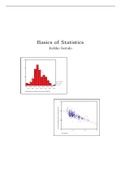
Std. Dev = 486.32
Mean = 3553.8
0 N = 120.00
2400.0 2800.0 3200.0 3600.0 4000.0 4400.0 4800.0
2600.0 3000.0 3400.0 3800.0 4200.0 4600.0 5000.0
Birthweights of children during years 1965-69
30
Time to Accelerate from 0 to 60 mph (sec)
20
10
0
0 100 200 300
Horsepower
, 1
Preface
These lecture notes have been used at Basics of Statistics course held in Uni-
versity of Tampere, Finland. These notes are heavily based on the following
books.
Agresti, A. & Finlay, B., Statistical Methods for the Social Sci-
ences, 3th Edition. Prentice Hall, 1997.
Anderson, T. W. & Sclove, S. L., Introductory Statistical Analy-
sis. Houghton Mifflin Company, 1974.
Clarke, G.M. & Cooke, D., A Basic course in Statistics. Arnold,
1998.
Electronic Statistics Textbook,
http://www.statsoftinc.com/textbook/stathome.html.
Freund, J.E.,Modern elementary statistics. Prentice-Hall, 2001.
Johnson, R.A. & Bhattacharyya, G.K., Statistics: Principles and
Methods, 2nd Edition. Wiley, 1992.
Leppälä, R., Ohjeita tilastollisen tutkimuksen toteuttamiseksi SPSS
for Windows -ohjelmiston avulla, Tampereen yliopisto, Matem-
atiikan, tilastotieteen ja filosofian laitos, B53, 2000.
Moore, D., The Basic Practice of Statistics. Freeman, 1997.
Moore, D. & McCabe G., Introduction to the Practice of Statis-
tics, 3th Edition. Freeman, 1998.
Newbold, P., Statistics for Business and Econometrics. Prentice
Hall, 1995.
Weiss, N.A., Introductory Statistics. Addison Wesley, 1999.
Please, do yourself a favor and go find originals!
, 2
1 The Nature of Statistics
[Agresti & Finlay (1997), Johnson & Bhattacharyya (1992), Weiss
(1999), Anderson & Sclove (1974) and Freund (2001)]
1.1 What is statistics?
Statistics is a very broad subject, with applications in a vast number of
different fields. In generally one can say that statistics is the methodology
for collecting, analyzing, interpreting and drawing conclusions from informa-
tion. Putting it in other words, statistics is the methodology which scientists
and mathematicians have developed for interpreting and drawing conclu-
sions from collected data. Everything that deals even remotely with the
collection, processing, interpretation and presentation of data belongs to the
domain of statistics, and so does the detailed planning of that precedes all
these activities.
Definition 1.1 (Statistics). Statistics consists of a body of methods for col-
lecting and analyzing data. (Agresti & Finlay, 1997)
From above, it should be clear that statistics is much more than just the tabu-
lation of numbers and the graphical presentation of these tabulated numbers.
Statistics is the science of gaining information from numerical and categori-
cal1 data. Statistical methods can be used to find answers to the questions
like:
• What kind and how much data need to be collected?
• How should we organize and summarize the data?
• How can we analyse the data and draw conclusions from it?
• How can we assess the strength of the conclusions and evaluate their
uncertainty?
1
Categorical data (or qualitative data) results from descriptions, e.g. the blood type
of person, marital status or religious affiliation.
, 3
That is, statistics provides methods for
1. Design: Planning and carrying out research studies.
2. Description: Summarizing and exploring data.
3. Inference: Making predictions and generalizing about phenomena rep-
resented by the data.
Furthermore, statistics is the science of dealing with uncertain phenomenon
and events. Statistics in practice is applied successfully to study the effec-
tiveness of medical treatments, the reaction of consumers to television ad-
vertising, the attitudes of young people toward sex and marriage, and much
more. It’s safe to say that nowadays statistics is used in every field of science.
Example 1.1 (Statistics in practice). Consider the following problems:
–agricultural problem: Is new grain seed or fertilizer more productive?
–medical problem: What is the right amount of dosage of drug to treatment?
–political science: How accurate are the gallups and opinion polls?
–economics: What will be the unemployment rate next year?
–technical problem: How to improve quality of product?
1.2 Population and Sample
Population and sample are two basic concepts of statistics. Population can
be characterized as the set of individual persons or objects in which an inves-
tigator is primarily interested during his or her research problem. Sometimes
wanted measurements for all individuals in the population are obtained, but
often only a set of individuals of that population are observed; such a set of
individuals constitutes a sample. This gives us the following definitions of
population and sample.
Definition 1.2 (Population). Population is the collection of all individuals
or items under consideration in a statistical study. (Weiss, 1999)
Definition 1.3 (Sample). Sample is that part of the population from which
information is collected. (Weiss, 1999)


