

ARITHMETIC PROGRESSIONS 93
ARITHMETIC PROGRESSIONS 5
5.1 Introduction
You must have observed that in nature, many things follow a certain pattern, such as
the petals of a sunflower, the holes of a honeycomb, the grains on a maize cob, the
spirals on a pineapple and on a pine cone etc.
We now look for some patterns which occur in our day-to-day life. Some such
examples are :
(i) Reena applied for a job and got selected. She
has been offered a job with a starting monthly
salary of ` 8000, with an annual increment of
` 500 in her salary. Her salary (in `) for the 1st,
2nd, 3rd, . . . years will be, respectively
8000, 8500, 9000, . . . .
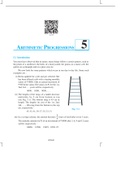
(ii) The lengths of the rungs of a ladder decrease
uniformly by 2 cm from bottom to top
(see Fig. 5.1). The bottom rung is 45 cm in
length. The lengths (in cm) of the 1st, 2nd,
3rd, . . ., 8th rung from the bottom to the top
are, respectively
Fig. 5.1
45, 43, 41, 39, 37, 35, 33, 31
5
(iii) In a savings scheme, the amount becomes times of itself after every 3 years.
4
The maturity amount (in `) of an investment of ` 8000 after 3, 6, 9 and 12 years
will be, respectively :
10000, 12500, 15625, 19531.25
2019-20
,94 MATHEMATICS
(iv) The number of unit squares in squares with side 1, 2, 3, . . . units (see Fig. 5.2)
are, respectively
12, 22, 32, . . . .
Fig. 5.2
(v) Shakila puts ` 100 into her daughter’s money box when she was one year old
and increased the amount by ` 50 every year. The amounts of money (in `) in the
box on the 1st, 2nd, 3rd, 4th, . . . birthday were
100, 150, 200, 250, . . ., respectively.
(vi) A pair of rabbits are too young to produce in their first month. In the second, and
every subsequent month, they produce a new pair. Each new pair of rabbits
produce a new pair in their second month and in every subsequent month (see
Fig. 5.3). Assuming no rabbit dies, the number of pairs of rabbits at the start of
the 1st, 2nd, 3rd, . . ., 6th month, respectively are :
1, 1, 2, 3, 5, 8
Fig. 5.3
2019-20
, ARITHMETIC PROGRESSIONS 95
In the examples above, we observe some patterns. In some, we find that the
succeeding terms are obtained by adding a fixed number, in other by multiplying
with a fixed number, in another we find that they are squares of consecutive
numbers, and so on.
In this chapter, we shall discuss one of these patterns in which succeeding terms
are obtained by adding a fixed number to the preceding terms. We shall also see how
to find their nth terms and the sum of n consecutive terms, and use this knowledge in
solving some daily life problems.
5.2 Arithmetic Progressions
Consider the following lists of numbers :
(i) 1, 2, 3, 4, . . .
(ii) 100, 70, 40, 10, . . .
(iii) – 3, –2, –1, 0, . . .
(iv) 3, 3, 3, 3, . . .
(v) –1.0, –1.5, –2.0, –2.5, . . .
Each of the numbers in the list is called a term.
Given a term, can you write the next term in each of the lists above? If so, how
will you write it? Perhaps by following a pattern or rule. Let us observe and write the
rule.
In (i), each term is 1 more than the term preceding it.
In (ii), each term is 30 less than the term preceding it.
In (iii), each term is obtained by adding 1 to the term preceding it.
In (iv), all the terms in the list are 3 , i.e., each term is obtained by adding
(or subtracting) 0 to the term preceding it.
In (v), each term is obtained by adding – 0.5 to (i.e., subtracting 0.5 from) the
term preceding it.
In all the lists above, we see that successive terms are obtained by adding a fixed
number to the preceding terms. Such list of numbers is said to form an Arithmetic
Progression ( AP ).
So, an arithmetic progression is a list of numbers in which each term is
obtained by adding a fixed number to the preceding term except the first
term.
This fixed number is called the common difference of the AP. Remember that
it can be positive, negative or zero.
2019-20
ARITHMETIC PROGRESSIONS 5
5.1 Introduction
You must have observed that in nature, many things follow a certain pattern, such as
the petals of a sunflower, the holes of a honeycomb, the grains on a maize cob, the
spirals on a pineapple and on a pine cone etc.
We now look for some patterns which occur in our day-to-day life. Some such
examples are :
(i) Reena applied for a job and got selected. She
has been offered a job with a starting monthly
salary of ` 8000, with an annual increment of
` 500 in her salary. Her salary (in `) for the 1st,
2nd, 3rd, . . . years will be, respectively
8000, 8500, 9000, . . . .
(ii) The lengths of the rungs of a ladder decrease
uniformly by 2 cm from bottom to top
(see Fig. 5.1). The bottom rung is 45 cm in
length. The lengths (in cm) of the 1st, 2nd,
3rd, . . ., 8th rung from the bottom to the top
are, respectively
Fig. 5.1
45, 43, 41, 39, 37, 35, 33, 31
5
(iii) In a savings scheme, the amount becomes times of itself after every 3 years.
4
The maturity amount (in `) of an investment of ` 8000 after 3, 6, 9 and 12 years
will be, respectively :
10000, 12500, 15625, 19531.25
2019-20
,94 MATHEMATICS
(iv) The number of unit squares in squares with side 1, 2, 3, . . . units (see Fig. 5.2)
are, respectively
12, 22, 32, . . . .
Fig. 5.2
(v) Shakila puts ` 100 into her daughter’s money box when she was one year old
and increased the amount by ` 50 every year. The amounts of money (in `) in the
box on the 1st, 2nd, 3rd, 4th, . . . birthday were
100, 150, 200, 250, . . ., respectively.
(vi) A pair of rabbits are too young to produce in their first month. In the second, and
every subsequent month, they produce a new pair. Each new pair of rabbits
produce a new pair in their second month and in every subsequent month (see
Fig. 5.3). Assuming no rabbit dies, the number of pairs of rabbits at the start of
the 1st, 2nd, 3rd, . . ., 6th month, respectively are :
1, 1, 2, 3, 5, 8
Fig. 5.3
2019-20
, ARITHMETIC PROGRESSIONS 95
In the examples above, we observe some patterns. In some, we find that the
succeeding terms are obtained by adding a fixed number, in other by multiplying
with a fixed number, in another we find that they are squares of consecutive
numbers, and so on.
In this chapter, we shall discuss one of these patterns in which succeeding terms
are obtained by adding a fixed number to the preceding terms. We shall also see how
to find their nth terms and the sum of n consecutive terms, and use this knowledge in
solving some daily life problems.
5.2 Arithmetic Progressions
Consider the following lists of numbers :
(i) 1, 2, 3, 4, . . .
(ii) 100, 70, 40, 10, . . .
(iii) – 3, –2, –1, 0, . . .
(iv) 3, 3, 3, 3, . . .
(v) –1.0, –1.5, –2.0, –2.5, . . .
Each of the numbers in the list is called a term.
Given a term, can you write the next term in each of the lists above? If so, how
will you write it? Perhaps by following a pattern or rule. Let us observe and write the
rule.
In (i), each term is 1 more than the term preceding it.
In (ii), each term is 30 less than the term preceding it.
In (iii), each term is obtained by adding 1 to the term preceding it.
In (iv), all the terms in the list are 3 , i.e., each term is obtained by adding
(or subtracting) 0 to the term preceding it.
In (v), each term is obtained by adding – 0.5 to (i.e., subtracting 0.5 from) the
term preceding it.
In all the lists above, we see that successive terms are obtained by adding a fixed
number to the preceding terms. Such list of numbers is said to form an Arithmetic
Progression ( AP ).
So, an arithmetic progression is a list of numbers in which each term is
obtained by adding a fixed number to the preceding term except the first
term.
This fixed number is called the common difference of the AP. Remember that
it can be positive, negative or zero.
2019-20


