Topic 1 - Cell Biology
All living things are made from cells, they are the building blocks of every organism in the plant. Cells are either prokaryotic or
eukaryotic. Prokaryotic cells are smaller and simple (bacterial cells). Eukaryotic cells are complex (animal/plant cells). Eukaryotes are
organisms made up from eukaryotic cells, and a prokaryote is a single-celled organism (a prokaryotic cell). Bacteria are prokaryotes.
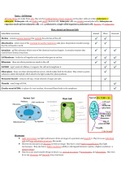
Plant, Animal and Bacterial Cells
Subcellular structures Animal Plant Bacterial
Nucleus - contains genetic material that controls the activities of the cell. ✔️ ✔️
Mitochondria - where most of the reactions for aerobic respiration take place. Respiration transfers energy
that the cell needs to work.
✔️ ✔️
Cytoplasm - gel like substance where most of the chemical reactions happen. It contains enzymes that
control these chemical reactions.
✔️ ✔️ ✔️
Cell Membrane - holds the cell together and controls what goes in and out. ✔️ ✔️ ✔️
Ribosomes - these are where proteins are made in the cell. ✔️ ✔️ ✔️
Cell Wall - rigid, made of cellulose, it supports the cell and strengthens it. ✔️ ✔️
Chloroplasts - these are where photosynthesis occurs, which makes food for the plant. They contain a green
substance called chlorophyll, which absorbs the light needed for photosynthesis.
✔️
Permanent Vacuole - contains cell sap, a weak solution of sugar and salts. ✔️
Plasmids - small rings of DNA. ✔️
Circular strand of DNA - in place of a ‘true’ nucleus, the strand floats freely in the cytoplasm. ✔️
Microscopy
❖ Light microscopes use light and lenses to form an image of a specimen and magnify it. They let us see individual
cells and large subcellular structures, like nuclei.
❖ Electron microscopes use electrons to form an image. They have a much higher magnification than light
microscopes. They also have a higher resolution (ability to distinguish between 2 points, a higher resolution = a
sharper image).
❖ They let us see much smaller things in detail, e.g. internal structures of mitochondria and chloroplasts. They even
let us see ribosomes and plasmids (tiny structures).
, Magnification Formula
Cell Differentiation
Cells Differentiate to become specialised
Differentiation - is the process by which a cell changes to become
specialised for its job
❏ Cells develop different subcellular structures and turn into
different type of cells, allowing them to do a specific function
❏ So in animal cells differentiation occurs at an early stage after
they become specialised.
❏ Lots of plant cells don’t ever lose the ability to differentiate
❏ Cells that differentiate in mature animals are mainly used for
repairing or replacing cells
❏ Some cells are undifferentiated cells - Stem Cells
EXAMPLES YOU NEED TO KNOW:
Cell Specialisation
All living things are made from cells, they are the building blocks of every organism in the plant. Cells are either prokaryotic or
eukaryotic. Prokaryotic cells are smaller and simple (bacterial cells). Eukaryotic cells are complex (animal/plant cells). Eukaryotes are
organisms made up from eukaryotic cells, and a prokaryote is a single-celled organism (a prokaryotic cell). Bacteria are prokaryotes.
Plant, Animal and Bacterial Cells
Subcellular structures Animal Plant Bacterial
Nucleus - contains genetic material that controls the activities of the cell. ✔️ ✔️
Mitochondria - where most of the reactions for aerobic respiration take place. Respiration transfers energy
that the cell needs to work.
✔️ ✔️
Cytoplasm - gel like substance where most of the chemical reactions happen. It contains enzymes that
control these chemical reactions.
✔️ ✔️ ✔️
Cell Membrane - holds the cell together and controls what goes in and out. ✔️ ✔️ ✔️
Ribosomes - these are where proteins are made in the cell. ✔️ ✔️ ✔️
Cell Wall - rigid, made of cellulose, it supports the cell and strengthens it. ✔️ ✔️
Chloroplasts - these are where photosynthesis occurs, which makes food for the plant. They contain a green
substance called chlorophyll, which absorbs the light needed for photosynthesis.
✔️
Permanent Vacuole - contains cell sap, a weak solution of sugar and salts. ✔️
Plasmids - small rings of DNA. ✔️
Circular strand of DNA - in place of a ‘true’ nucleus, the strand floats freely in the cytoplasm. ✔️
Microscopy
❖ Light microscopes use light and lenses to form an image of a specimen and magnify it. They let us see individual
cells and large subcellular structures, like nuclei.
❖ Electron microscopes use electrons to form an image. They have a much higher magnification than light
microscopes. They also have a higher resolution (ability to distinguish between 2 points, a higher resolution = a
sharper image).
❖ They let us see much smaller things in detail, e.g. internal structures of mitochondria and chloroplasts. They even
let us see ribosomes and plasmids (tiny structures).
, Magnification Formula
Cell Differentiation
Cells Differentiate to become specialised
Differentiation - is the process by which a cell changes to become
specialised for its job
❏ Cells develop different subcellular structures and turn into
different type of cells, allowing them to do a specific function
❏ So in animal cells differentiation occurs at an early stage after
they become specialised.
❏ Lots of plant cells don’t ever lose the ability to differentiate
❏ Cells that differentiate in mature animals are mainly used for
repairing or replacing cells
❏ Some cells are undifferentiated cells - Stem Cells
EXAMPLES YOU NEED TO KNOW:
Cell Specialisation