Nutr 445 Exam 2 (Aka Hell)
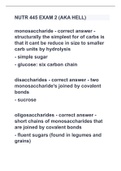
monosaccharide - structurally the simplest for of carbs is that it cant be reduce in size to smaller carb units by hydrolysis - simple sugar - glucose: six carbon chain disaccharides - two monosaccharide's joined by covalent bonds - sucrose oligosaccharides - short chains of monosaccharides that are joined by covalent bonds - fluent sugars (found in legumes and grains) chemistry of polysaccharides - simple carbs :: ring structure: chiral carbon - four different atoms or groups covalently attached / diasteromers - two or more chiral carbon atoms with the same four groups attached but not mirror images of each other / maltose - formed by partial hydrolysis of starch, found in beer and malt liquors lactose - in milk sucrose - can sugar, beet sugar: most widely distribute commonly used sweetener - complex carbs :: oligosaccharides - made up glucose, galactose and fructose / found in beans, bran, peas and whole grains / human digestive enzymes do not hydrolyze them / bacteria in intestine can digest them - flactulence / polysaccharides digestion of monosaccharides ... digestion of polysaccharides salivary amylase: mouth pancreatic amylase: small intestine resistant starches amylase inhibitors can be used to impede digestion of dietary starch and combat the overweight and obesity problem digestion of disaccharides - digestion in primarily in microvilli of enterocytes - lactate, sucrose, maltase isomaltase and trehalase - dietary starches and disaccharides hydrolyzed by specific glycosides to their constituent monosaccharide units - then absorbed by intestinal mucosal cells cellular transporters of simple sugars GLUT1 - basic supply of glucose to cells GLUT2 - low affinity transporter; glucose from enterocyte to blood (low affinity - stores more glucose) GLUT3 - high affinity for brain and other glucose dependent tissues (high affinity - stores less glucose) GLUT4 - insulin sensitive, in muscles and adipose tissue GLUT5- for fructose SGLT1 - high-affinity Na+/ glucose cotransporter SGLT2 - protein in humans Anatomy of the pancreas the right side of the organ, called the head is the widest part of the organ, it lies in the curve of the duodenum insulin and glucagon in the pancreas insulin - role in cellular glucose absorption / binds to membrane receptor / stimulate GLUT4 to move to membrane / maintenance of blood glucose levels glucagon -released when the concentration of glucose in the bloodstream falls too low. Glucagon causes the liver to convert stored glycogen into glucose how is blood glucose regulated - insulin and glucagon is released in the blood hyperglycemia - further increases inflammation, increase risk for infection, reduces wound healing, and increases length of hospital stay and mortality hypoglycemia - results when there is excessive insulin secretion occurring secondary to the consumption of foods usually simple sugars glucagon (alpha cells, islets of langerhans, pancreas) 1. raises glycogenolysis 2. raises gluconeogensis in liver
Document information
- Uploaded on
- February 21, 2023
- Number of pages
- 34
- Written in
- 2022/2023
- Type
- Exam (elaborations)
- Contains
- Questions & answers