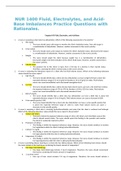
NUR 1400 Fluid, Electrolytes, and Acid-Base Imbalances Practice Questions with Rationales. 2022/2023 update
NUR 1400 Fluid, Electrolytes, and Acid-Base Imbalances Practice Questions with Rationales. Targeted ATI Fluid, Electrolyte, and Acid-Base 1. A nurse is assessing a client who has dehydration. Which of the following assessments is the priority? a. Skin turgor i. The nurse should assess skin turgor to monitor the client's hydration status. Poor skin turgor is a manifestation of dehydration. However, another assessment is the nurse's priority. b. Urine output i. The nurse should assess urine output to monitor the client's hydration status. Decreased urine output is a manifestation of dehydration. However, another assessment is the nurse's priority. c. Weight i. The nurse should weigh the client because weight loss is a manifestation of dehydration. Decreased weight is the best indication of the client's fluid status. However, another assessment is the nurse's priority. d. Mental status i. The greatest risk to this client is injury from a fall due to a decline in their mental status. Therefore, assessing the client's mental status is the nurse's priority. 2. A nurse is reviewing the laboratory report of a client who has fluid volume excess. Which of the following laboratory values should the nurse expect? a. Hgb 20 g/dL i. The nurse should identify that a client who has dehydration can have a Hgb level that is above the expected reference range of 12 to 16 g/dL for females or 14 to 18 g/dL for males. Fluid volume excess can cause hemodilution and a decreased hemoglobin level. b. Hct 34% i. The nurse should identify that a client who has fluid volume excess can have a Hct level that is below the expected reference range of 37% to 47% for females or 42% to 52% for males. Fluid volume excess can cause hemodilution and a decreased hematocrit level. c. BUN 25 mg/dL i. The nurse should identify that a client who has dehydration can have a BUN that is above the expected reference range of 10 to 20 mg/dL. Fluid volume excess can cause a decrease in BUN. d. Urine specific gravity 1.050 i. The nurse should identify that a client who has dehydration can have a urine specific gravity that is above the expected reference range of 1.010 to 1.025. Fluid volume excess can cause a decrease in urine specific gravity. 3. A nurse is assessing a client who is receiving hydrochlorothiazide and notes that the client is confused and lethargic. Which of the following laboratory values should the nurse report to the provider? a. Sodium 128 mEq/L i. This level is below the expected reference range of 136 to 145 mEq/L and is the likely cause of the client's altered mental status. The nurse should report this finding to the provider and monitor the client for weakened respiratory effort. b. Potassium 4.8 mEq/L i. This finding is within the expected reference range. However, the nurse should continue to monitor for hypokalemia while the client is taking hydrochlorothiazide. c. Calcium 9.1 mg/dL i. This finding is within the expected reference range. However, the nurse should continue to monitor for hypercalcemia while the client is taking hydrochlorothiazide. d. Magnesium 2.0 mEq/L i. This finding is within the expected reference range. However, the nurse should continue to monitor for hypomagnesemia while the client is taking hydrochlorothiazide. 4. A nurse is providing dietary teaching to a client who has kidney disease. Which of the following food choices should the nurse include in the teaching as containing the lowest amount of magnesium? a. One large, hard-boiled egg i. One large, hard-boiled egg contains 5 mg of magnesium. Therefore, the nurse should recommend this food as containing the lowest amount of magnesium. b. 1 cup bran cereal i. One cup of bran cereal contains 112 mg of magnesium. Therefore, the nurse should include a different food as containing the lowest amount of magnesium. c. ½ cup almondsz i. One-half cup of almonds contains 193 mg of magnesium. Therefore, the nurse should include a different food as containing the lowest amount of magnesium. d. 1 cup cooked spinach i. One cup of cooked spinach contains 157 mg of magnesium. Therefore, the nurse should include a different food as containing the lowest amount of magnesium. 5. A nurse is assessing a client who has a serum calcium level of 8.1 mg/dL. Which of the following findings is the priority for the nurse to assess? a. Deep-tendon reflexes i. The nurse should assess the client's deep-tendon reflexes because this total serum calcium level is below the expected reference range of 9 to 10.5 mg/dL, and hypocalcemia can cause neuromuscular changes. However, there is another assessment the nurse should make first. b. Cardiac rhythm i. When using the airway, breathing, circulation approach to client care, the nurse should first assess the client's cardiac rhythm because this total serum calcium level is below the expected reference range. Hypocalcemia can cause ECG changes, bradycardia, or tachycardia. c. Peripheral sensation i. The nurse should assess the client's peripheral sensation to check for paresthesia because this total serum calcium level is below the expected reference range, and hypocalcemia can cause neuromuscular changes. However, there is another assessment the nurse should make first. d. Bowel sounds i. The nurse should assess the client's bowel sounds to check for hypermotility because this total serum calcium level is below the expected reference range, and hypocalcemia can cause increased peristalsis. However, there is another assessment the nurse should make first. 6. A nurse is caring for a client who has a sodium level of 155 mEq/L. Which of the following IV fluids should the nurse anticipate the provider to prescribe? a. Dextrose 5% in 0.9% sodium chloride i. A sodium level of 155 mEq/L is an indication of hypernatremia. Dextrose 5% in 0.9% sodium chloride is a hypertonic solution. The nurse should anticipate a prescription for a hypotonic solution. b. Dextrose 5% in lactated Ringer’s i. A sodium level of 155 mEq/L is an indication of hypernatremia. Lactated Ringer's contains sodium and other electrolytes and is not indicated for hypernatremia. c. 3% sodium chloride i. A sodium level of 155 mEq/L is an indication of hypernatremia, and 3% sodium chloride is a hypertonic solution. The nurse should anticipate a prescription for a hypotonic solution. d. 0.45% sodium chloride i. A sodium level of 155 mEq/L is an indication of hypernatremia. The nurse should anticipate a prescription for a hypotonic solution. The 0.45% sodium chloride is a hypotonic solution used to provide free water and treat cellular dehydration, which promotes waste elimination by the kidneys. 7. A nurse is assessing a client who has hypomagnesemia. Which of the following findings should the nurse expect? a. Hyperactive deep-tendon reflexes i. Hyperactive deep-tendon reflexes are an expected finding for a client who has hypomagnesemia. Other expected findings include muscle cramps, numbness, and tingling. b. Increased bowel sounds i. Decreased bowel sounds are an expected finding for a client who has hypomagnesemia. c. Drowsiness i. Insomnia is an expected finding for a client who has hypomagnesemia. d. Decreased blood pressure i. Increased blood pressure is an expected finding for a client who has hypomagnesemia. 8. A nurse is assessing a client who has a phosphorous level of 2.4 mg/dL. Which of the following findings should the nurse expect? a. Hepatic failure i. This phosphorus level is below the expected reference range of 3 to 4.5 mg/dL. The nurse should assess a client who has hypophosphatemia for manifestations of kidney failure, not hepatic failure. b. Abdominal pain i. This phosphorus level is below the expected reference range. Hypophosphatemia causes weakness of skeletal muscles and rhabdomyolysis, which is acute muscle breakdown. It does not cause abdominal pain. c. Slow peripheral pulses
Document information
- Uploaded on
- February 18, 2023
- Number of pages
- 34
- Written in
- 2022/2023
- Type
- Exam (elaborations)
- Contains
- Questions & answers