

IGCSE PHYSICS – TOPIC 7
RADIOACTIVITY AND PARTICLES
a) RADIOACTIVITY
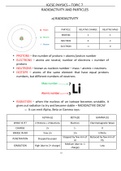
PARTICLE RELATIVE CHARGE RELATIVE MASS
PROTON 1 1
NEUTRON 0 2
ELECTRON -1 0
• PROTONS – the number of protons = atomic/proton number
• ELECTRONS – atoms are neutral, number of electrons = number of
protons
• NEUTRONS – known as nucleon number – mass – atomic = neutrons
• ISOTOPE – atoms of the same element that have equal protons
numbers, but different numbers of neutrons
• RADIATION – when the nucleus of an isotope becomes unstable, it
gives out radiation to try and become stable – RADIOACTIVE DECAY
o It can emit Alpha, Beta or Gamma rays:
ALPHA (α) BETA (β) GAMMA (Ɣ)
WHAT IS IT? 2 Protons + 2 Neutrons Electron Electromagnetic Wave
CHARGE 2+ 1- 0
RANGE IN AIR Few cm 1m Infinite
Stopped by few mm of Reduced by few mm of
PENETRATION Stopped by paper
Al Pb
Medium (due to -1
IONISATION High (due to 2+ charge) Low
charge)
42
, PRACTICAL TO INVESTIGATE: the penetration power of different radioactive sources
Method:
• Connect a GEIGER-MULLER TUBE to a counter without any sources present and measure
background radiation – 3 times and take an average
• Place radioactive source 3cm away and take reading
• Place absorbers between source and tube and take reading every minute
• SAFETY – use tweezers and gloves, don’t handle if pregnant, don’t point at reproductive
organs
TYPE WHAT HAPPENS EQUATION
The nucleus loses two protons
and 2 neutrons
ALPHA (α) The atomic number decreases
by 2 and the mass number
decreases by 4
The particle loses one electron
The atomic number increases
BETA (β)
by 1 and the mass number
doesn't change
No protons and neutrons are
GAMMA (Ɣ) lost and the atomic and mass
numbers stay the same
When the nucleus emits one
neutron
NEUTRON EMMISION The atomic number doesn't
change but the mass number
increases by 1
43
RADIOACTIVITY AND PARTICLES
a) RADIOACTIVITY
PARTICLE RELATIVE CHARGE RELATIVE MASS
PROTON 1 1
NEUTRON 0 2
ELECTRON -1 0
• PROTONS – the number of protons = atomic/proton number
• ELECTRONS – atoms are neutral, number of electrons = number of
protons
• NEUTRONS – known as nucleon number – mass – atomic = neutrons
• ISOTOPE – atoms of the same element that have equal protons
numbers, but different numbers of neutrons
• RADIATION – when the nucleus of an isotope becomes unstable, it
gives out radiation to try and become stable – RADIOACTIVE DECAY
o It can emit Alpha, Beta or Gamma rays:
ALPHA (α) BETA (β) GAMMA (Ɣ)
WHAT IS IT? 2 Protons + 2 Neutrons Electron Electromagnetic Wave
CHARGE 2+ 1- 0
RANGE IN AIR Few cm 1m Infinite
Stopped by few mm of Reduced by few mm of
PENETRATION Stopped by paper
Al Pb
Medium (due to -1
IONISATION High (due to 2+ charge) Low
charge)
42
, PRACTICAL TO INVESTIGATE: the penetration power of different radioactive sources
Method:
• Connect a GEIGER-MULLER TUBE to a counter without any sources present and measure
background radiation – 3 times and take an average
• Place radioactive source 3cm away and take reading
• Place absorbers between source and tube and take reading every minute
• SAFETY – use tweezers and gloves, don’t handle if pregnant, don’t point at reproductive
organs
TYPE WHAT HAPPENS EQUATION
The nucleus loses two protons
and 2 neutrons
ALPHA (α) The atomic number decreases
by 2 and the mass number
decreases by 4
The particle loses one electron
The atomic number increases
BETA (β)
by 1 and the mass number
doesn't change
No protons and neutrons are
GAMMA (Ɣ) lost and the atomic and mass
numbers stay the same
When the nucleus emits one
neutron
NEUTRON EMMISION The atomic number doesn't
change but the mass number
increases by 1
43


