

IGCSE CHEMISTRY – TOPIC 1
PRINCIPLES OF CHEMISTRY
a) STATES OF MATTER
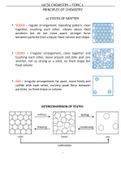
• SOLIDS – regular arrangement, repeating pattern, close
together, touching each other, vibrate about fixed
positions but do not move apart, stronger force
between particles than a liquid, fixed volume and shape
• LIQUID – irregular arrangement, close together and
touching each other, move around and slide past one
another, not as strong as a solid, no fixed shape but
fixed volume
• GAS – irregular arrangement, far apart, move freely and
collide with each other, no/very weak force between
particles, no fixed shape or volume
INTERCONVERSION OF STATES:
3
, • MELTING – process of converting solid to liquid (MELTING POINT – the
temperature at which a solid begins to melt – ice melts at 0°C)
o When a solid is heated the PARTICLES GAIN KINETIC ENERGY and
start to vibrate faster about their fixed position. When the
temperature is high enough, the vibration of particles becomes
sufficient to OVERCOME THE FORCES OF ATTRACTION between
them. The particles begin to break away from their regular
pattern. They can now slide past each other. The solid becomes a
liquid.
• EVAPORATION/BOILING – process of converting liquid to gas (BOILING
POINT – the temperature at which a liquid begins evaporates – water
boils at 100°C)
o When a liquid is heated, the PARTICLES GAIN KINETIC ENERGY and
mover further apart. Eventually, the ATTRACTIVE FORCES IN THE
LIQUID ARE BROKEN. Bubbles of gaseous particles escape from
the liquid. The substance becomes gas.
• CONDENSATION – process by which a gas turns to a liquid
o When a gas is cooled, the PARTICLES LOSE KINETIC ENERGY and
the attractive forces become great enough to keep the particles
closer together as a liquid.
• SUBLIMATION – the process by which a gas turns directly to solid
o The solid PARTICLES GAIN KINETIC energy and vibrate faster.
Eventually, the forces of attraction between the particles are
completely broken and they escape from the solid as a gas.
• FREEZING – the process by which a liquid turns into a solid
o When a liquid is cooled, the particles LOSE THEIR KINETIC ENERGY.
When the temperature is low enough, the particles no longer
have the energy to slide over each other. The forces of attraction
can hold the particles together in a regular pattern. The substance
becomes solid.
4
PRINCIPLES OF CHEMISTRY
a) STATES OF MATTER
• SOLIDS – regular arrangement, repeating pattern, close
together, touching each other, vibrate about fixed
positions but do not move apart, stronger force
between particles than a liquid, fixed volume and shape
• LIQUID – irregular arrangement, close together and
touching each other, move around and slide past one
another, not as strong as a solid, no fixed shape but
fixed volume
• GAS – irregular arrangement, far apart, move freely and
collide with each other, no/very weak force between
particles, no fixed shape or volume
INTERCONVERSION OF STATES:
3
, • MELTING – process of converting solid to liquid (MELTING POINT – the
temperature at which a solid begins to melt – ice melts at 0°C)
o When a solid is heated the PARTICLES GAIN KINETIC ENERGY and
start to vibrate faster about their fixed position. When the
temperature is high enough, the vibration of particles becomes
sufficient to OVERCOME THE FORCES OF ATTRACTION between
them. The particles begin to break away from their regular
pattern. They can now slide past each other. The solid becomes a
liquid.
• EVAPORATION/BOILING – process of converting liquid to gas (BOILING
POINT – the temperature at which a liquid begins evaporates – water
boils at 100°C)
o When a liquid is heated, the PARTICLES GAIN KINETIC ENERGY and
mover further apart. Eventually, the ATTRACTIVE FORCES IN THE
LIQUID ARE BROKEN. Bubbles of gaseous particles escape from
the liquid. The substance becomes gas.
• CONDENSATION – process by which a gas turns to a liquid
o When a gas is cooled, the PARTICLES LOSE KINETIC ENERGY and
the attractive forces become great enough to keep the particles
closer together as a liquid.
• SUBLIMATION – the process by which a gas turns directly to solid
o The solid PARTICLES GAIN KINETIC energy and vibrate faster.
Eventually, the forces of attraction between the particles are
completely broken and they escape from the solid as a gas.
• FREEZING – the process by which a liquid turns into a solid
o When a liquid is cooled, the particles LOSE THEIR KINETIC ENERGY.
When the temperature is low enough, the particles no longer
have the energy to slide over each other. The forces of attraction
can hold the particles together in a regular pattern. The substance
becomes solid.
4


