
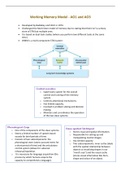
Working Memory Model - AO1 and AO3
• Developed by Baddeley and Hitch in 1974.
• Challenged the Multi-Store model of memory due to stating that there isn’t a unitary
store of STM but multiple ones.
• It is based on dual-task studies (where you perform two different tasks at the same
time.)
• WMM is a multi-component STM system:
Central executive
o Supervisory system for the overall
control and running of the memory
system.
o Controls attentional mechanisms.
o Has limited capacity.
o Involved in problem solving and decision
making.
o Monitors and co-ordinates the operation
of the two slave systems.
Phonological Loop Visuo-spatial Sketchpad
o One of the components of the slave systems.
o Stores visual and spatial information.
o Stores a limited number of speech-based
o Responsible for setting up and
sounds for brief periods of time.
manipulating mental images.
o Consists of two subcomponents: the
o Has limited capacity.
phonological store (stores acoustic items for
o Two subcomponents: inner scribe (deals
a short period of time) and the articulatory
with the spatial relationship between
control system (allows for subvocal
objects so visualising shapes in our
rehearsal/repetition.
“mind’s eye”) and the visual cache
o It is necessary for language acquisition (the
(stores visual information like form,
process by which humans acquire the
shape and colour of an object.
capacity to comprehend a language).
• Developed by Baddeley and Hitch in 1974.
• Challenged the Multi-Store model of memory due to stating that there isn’t a unitary
store of STM but multiple ones.
• It is based on dual-task studies (where you perform two different tasks at the same
time.)
• WMM is a multi-component STM system:
Central executive
o Supervisory system for the overall
control and running of the memory
system.
o Controls attentional mechanisms.
o Has limited capacity.
o Involved in problem solving and decision
making.
o Monitors and co-ordinates the operation
of the two slave systems.
Phonological Loop Visuo-spatial Sketchpad
o One of the components of the slave systems.
o Stores visual and spatial information.
o Stores a limited number of speech-based
o Responsible for setting up and
sounds for brief periods of time.
manipulating mental images.
o Consists of two subcomponents: the
o Has limited capacity.
phonological store (stores acoustic items for
o Two subcomponents: inner scribe (deals
a short period of time) and the articulatory
with the spatial relationship between
control system (allows for subvocal
objects so visualising shapes in our
rehearsal/repetition.
“mind’s eye”) and the visual cache
o It is necessary for language acquisition (the
(stores visual information like form,
process by which humans acquire the
shape and colour of an object.
capacity to comprehend a language).


