

Core summery macro economics
12.1 market failure: external effects of pollution
Market failure = when markets allocate resources in a pareto inefficient way.
More parties are involved than suppliers and buyers.
External cost = a positive or negative effect of a production, consumption, or
other economic decision on another person or people that is not specified as a
benefit or liability in a contract. It is called an external effect because the effect
in question is outside the contract.
Marginal private cost (MPC) = the cost for the producer of producing an additional
unit of a good, not taking into account any costs its production imposes on others.
Marginal social cost (MSC) = the cost of producing an additional unit of a good, taking
into account both the cost for the producer and the costs incurred by others affected
by the good’s production. Marginal social cost is the sum of the marginal private cost
and the marginal external cost.
Marginal external cost (MEC) = the cost of producing an additional unit of a good that
is incurred by anyone other than the producer of the good.
Total external cost = the sum of the differences between the marginal social cost and the
marginal private cost at each level of production, it is the sum of the marginal external costs
of production of all the robots
Example:
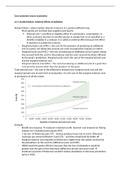
80.000 tons bananas producers maximize profit, however cost imposed on fishing
industry isn’t included (price equals MPC)
1 ton less fishermen gain 270, - banana producer loses not so much, fisherman
could pay any amount between 0 and 270, - and they would both be better off
Marginal external cost imposed on fisherman is higher than the surplus received by
the plantations on the next ton (difference price and MPC)
38000 would be pareto efficient, because than the loss of plantations would be
greater than the gain of the fisherman (difference private and social cost)
maximum payment of fishermen wouldn’t induce plantations to decrease production
(price is MSC)
,12.2 external effects and bargaining
If two parties negotiate a private bargain (producing 38000 tons and fisherman pays)
coasean bargaining
Transaction costs = costs that impede the bargaining process or the agreement of a contract.
They include costs of acquiring information about the good to be traded, and costs of
enforcing a contract.
Reservation option (producing 80000 tons of bananas) = a person’s next best alternative
among all options in a particular transaction what will the parties doe when there isn’t an
agreement.
,The minimum acceptable offer is the offer when the fisherman compensates for the loss of
profit, fisherman would be better off, and the plantation would be equal equals producer
surplus
The maximum the fisherman would pay is the fallback (reservation) option = a person’s next
best alternative among all options in a particular transaction
Practical obstacles to bargaining may prevent achievement of pareto efficiency
Impediments to collective action: many parties on both sides of the external effect
will make it harder to bargain
Missing information: it differs per party and participant, or other information that is
lacking
Tradability and enforcement: The bargain involve the trading of property rights, and
the contract governing the trade must be enforceable
Limited funds
Correcting market failure through bargaining does require a large legal framework
12.3 external effects: policies and income distribution
Three ways to influence the output on the goods causing external effects:
Regulation of quantity produced
Difficult when there are more producers
Producer surplus is lost
Taxation of the production or sale of the food
At the pareto-efficient quantity the MPC is, for example, 295, -, the MSC is 400, -
external cost = MSC – MPC = 105, -
If the tax is 105, then the after-tax price is 295, -
MPC = after tax price profit maximizing
The tax causes the plantations to face full marginal social cost of their decision
Tax is equal to the cost imposed on the fishermen = pigouvian tax = a tax levied
on activities that generate negative external effects so as to correct an
inefficient market outcome.
External benefit = a positive external effect: that is, a positive effect of a
production, consumption, or other economic decision on another person or
people that is not specified as a benefit in a contract.
Reduction in producer is greater than by regulation
, Enforcing compensation for the costs imposed on the other party
Compensation is difference between MSC – MPC
Causing that the marginal cost = the MPC + compensation (=MSC)
P2 is profit maximizing
Better for fishermen, they receive the government revenue
Incentives to find other methods
Enforcing compensation is an incentive, because they need to compensate for the
use of chemicals and the production. If they find other ways which doesn’t impose
costs on other than they do not need to pay
If the use of the, in this case, chemicals is regulated or taxed than it makes that the
producers could produce more if they found other ways to produce without
Difficulties of Pigouvian taxes
The degree of harm suffered by each fisherman are unknown, compensation policy is
hard to create
Marginal social cost is difficult to measure, while the plantations marginal costs are
probably well known, it is harder to determine marginal social costs, such as the
pollution costs to either individuals or to society as a whole
The government may favor the more powerful group: in this case it could impose a
pareto-efficient outcome that is also unfair
12.4 property rights, contracts and market failures
12.1 market failure: external effects of pollution
Market failure = when markets allocate resources in a pareto inefficient way.
More parties are involved than suppliers and buyers.
External cost = a positive or negative effect of a production, consumption, or
other economic decision on another person or people that is not specified as a
benefit or liability in a contract. It is called an external effect because the effect
in question is outside the contract.
Marginal private cost (MPC) = the cost for the producer of producing an additional
unit of a good, not taking into account any costs its production imposes on others.
Marginal social cost (MSC) = the cost of producing an additional unit of a good, taking
into account both the cost for the producer and the costs incurred by others affected
by the good’s production. Marginal social cost is the sum of the marginal private cost
and the marginal external cost.
Marginal external cost (MEC) = the cost of producing an additional unit of a good that
is incurred by anyone other than the producer of the good.
Total external cost = the sum of the differences between the marginal social cost and the
marginal private cost at each level of production, it is the sum of the marginal external costs
of production of all the robots
Example:
80.000 tons bananas producers maximize profit, however cost imposed on fishing
industry isn’t included (price equals MPC)
1 ton less fishermen gain 270, - banana producer loses not so much, fisherman
could pay any amount between 0 and 270, - and they would both be better off
Marginal external cost imposed on fisherman is higher than the surplus received by
the plantations on the next ton (difference price and MPC)
38000 would be pareto efficient, because than the loss of plantations would be
greater than the gain of the fisherman (difference private and social cost)
maximum payment of fishermen wouldn’t induce plantations to decrease production
(price is MSC)
,12.2 external effects and bargaining
If two parties negotiate a private bargain (producing 38000 tons and fisherman pays)
coasean bargaining
Transaction costs = costs that impede the bargaining process or the agreement of a contract.
They include costs of acquiring information about the good to be traded, and costs of
enforcing a contract.
Reservation option (producing 80000 tons of bananas) = a person’s next best alternative
among all options in a particular transaction what will the parties doe when there isn’t an
agreement.
,The minimum acceptable offer is the offer when the fisherman compensates for the loss of
profit, fisherman would be better off, and the plantation would be equal equals producer
surplus
The maximum the fisherman would pay is the fallback (reservation) option = a person’s next
best alternative among all options in a particular transaction
Practical obstacles to bargaining may prevent achievement of pareto efficiency
Impediments to collective action: many parties on both sides of the external effect
will make it harder to bargain
Missing information: it differs per party and participant, or other information that is
lacking
Tradability and enforcement: The bargain involve the trading of property rights, and
the contract governing the trade must be enforceable
Limited funds
Correcting market failure through bargaining does require a large legal framework
12.3 external effects: policies and income distribution
Three ways to influence the output on the goods causing external effects:
Regulation of quantity produced
Difficult when there are more producers
Producer surplus is lost
Taxation of the production or sale of the food
At the pareto-efficient quantity the MPC is, for example, 295, -, the MSC is 400, -
external cost = MSC – MPC = 105, -
If the tax is 105, then the after-tax price is 295, -
MPC = after tax price profit maximizing
The tax causes the plantations to face full marginal social cost of their decision
Tax is equal to the cost imposed on the fishermen = pigouvian tax = a tax levied
on activities that generate negative external effects so as to correct an
inefficient market outcome.
External benefit = a positive external effect: that is, a positive effect of a
production, consumption, or other economic decision on another person or
people that is not specified as a benefit in a contract.
Reduction in producer is greater than by regulation
, Enforcing compensation for the costs imposed on the other party
Compensation is difference between MSC – MPC
Causing that the marginal cost = the MPC + compensation (=MSC)
P2 is profit maximizing
Better for fishermen, they receive the government revenue
Incentives to find other methods
Enforcing compensation is an incentive, because they need to compensate for the
use of chemicals and the production. If they find other ways which doesn’t impose
costs on other than they do not need to pay
If the use of the, in this case, chemicals is regulated or taxed than it makes that the
producers could produce more if they found other ways to produce without
Difficulties of Pigouvian taxes
The degree of harm suffered by each fisherman are unknown, compensation policy is
hard to create
Marginal social cost is difficult to measure, while the plantations marginal costs are
probably well known, it is harder to determine marginal social costs, such as the
pollution costs to either individuals or to society as a whole
The government may favor the more powerful group: in this case it could impose a
pareto-efficient outcome that is also unfair
12.4 property rights, contracts and market failures


