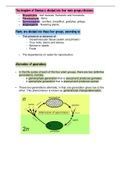
The kingdom of Plantae is divided into four main groups/divisions:
Bryophytes - leaf mosses, liverworts and hornworts.
Pteridophyte - ferns.
Gymnosperm - conifers, breadfruit, gnetales, ginkgo.
Angiosperm - flowering plants.
Plants are divided into these four groups, according to:
The presence or absence of:
o Vessel/vascular tissue (xylem and phloem)
o True roots, stems and leaves.
o Spores or seeds
o Fruits
The dependence on water for reproduction.
Alternation of generations:
In the life cycles of each of the four plant groups, there are two definitive
generations, namely:
o A gametophyte generation that is sexual and produces gametes.
o A sporophyte generation that is asexual and produces spores.
These two generations alternate, in that one generation gives rise to the
other. This phenomenon is known as generational change/alternation.
, Bryophytes include three groups, namely:
o Leaf mosses
o Liverworts
o Hornworts
Mosses grow in cool, moist, shady environments.
The gametophyte generation = dominant generation - represented by the
mature adult moss plant.
The plant body has no true roots, stems and leaves - known as a thallus.
In its place, it possesses leaf-like structures, stem-like structures and
rhizoids.
The rhizoids firmly anchor plant in the soil + absorb water and mineral salts.
Vascular tissue, xylem and phloem lacking.
Gametes (egg cells and sperm cells) develop into male and female
reproductive organs produced from the gametophyte.
During sexual reproduction - sperm cells need water for movement towards
the ovum so that fertilisation can take place.
After fertilisation has taken place, a zygote is formed, which is the
beginning of the sporophyte generation.
The sporophyte develops on the gametophyte plant and is dependent on it.