SILVERTHORN
CHAPTER 12 – MUSCLES
SKELETAL MUSCLE
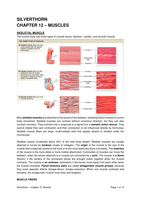
The human body has three types of muscle tissue: skeletal-, cardiac- and smooth muscle.
Most skeletal muscles are attached to the bones of the skeleton, enabling these muscles to control
body movement. Skeletal muscles can contract without conscious direction, but they can also
contract voluntary. They contract only in response to a signal from a somatic motor neuron. They
cannot initiate their own contraction and their contraction is not influenced directly by hormones.
Skeletal muscle fibers are large, multinucleate cells that appear striped or striated under the
microscope.
Skeletal muscle constitutes about 40% of the total body weight. Skeletal muscles are usually
attached to bones by tendons (made of collagen). The origin of the muscle is the end of the
muscle that is attached closed to the trunk or to the more stationary bone (immobile). The insertion
of the muscle is the more distal or more mobile attachment. Contraction of muscles can move the
skeleton, when the bones attached to a muscle are connected by a joint. The muscle is a flexor
(flexion) if the centers of the connected bones are brought closer together when the muscle
contracts. The muscle is an extensor (extension) if the bones move away from each other when
the muscle contracts. Flexor-extensor pairs are called antagonistic muscle groups, because
they exert opposite effects (biceps=flexor, triceps=extensor). When one muscle contracts and
shortens, the antagonistic muscle must relax and lengthen.
MUSCLE FIBERS
Silverthorn – chapter 12: Muscle Page 1 of 14
CHAPTER 12 – MUSCLES
SKELETAL MUSCLE
The human body has three types of muscle tissue: skeletal-, cardiac- and smooth muscle.
Most skeletal muscles are attached to the bones of the skeleton, enabling these muscles to control
body movement. Skeletal muscles can contract without conscious direction, but they can also
contract voluntary. They contract only in response to a signal from a somatic motor neuron. They
cannot initiate their own contraction and their contraction is not influenced directly by hormones.
Skeletal muscle fibers are large, multinucleate cells that appear striped or striated under the
microscope.
Skeletal muscle constitutes about 40% of the total body weight. Skeletal muscles are usually
attached to bones by tendons (made of collagen). The origin of the muscle is the end of the
muscle that is attached closed to the trunk or to the more stationary bone (immobile). The insertion
of the muscle is the more distal or more mobile attachment. Contraction of muscles can move the
skeleton, when the bones attached to a muscle are connected by a joint. The muscle is a flexor
(flexion) if the centers of the connected bones are brought closer together when the muscle
contracts. The muscle is an extensor (extension) if the bones move away from each other when
the muscle contracts. Flexor-extensor pairs are called antagonistic muscle groups, because
they exert opposite effects (biceps=flexor, triceps=extensor). When one muscle contracts and
shortens, the antagonistic muscle must relax and lengthen.
MUSCLE FIBERS
Silverthorn – chapter 12: Muscle Page 1 of 14