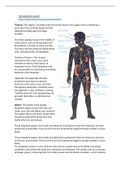
The lymphatic system
https://www.britannica.com/science/tonsil
Thymus: This organ is situated under the breast bone in the upper chest. It develops a
particular form of white blood cell that
defends the body against foreign
invaders.
The thick, spongy tissue in the middle of
some bones, such as the hip bone and
breastbone, is known as bone marrow.
The bone marrow produces white blood
cells, red blood cells, and platelets.
Patches of Peyer's: The mucous
membrane that covers your small
intestine contains small masses of
lymphatic tissue. These lymphoid cells
are responsible for monitoring and killing
bacteria in the intestines.
Appendix: The appendix includes
lymphoid tissue that can destroy
bacteria until it enters your intestine
throughout absorption. Scientists claim
the appendix is also involved in storing
"healthy bacteria" and repopulating our
gut with them after an infection has
cleared.
Spleen: The spleen is the largest
lymphatic organ on your left side, just
under your ribs and above your stomach.
The spleen filters and stores blood while
also generating white blood cells that
battle infection and disease.
These lymphoid organs, the tonsils and adenoid, trap bacteria from the food you consume
and the air you breathe. They are the first line of protection against foreign invaders in your
body.
These lymphoid organs, the tonsils and adenoid, trap bacteria from the food you consume
and the air you breathe. They are the first line of protection against foreign invaders in your
body.
The lymphatic system is very similar to the immune system due to its ability to produce
antibodies and defend the body from infections and diseases. The system acts as a one way
drainage system, removing fluid from body tissues into the blood circulation, and it contains
, lymphocytes to fight infections and it also gets rid of any waste that cells make. In addition,
it removes and filters interstitial fluid from tissues, absorbs and transports fatty acids and
fats from the digestive system as chyle, and transports many immune system-related cells
through lymph.
The lymphatic system is built upon numerous lymphatic capillaries which remove blood fluid
from the blood capillaries called the lymph. The lymph is a colourless, watery, bodily fluid
consisting mainly of white blood cells, which contains most of the plasmas constituents and
leucocytes. The lymph is formed from the fluid that contains oxygen, proteins and other
tissue nourishing nutrients which seep through the walls of the capillaries into the body’s
tissues. The lymphatic capillaries empty the lymph into the circulatory system along the
superior vena cava, which then passes the lymph across the lymph nodes. Lymph nodes act
as a filter as they remove pathogens before the fluid is returned to the venous circulation,
they’re shaped as small oval bodies that are scatted along the lymphatic vessels in the
armpits, groin, neck, chest and abdomen. Inside the nodes are white blood cells
(lymphocytes) which attack and break down bacteria, viruses, damaged cells or cancer cells.
Lymphocytes are forced from mitosis of stem cells in bone marrow. The lymph fluid then
carries the waste products and destroyed bacteria into the bloodstream where it travels to
the liver or kidney. Here, they are removed from the blood through bowel movements or
urination.
Fluid removal
During the process, interstitial fluid gathers in the tissues as a result of the pressure exerted from
the capillaries, hydrostatic and osmotic pressure or from protein leakage into the tissue during
inflammation. These variables force the interstitial fluid from capillaries into the tissues which is
drained by the lymphatic system. The system then drains tissue fluids, cells and large extracellular
molecules (lymphs) into the interstitial spaces of tissues and organs. They are then transported to
thicker collecting lymphatic which are embedded with multiple lymph nodes, and are returned to
the blood circulation via the left and right subclavian veins and into the vena cava. Since veins have
lower blood pressure, they flow into venous circulation, which reduces the effect of lymph cycling on
blood pressure. Pathogens and other abnormalities are removed from lymph fluid by lymph nodes
situated at lymph vessel junctions. It is important for fluid to be removed as it prevents edema from
growing. Edema is any type of tissue swelling from increased flow of the fluid into tissues relative to
fluid drainage. It can be very harmful to the body and can still occur if drainage components of the
lymph vessels are obstructed.
Hydrostatic pressure
Since the lymphatic capillaries collect lymph fluid from the tissues this allows them to regulate the
pressure of interstitial fluid. The importance of this fluid is for the plasma that leaks from
cardiovascular capillaries into the tissues due to the forces of hydrostatic pressure.
Fatty acid absorption
The lymphatic system is also responsible for transporting fatty acids from the digestive systems.
During dissections of fats, fatty acids are digested, emulsified and covered within intestinal cells into
lipoproteins (chylomicrons). The chylomicrons are absorbed into lymph fluid by lacteals, which are
lymph drainage vessels that line the intestine. The chylomicrons are then carried into the
bloodstream by lymph vessels, where they react with HDL cholesterols before being broken down in
the liver. As the pressure in the interstitial fluid exceeds the pressure in the lymph due to interstitial
fluid deposition, the mini valves open slightly like a one-way swinging lock, allowing fluid to reach
the lymphatic capillary. As the pressure inside a lymphatic capillary is higher, the cells stick together