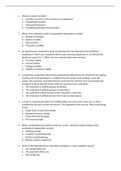
1. What are subject variables?
a. Variables we wish to hold constant in an experiment
b. Manipulated variables
c. Measured behaviours
d. Preexisting participant characteristics
2. Which of the following is NOT a manipulated independent variable?
a. Situational variables
b. Subject variables
c. Task variables
d. Instruction variables
3. An experimenter conducted a series of experiments in her laboratory that confirmed
hypothesis A. When she conducted a fiend study examining hypothesis A, she did not find
significant support for it. What were her original experiments missing?
a. Construct validity
b. Internal validity
c. Ecological validity
d. Statistical conclusion validity
4. A researcher conducted a clinical trial examining the effectiveness of a treatment for quitting
smoking. Out of 20 participants, 7 withdrew from the study, 8 quit smoking, and 5 still
smoke. The researcher concluded that the treatment was effective since more people quit
compared to those who still smoke. What do you think of his conclusion?
a. The conclusion is unlikely because of attrition
b. The conclusion is unlikely because of maturation
c. The conclusion is likely because of the researcher’s reasoning
d. The conclusion is unlikely because there was no control group
5. A study is comparing the effects of complimenting men and women (one, two, or three
compliments per day) on their self-esteem. The experiment lasts one day. What study design
is this?
a. Single-factor ex-post facto design
b. Repeated measures design
c. Mixed PxE factorial design
d. PxE factorial design
6. Which counterbalancing method would you use for a between-subjects design with a
manipulated independent variable?
a. Matching groups
b. Complete counterbalancing
c. Partial counterbalancing
d. Blocked random assignment
7. Which of the following factors does NOT contribute to a test’s statistical power?
a. The sample effect size
b. The population effect size
c. The sample size
a. Variables we wish to hold constant in an experiment
b. Manipulated variables
c. Measured behaviours
d. Preexisting participant characteristics
2. Which of the following is NOT a manipulated independent variable?
a. Situational variables
b. Subject variables
c. Task variables
d. Instruction variables
3. An experimenter conducted a series of experiments in her laboratory that confirmed
hypothesis A. When she conducted a fiend study examining hypothesis A, she did not find
significant support for it. What were her original experiments missing?
a. Construct validity
b. Internal validity
c. Ecological validity
d. Statistical conclusion validity
4. A researcher conducted a clinical trial examining the effectiveness of a treatment for quitting
smoking. Out of 20 participants, 7 withdrew from the study, 8 quit smoking, and 5 still
smoke. The researcher concluded that the treatment was effective since more people quit
compared to those who still smoke. What do you think of his conclusion?
a. The conclusion is unlikely because of attrition
b. The conclusion is unlikely because of maturation
c. The conclusion is likely because of the researcher’s reasoning
d. The conclusion is unlikely because there was no control group
5. A study is comparing the effects of complimenting men and women (one, two, or three
compliments per day) on their self-esteem. The experiment lasts one day. What study design
is this?
a. Single-factor ex-post facto design
b. Repeated measures design
c. Mixed PxE factorial design
d. PxE factorial design
6. Which counterbalancing method would you use for a between-subjects design with a
manipulated independent variable?
a. Matching groups
b. Complete counterbalancing
c. Partial counterbalancing
d. Blocked random assignment
7. Which of the following factors does NOT contribute to a test’s statistical power?
a. The sample effect size
b. The population effect size
c. The sample size