
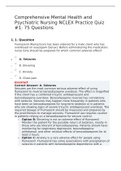
NCLEX Comprehensive Mental Health and Psychiatric Nursing Practice Quiz #1: 75 Questions
1. 1. Question Flumazenil (Romazicon) has been ordered for a male client who has overdosed on oxazepam (Serax). Before administering the medication, nurse Gina should be prepared for which common adverse effect? o A. Seizures o B. Shivering o C. Anxiety o D. Chest pain Incorrect Correct Answer: A. Seizures Seizures are the most common serious adverse effect of using flumazenil to reverse benzodiazepine overdose. The effect is magnified if the client has a combined tricyclic antidepressant and benzodiazepine overdose. Benzodiazepine reversal has correlations with seizures. Seizures may happen more frequently in patients who have been on benzodiazepines for long-term sedation or in patients who are showing signs of severe tricyclic antidepressant overdose. The required dosage of Flumazenil should be measured and prepared by the practitioners to manage seizures. Flumazenil use requires caution in patients relying on a benzodiazepine for seizure control. • Option B: Shivering is not an adverse effect of flumazenil. Monitor the patient for the possible return of sedation, mostly in those who are tolerant of benzodiazepines. Patients should have monitoring for respiratory depression, benzodiazepine withdrawal, and other residual effects of benzodiazepines for at least 2 hours. • Option C: Anxiety is a rare adverse effect for people using flumazenil. Flumazenil has some associations with precipitation of seizures in patients with benzodiazepine dependence with a history of seizures. Flumazenil overdose is extremely rare. There is no precise antidote for flumazenil toxicity. In mild to severe toxicity, symptomatic and supportive treatment should be a consideration. • Option D: An overdose of flumazenil in a patient who is not a chronic benzodiazepine user would not be expected. Chronic benzodiazepines users may experience withdrawal with abrupt discontinuation of the drug. Administration of benzodiazepines or barbiturates may be necessary for seizure control. 2. 2. Question Nurse Tamara is caring for a client diagnosed with bulimia. The most appropriate initial goal for a client diagnosed with bulimia is to: • A. Avoid shopping for large amounts of food. • B. Control eating impulses. • C. Identify anxiety-causing situations. • D. Eat only three meals per day. Incorrect Correct Answer: C. Identify anxiety-causing situations Bulimic behavior is generally a maladaptive coping response to stress and underlying issues. The client must identify anxiety-causing situations that stimulate the bulimic behavior and then learn new ways of coping with the anxiety. Bulimia nervosa is a condition that occurs most commonly in adolescent females, characterized by indulgence in binge-eating, and inappropriate compensatory behaviors to prevent weight gain. • Option A: Controlling shopping for large amounts of food isn’t a goal early in treatment. It is important to educate patients who abuse laxatives that these medications work in the gastrointestinal tract after the areas where caloric absorption has occurred primarily. It is crucial to inform patients that a period of edema and weight gain may follow up to several weeks after discontinuation of purging behavior. • Option B: Managing eating impulses and replacing them with adaptive coping mechanisms can be integrated into the plan of care after initially addressing stress and underlying issues. The primary objective of treatment is a cessation of the binging and purging behavior. Selective serotonin reuptake inhibitors such as fluoxetine, citalopram, and sertraline have shown to reduce symptoms of bulimia nervosa. Fluoxetine is the only FDA approved medication for bulimia nervosa. It appears that a higher dose (60 mg) is significantly better than a placebo in decreasing the frequency of binge and vomiting episodes. • Option D: Eating three meals per day isn’t a realistic goal early in treatment. Patients with bulimia nervosa who purge by vomiting often brush their teeth immediately after purging, which can accelerate dental erosion. The clinician should instruct the patients who persist in vomiting to rinse their mouths with water or fluoride rather than brushing their teeth within 30 minutes of each episode. Consider consulting a dentist to address dental issues associated with vomiting. 3. 3. Question A female client who’s at high risk for suicide needs close supervision. To best ensure the client’s safety, Nurse Mary should: • A. Check the client frequently at irregular intervals throughout the night. • B. Assure the client that the nurse will hold in confidence anything the client says. • C. Repeatedly discuss previous suicide attempts with the client. • D. Disregard decreased communication by the client because this is common with suicidal clients. Incorrect Correct Answer: A. Check the client frequently at irregular intervals throughout the night Checking the client frequently but at irregular intervals prevents the client from predicting when observation will take place and altering behavior in a misleading way at these times. Once the patient is deemed to be at risk for suicide, then intervention steps must be initiated right away. The individual must not be left alone. Enlist the help of a support person while at home. The suicidal individual must be treated in a safe and secure place. In addition, the place has to be monitored. • Option B: This may encourage the client to try to manipulate the nurse or seek attention for having a secret suicide plan. Assessing the individual’s judgment is critical. One should try and determine how the individual can handle stress. Does he or she have an impairment in decision making? Does the individual know that jumping in front of a train is dangerous? Reflect empathy and concern. Offer a hand to help. Provide the patient with confidence that he or she can overcome the issues. • Option C: This may reinforce suicidal ideas. Help develop internal coping strategies (e.g., exercise, journaling, reading, developing a hobby). Utilize the help of healthcare professionals to follow up on therapy. Once the individual is safe as an inpatient or outpatient, a formal treatment plan should be established. The next step is to refer all patients deemed to be at higher risk for suicide to a mental health counselor as soon as possible. Every state has laws and procedures regarding this process which must be incorporated into the clinical practice when addressing individuals at high suicide risk. • Option D: Decreased communication is a sign of withdrawal that may indicate the client has decided to commit suicide; the nurse shouldn’t disregard it. In some cases, assessment of the mental status may provide a clue to the individual’s potential for self-harm. Depressed patients will often tend to appear unclean and unkempt. The clothing may not be ironed or dirty. The risk of suicide is often high in people who appear very anxious or depressed. The patient may exhibit a flat affect or no emotions at all. Some depressed patients may develop hallucinations that may be telling him or her to kill themselves. The majority of these hallucinations are auditory. 4. 4. Question Which of the following drugs should Nurse Mary prepare to administer to a client with a toxic acetaminophen (Tylenol) level? • A. Deferoxamine mesylate (Desferal) • B. Succimer (Chemet) • C. Flumazenil (Romazicon) • D. Acetylcysteine (Mucomyst) Incorrect Correct Answer: D. Acetylcysteine (Mucomyst)
Document information
- Uploaded on
- January 21, 2023
- Number of pages
- 94
- Written in
- 2022/2023
- Type
- Exam (elaborations)
- Contains
- Questions & answers


