
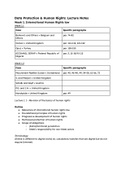
Data Protection & Human Rights: Lecture Notes
Week 1: International Human Rights law
Week 1.1
Case Specific paragraphs
Banković and Others v Belgium and par. 74-82
Others
Osman v United Kingdom par. 114-116, 121-122
Opuz v Turkey par. 128-153
(ECOWAS), SERAP v Federal Republic of par. 3, 12-18,91-112
Nigeria
Week 1.2
Case Specific paragraphs
Mouvement Raëlien Suisse v Switzerland par. 40, 46-48, 49, 54-58, 61–66, 72
S. and Marper v United Kingdom
Schalk and Kopf v Austria
P.G. and J.H. v United Kingdom
Handyside v United Kingdom par. 49
Lecture 1. 1 - Revision of the basics of human rights
Outline
● Relevance of international human rights law
● Foundational principles of human rights
● Progressive development of human rights
● Multi-level protection of human rights
● Scope of obligations
○ (Extra)Territorial jurisdiction
○ State’s responsibility for non-State actors
Terminology
(Online is different to digital world; ex. calculators/watches that are digital but do not
require Internet)
,Relevance of international human rights
>When discussing data protection issues and/or technological developments?
Important for matters of right to privacy, non-discrimination, freedom of
expression/opinion
Functions:
- Set binding standards (not a wish list)
- Set of claims for individual (rights)
- Set of obligations incumbent upon State
- What about non-State actors?
- Human rights law regulates relationship between
individual(s) and State; body of law to protect individuals
from the State; so, it does not apply to non-State actors
- There are some exceptions: ex. obligations imposed
on basis of domestic legislation
- Bring back fundamental values and principles
- (Re)frames policy-making debate
- Human rights law + human rights language
- Ex. Google having a lot of power; difficult to regulate; introducing
tools to introduce responsibilities for such actors
>International human rights law may give you tools to be critical of GDPR + data
protection (eg. tensions with freedom of expression, interlinkages with other human
rights)
- Reinforce or bring tensions with human rights
>International human rights law instructs to look everywhere and not be
EU/Europe/West-centric (eg. trend, legislation, judgements from around the world)
- Example: Internet Shutdowns & Access to Internet in Indonesia, India, etc.
Foundational principles of human rights
What are they?
‘All human beings are born free and equal in dignity and rights. They are endowed with
reason and conscience and should act towards one another in a spirit of brotherhood’
(art. 1 UDHR)
- Human dignity
- Freedom
, - Legality
- Principle of legality: prescribed by law for legal certainty and lack
of/prevention of arbitrariness
- Ex. Magna Carta in Europe
- Accountability
- Making perpetrators of breaches of law accountable
- Fairness & equal treatment
+ Universality, indivisibility and interdependence (must apply in a way that they
coexist and be considered of each other) of human rights
>Function to bring back values and (underlying) principles
They are needed as with the rise of technology, we are back at basics due to, for
example, AI, (semi) automated decision making in public + private sectors (eg. SyRI
case), Digital IDs (& relation to human rights)
= Freedom, transparency & accountability, legality + fairness are needed
How does human rights law progressively develop?
Does existing human rights law need to be adjusted for technology developments?
= Yes
But how does human rights law evolve?
● Judgements/views by international bodies/courts
○ Also domestic courts
● Customary international law
● General principles of law
● Treaties
○ Regional human right treaties
○ New specialized human right treaties
○ Amending existing human right treaties
● Declarations/soft law
○ Indications, suggest trends
■ Could develop into binding law
● Protocols: new Treaty attached to existing Treaty (optional protocols)
○ Additional protocols adding new rights
○ Additional protocols adding new mechanisms
● International Bill of Rights
● Interpretation
○ Courts interpret + apply
, ■ Ex. ECHR by ECtHR
+ Withdrawal and reservations
‘Unfortunately, in the absence of an international legislature, international law does not
dispose of sufficient autonomy to develop rationally "by its own bootstraps," for it does
not have any boots and perhaps not even any feet. It has to develop like a parasitic
plant, by seizing on all opportunities and latching onto anything that gives it the
possibility of moving upwards towards the light’ (Georges Abi-Saab)
9 Core UN Human Rights Instruments
Universal Declaration of Human Rights (UDHR) 1948
- Not a treaty
1. International Covenant on Civil and Political Rights (ICCPR) 1966
2. International Covenant on Economic Social and Cultural Rights (ICESCR) 1966
3. Convention on Elimination of All Forms of Racial Discrimination (ICERD) 1966
4. Convention on Women’s Rights (CEDAW) 1979
5. Convention Against Torture (CAT) 1984
6. Convention on Rights of the Child (CRC) 1989
7. Convention on Migrant Workers (CMW) 1990
8. Convention on Rights of Persons with Disabilities (CRPD) 2006
9. Convention on Enforced Disappearances (CED) 2006
Monitoring mechanisms/international courts on human rights
Treaty-based bodies: monitor implementation of core international human rights
treaties
● Committee on Elimination of Racial Discrimination
● Committee on Economic Social and Cultural Rights
● Human Rights Committee
● Committee on Elimination of Discrimination against Women
● Committee against Torture
● Committee on Rights of Child
● Committee on Migrant Workers
● Subcommittee on Prevention of Torture
● Committee on Rights of Persons with Disabilities
● Committee on Enforced Disappearances
- Inter-American Court of Human Rights
- African Court on Human and People’s Rights
- Court of Justice of European Union
Week 1: International Human Rights law
Week 1.1
Case Specific paragraphs
Banković and Others v Belgium and par. 74-82
Others
Osman v United Kingdom par. 114-116, 121-122
Opuz v Turkey par. 128-153
(ECOWAS), SERAP v Federal Republic of par. 3, 12-18,91-112
Nigeria
Week 1.2
Case Specific paragraphs
Mouvement Raëlien Suisse v Switzerland par. 40, 46-48, 49, 54-58, 61–66, 72
S. and Marper v United Kingdom
Schalk and Kopf v Austria
P.G. and J.H. v United Kingdom
Handyside v United Kingdom par. 49
Lecture 1. 1 - Revision of the basics of human rights
Outline
● Relevance of international human rights law
● Foundational principles of human rights
● Progressive development of human rights
● Multi-level protection of human rights
● Scope of obligations
○ (Extra)Territorial jurisdiction
○ State’s responsibility for non-State actors
Terminology
(Online is different to digital world; ex. calculators/watches that are digital but do not
require Internet)
,Relevance of international human rights
>When discussing data protection issues and/or technological developments?
Important for matters of right to privacy, non-discrimination, freedom of
expression/opinion
Functions:
- Set binding standards (not a wish list)
- Set of claims for individual (rights)
- Set of obligations incumbent upon State
- What about non-State actors?
- Human rights law regulates relationship between
individual(s) and State; body of law to protect individuals
from the State; so, it does not apply to non-State actors
- There are some exceptions: ex. obligations imposed
on basis of domestic legislation
- Bring back fundamental values and principles
- (Re)frames policy-making debate
- Human rights law + human rights language
- Ex. Google having a lot of power; difficult to regulate; introducing
tools to introduce responsibilities for such actors
>International human rights law may give you tools to be critical of GDPR + data
protection (eg. tensions with freedom of expression, interlinkages with other human
rights)
- Reinforce or bring tensions with human rights
>International human rights law instructs to look everywhere and not be
EU/Europe/West-centric (eg. trend, legislation, judgements from around the world)
- Example: Internet Shutdowns & Access to Internet in Indonesia, India, etc.
Foundational principles of human rights
What are they?
‘All human beings are born free and equal in dignity and rights. They are endowed with
reason and conscience and should act towards one another in a spirit of brotherhood’
(art. 1 UDHR)
- Human dignity
- Freedom
, - Legality
- Principle of legality: prescribed by law for legal certainty and lack
of/prevention of arbitrariness
- Ex. Magna Carta in Europe
- Accountability
- Making perpetrators of breaches of law accountable
- Fairness & equal treatment
+ Universality, indivisibility and interdependence (must apply in a way that they
coexist and be considered of each other) of human rights
>Function to bring back values and (underlying) principles
They are needed as with the rise of technology, we are back at basics due to, for
example, AI, (semi) automated decision making in public + private sectors (eg. SyRI
case), Digital IDs (& relation to human rights)
= Freedom, transparency & accountability, legality + fairness are needed
How does human rights law progressively develop?
Does existing human rights law need to be adjusted for technology developments?
= Yes
But how does human rights law evolve?
● Judgements/views by international bodies/courts
○ Also domestic courts
● Customary international law
● General principles of law
● Treaties
○ Regional human right treaties
○ New specialized human right treaties
○ Amending existing human right treaties
● Declarations/soft law
○ Indications, suggest trends
■ Could develop into binding law
● Protocols: new Treaty attached to existing Treaty (optional protocols)
○ Additional protocols adding new rights
○ Additional protocols adding new mechanisms
● International Bill of Rights
● Interpretation
○ Courts interpret + apply
, ■ Ex. ECHR by ECtHR
+ Withdrawal and reservations
‘Unfortunately, in the absence of an international legislature, international law does not
dispose of sufficient autonomy to develop rationally "by its own bootstraps," for it does
not have any boots and perhaps not even any feet. It has to develop like a parasitic
plant, by seizing on all opportunities and latching onto anything that gives it the
possibility of moving upwards towards the light’ (Georges Abi-Saab)
9 Core UN Human Rights Instruments
Universal Declaration of Human Rights (UDHR) 1948
- Not a treaty
1. International Covenant on Civil and Political Rights (ICCPR) 1966
2. International Covenant on Economic Social and Cultural Rights (ICESCR) 1966
3. Convention on Elimination of All Forms of Racial Discrimination (ICERD) 1966
4. Convention on Women’s Rights (CEDAW) 1979
5. Convention Against Torture (CAT) 1984
6. Convention on Rights of the Child (CRC) 1989
7. Convention on Migrant Workers (CMW) 1990
8. Convention on Rights of Persons with Disabilities (CRPD) 2006
9. Convention on Enforced Disappearances (CED) 2006
Monitoring mechanisms/international courts on human rights
Treaty-based bodies: monitor implementation of core international human rights
treaties
● Committee on Elimination of Racial Discrimination
● Committee on Economic Social and Cultural Rights
● Human Rights Committee
● Committee on Elimination of Discrimination against Women
● Committee against Torture
● Committee on Rights of Child
● Committee on Migrant Workers
● Subcommittee on Prevention of Torture
● Committee on Rights of Persons with Disabilities
● Committee on Enforced Disappearances
- Inter-American Court of Human Rights
- African Court on Human and People’s Rights
- Court of Justice of European Union


