Ch. 1 Notes EMT A150
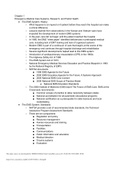
Chapter 1 Emergency Medical Care Systems, Research, and Public Health ● The EMS System: History ○ What happens to an injured or ill patient before they reach the hospital can make a critical difference ○ Lessons learned from observations in the Korean and Vietnam wars have impacted the development of modern EMS systems ○ In the past, care did not begin until the patient reached the hospital ○ In 1966, the EMS “white paper” identified deficiencies in prehospital medical care, including lack of EMT training and lack of organized systems ○ Modern EMS is part of a continuum of care that begins at the scene of the emergency and continues through hospital discharge and rehabilitation ○ Several significant developments helped lead to this EMS system ○ Introduction of cardiopulmonary resuscitation (CPR) in the 1960s ○ The Highway Safety Act of 1966 ○ The EMS System Act of 1973 ○ National Emergency Medical Services Education and Practice Blueprint in 1993 by the National Registry of EMTs ○ NHTSA documents ■ 1996 EMS Agenda for the Future ■ 2000 EMS Education Agenda for the Future: A Systems Approach ■ 2005 National EMS Core Content ■ 2006 National EMS Scope of Practice Model ● National EMS Education Standards ○ The 2006 Institute of Medicine (IOM) report The Future of EMS Care: EMS at the Crossroads recommends ■ Common scopes of practice to allow reciprocity between states ■ National accreditation for all paramedic educational programs ■ National certification as a prerequisite for state licensure and local credentialing ● The EMS System: Standards ○ NHTSA provides a set of recommended state standards, the Technical Assistance Program Assessment Standards ○ There are ten components ■ Regulation and policy ■ Resource management ■ Human resources and training ■ Transportation ■ Facilities ■ Communications ■ Public information and education ■ Medical direction ■ Trauma systems ■ Evaluation This study source was downloaded by from CourseH on :35:45 GMT -06:00 ● The EMS System: System Goals ○ Emergency Medical Services: Clinical Practice and Systems Oversight, 2015 ■ Clinical quality ■ Service quality ■ Economic efficiency ■ Accountability ■ Improvement ■ Resilience ● EMS System Access ○ The most common way for the public to access EMS is by dialing 911 ○ Enhanced 911 (E-911) allows ■ Automatic number identification ■ Automatic location information ○ Benefits of 911 ■ The number is easy to remember and use ■ Public safety answering point (PSAP) is staffed by specially trained dispatchers ■ All emergency services—police, fire, and EMS—are accessible by dialing one number ○ Cell phones pose some challenges to 911 systems ■ They are not identified with a fixed site, so the location is identified as the closest cell tower ■ Calls near geographic boundaries can go to a different PSAP ■ FCC rules are being implemented to improve cellular access to 911 ○ Voice over Internet Protocol (VoIP) also poses challenges addressed by FCC rules ■ 911 service must be a standard feature ■ Must give the physical location of where the service will be used ■ The provider must transmit all 911 calls to the appropriate PSAP ● Types of EMS Systems ○ A variety of EMS system types exist in the United States ■ Fire Department EMS ■ Municipal EMS ■ Private EMS ■ Hospital based EMS ■ Law enforcement EMS ● Levels of Providers ○ The National EMS Scope of Practice Model identifies four levels of EMS practitioners ■ Emergency Medical Responder (EMR) ■ Emergency Medical Technician (EMT) ■ Advanced Emergency Medical Technician (AEMT) ■ Paramedic ● The Health Care System This study source was downloaded by from CourseH on :35:45 GMT -06:00 ○ A health care system is a network of m
Document information
- Uploaded on
- January 19, 2023
- Number of pages
- 6
- Written in
- 2022/2023
- Type
- Exam (elaborations)
- Contains
- Questions & answers