NFHS First Aid, Health and Safety for Coaches Test Answers_2023.
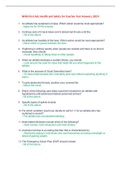
NFHS First Aid, Health and Safety for Coaches Test Answers_2023. 1. An athlete has sustained a bruise. Which action would be most appropriate? 2. Continue sets of 5 back blows and 5 abdominal thrusts until the: 3. An athlete has frostbite of the toes. Which action would be most appropriate? 4. If lightning is striking nearby when people are outside and there is no time to evacuate, they should: 5. When an athlete develops a sudden illness, you should: 6. What is the purpose of Good Samaritan laws? 7. To give abdominal thrusts, position your covered fist: 8. Which of the following care steps would be included for an athlete with hypothermia until advanced medical personnel arrives? 9. Specific types of splints include: 10. For which condition would you decide to call 9-1-1 for an athlete who has sustained a wound? 11. Heat-related illnesses include which of the following? 12. Anorexia nervosa is an eating disorder that is characterized by: 13. The Emergency Action Plan (EAP) should include: 14. When dealing with an athlete who has mental health issues, the coach's role is to: 15. An athlete has sustained an injury that involves the tearing of the muscles in the back of his leg. This type of injury is called: 16. If you are caring for an athlete with heat stroke and you cannot immerse the athlete up to his or her neck in an ice-water pool or tub, what other methods can you try? . 17. How do you care for an athlete with a possible head, neck or back injury? 18. To help control a nosebleed, you should have the athlete: 19. To care for an athlete having a diabetic emergency who can swallow, give some form of sugar, such as: 20. Common signals of bulimia nervosa include: 21. A concussion is a type of brain injury that usually involves: 22. One signal of a breathing emergency is: 23. Which type of injury involves an open wound where the bone has torn through the skin? 24. The general care for a muscle, bone or joint injury includes the following: 25. Which of the following would you expect to find in an athlete experiencing a diabetic emergency? 26. Activate the EMS system by: 27. An athlete is experiencing early signs and symptoms of heat illness. Which of the following would you do? 28. MRSA infections are most commonly spread by: 29. To prevent heat-related illness emergencies, which action would be most appropriate? 30. Which of the following is not a signal of a breathing emergency? 31. A football player who was wearing his helmet has sustained a suspected neck injury during practice. He is laying his back and is awake and talking. Which action would be appropriate? 32. Anaphylaxis kits contain which of the following: 33. Caring for shock involves which of the following steps? 34. The female athlete triad is a condition that involves low bone mass, amenorrhea, and _________? 35. The sudden illness that results from too much or too little sugar in the athlete's blood is: - 36. When checking for a concussion, common symptoms often include: 37. A rapid, weak pulse, confusion and seizures are among the signals of which life- threatening condition? 38. An athlete with frostbite would exhibit which of the following? 39. If an athlete takes a direct blow to the head, neck or back during an event, practice or game and becomes unconscious you should always: 40. What is a common signal of sudden illness? 41. When caring for an athlete with hypothermia, which action would be appropriate? 42. After putting on disposable gloves, what is the first step in caring for a wound with significant bleeding? 43. When applying a roller bandage, always: 44. If an open wound continues to bleed after applying direct pressure: 45. When caring for an athlete who is having a seizure, you should: 46. For an athlete who is suffering from a skin condition or an infection, you should: - 47. The simplest type of closed wound is: 48. By following universal precautions to protect yourself and the injured or ill athlete, you can: 49. An athlete sustains an injury in which the bone at a joint has moved away from its normal position. This is called: 50. Which is a sign that the condition of an athlete with hypothermia needs immediate medical attention?
Document information
- Uploaded on
- January 14, 2023
- Number of pages
- 4
- Written in
- 2022/2023
- Type
- Exam (elaborations)
- Contains
- Questions & answers