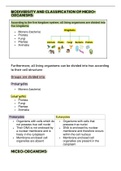
According to the five kingdom system, all living organisms are divided into
five kingdoms:
• Monera (bacteria)
• Protista
• Fungi
• Plantae
• Animalia
Furthermore, all living organisms can be divided into two according
to their cell structure:
Groups are divided into:
Prokaryotes:
• Monera (bacteria)
Eukaryotes:
• Protista
• Fungi
• Plantae
• Animalia
Prokaryotes Eukaryotes
• Organisms with cells which do • Organisms with cells that
not possess true cell nuclei possess true nuclei
• Their DNA is not enclosed by • DNA is enclosed by nuclear
a nuclear membrane and is membrane and therefore occurs
freely in the cytoplasm within the cell nucleus
• Membrane-enclosed cell • Membrane-enclosed cell
organelles are absent organelles are present in the
cytoplasm
,Some living organisms are so small that they are not visible to the naked eye
and are known as micro-organisms
There are several groups of micro organisms,, which include:
• Viruses
• Bacteria
• Protista
• Fungi
• Micro-organisms are the most abundant of all organisms on earth and
occur practically everywhere in nature, in enormously large numbers.
• Favourable conditions for the growth and multiplication of micro-
organisms include sufficient food, humidity and suitable temperature.
Are micro-organisms harmful or not?
• Free-living micro-organisms mostly harmless to plants + animals.
• However, some cause disease = known as pathogens.
• Most pathogens usually parasites and live in or on other organisms.
• All viruses and some bacteria, protists and fungi are pathogenic in
nature.
• Any disease caused by a micro-organism = infectious disease
• Viruses are difficult to classify and are not classified under one of the
kingdoms of the five-kingdom system.
• Viruses possess properties of non-living particles as well as living
organisms
Characteristics of life::
• Nutrition
• Response to stimuli
• Growth
, • Reproduction
• Respiration
• Excretion
• Movement
• Only characteristic of life that viruses do exhibit is reproduction. However,
viruses can only reproduce inside the cells of living organisms.
• Viruses do not consist of cells (non-cellular) and are therefore not
classified as pro or eukaryotic.
Basic build of viruses:
• Very small (20nm-450nm in diameter) and simple in constitution.
• A virus consists of a central nucleic acid surrounded and enclosed by a
protein coat/capsid.
• Viruses can infect plant, animal and bacterial cells.
• Viruses possess either DNA or RNA (never both).
• Some viruses, such as the influenza virus and MI virus, are further
enclosed by a spiny sheath of lipid protein molecules. This sheath is
derived from the host cell's cell membrane.
• Viruses are non-cellular and have no nucleus, cytoplasm or organelles.
• Viruses' shapes vary from rod-shaped, spherical to more complex shapes.
, General characteristics of viruses:
• Viruses are parasites that reproduce only inside living cells (plants, animals
and bacteria) and are known as obligate intracellular parasites.
• Host specific, some even tissue specific, e.g. poliovirus that infects only the
cells of nervous tissue.
• Viruses are pathogens, cause a variety of diseases in plants and
animals/people.
o A well-known plant virus is the tobacco mosaic virus (TMV). In
humans, AIDS, colds, flu, rabies, measles, and polio are caused by
viruses.
• Viruses reproduce by transforming genetic material (DNA or RNA) of host
cells into viral nucleic acids so that new viruses can be formed.
• Smallest + simplest living organisms.