AHA PALS Precourse Test_ answered_ Updated Fall 2022/2023.
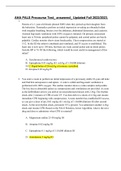
Parents of a 1-year-old female phoned EMS when they picked up their daughter from the babysitter. Paramedics perform an initial impression revealing an obtunded infant with irregular breathing, bruises over the abdomen, abdominal distension, and cyanosis. Assisted bag-mask ventilation with 100% oxygen is initiated. On primary assessment heart rate is 36/min, peripheral pulses cannot be palpated, and central pulses are barely palpable. Cardiac monitor shows sinus bradycardia. Chest compressions are started at 15:2. In the ED the infant is intubated and ventilated, and IV access is established. The heart rate is now up to 150/min, but there are weak central pulses and no distal pulses. Systolic BP is 74. Of the following, which would be most useful in management of this infant? A. Synchronized cardioversion B. Epinephrine 0.01 mg/kg (0.1 mL/kg of 1:10,000 dilution) IV C. Rapid bolus of 20 mL/kg of isotonic crystalloid D. Atropine 0.02 mg/kg IV 2. You enter a room to perform an initial impression of a previously stable 10-year-old male and find him unresponsive and apneic. A code is called and bag-mask ventilation is performed with 100% oxygen. The cardiac monitor shows a wide-complex tachycardia. The boy has no detectable pulses so compressions and ventilations are provided. As soon as the defibrillator arrives you deliver an unsynchronized shock with 2 J/kg. The rhythm check after 2 minutes of CPR reveals VF. You then deliver a shock of 4 J/kg and resume immediate CPR beginning with compressions. A team member has established IO access, so you give a dose of epi, 0.01 mg/kg (0.1 mL/kg of 1:10,000 dilution) IO after second shock. At the next rhythm check, persistent VF is present. You administer another 4 J/kg shock and resume CPR. Based on the PALS Pulseless Arrest Algorithm, what is the next drug and dose to administer when CPR is restarted? A. Magnesium sulfate 25-50 mg/kg IO B. Atropine 0.02 mg/kg IO C. Epinephrine 0.1 mg/kg of 1:10,000 dilution IO D. Amiodarone 5 mg/kg IO
Document information
- Uploaded on
- January 6, 2023
- Number of pages
- 18
- Written in
- 2022/2023
- Type
- Exam (elaborations)
- Contains
- Questions & answers