Chromosomes and Meiosis:
Chromosomes:
• 46 chromosomes: 22 pairs = autosomes, X and Y chromosomes = gonosomes
• Long, thread-like structures form chromatin network in nuclei
• Made of strand of DNA wound around histones (proteins)
• Can only be seen during replication (form an x shape)
• In somatic cells of diploid organisms:
- Number of chromosomes in each cell is the same
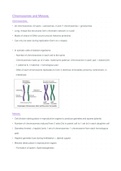
- Chromosomes made up of 2 sets: maternal & paternal. Chromosome in each pair = diploid (2n)
- 1 paternal & 1 maternal = homologous pair
- DNA of each chromosome replicates to form 2 identical chromatids joined by centromere, in
interphase
Meiosis:
• Cell division taking place in reproductive organs to produce gametes and spores (plants)
• Number of chromosomes reduced from 2 sets (2n) in parent cell to 1 set (n) in each daughter cell
• Gametes formed = haploid (only 1 set of chromosomes: 1 chromosome from each homologous
pair)
• Haploid gametes fuse during fertilisation = diploid zygote
• Meiosis takes place in reproductive organs
- Formation of sperm: Spermatogenesis
, - Formation of eggs: Oogenesis
Process of meiosis:
• DNA of parent cells is replicated in interphase. Replication is followed by:
- Meiosis 1: Reduction devision resulting in 2 cells forming with half the number of chromosomes
of parent cell (n)
- Meiosis 2: Copying devision where 2 haploid cells divide again by mitosis and form 4 haploid
cells
Meiosis 1: A reduction devision:
• Early prophase 1:
- Chromosomes become short & fat (visible)
• Late prophase 1:
- Chromosomes of homologous pairs lie along one side (bivalent)
- Centrioles move to opposite poles
- Spindle (protein thread) develops
- Crossing over takes place (inner chromatids)
• Metaphase 1:
- Bivalents move to middle of cell
- Centromeres attach to spindle threads
• Anaphase 1:
- Centromeres don't split. Bivalents separate and chromosomes (not chromatids) are pulled away
from each other by contracting spindle threads
- Chromosomes move to opposite poles
Chromosomes:
• 46 chromosomes: 22 pairs = autosomes, X and Y chromosomes = gonosomes
• Long, thread-like structures form chromatin network in nuclei
• Made of strand of DNA wound around histones (proteins)
• Can only be seen during replication (form an x shape)
• In somatic cells of diploid organisms:
- Number of chromosomes in each cell is the same
- Chromosomes made up of 2 sets: maternal & paternal. Chromosome in each pair = diploid (2n)
- 1 paternal & 1 maternal = homologous pair
- DNA of each chromosome replicates to form 2 identical chromatids joined by centromere, in
interphase
Meiosis:
• Cell division taking place in reproductive organs to produce gametes and spores (plants)
• Number of chromosomes reduced from 2 sets (2n) in parent cell to 1 set (n) in each daughter cell
• Gametes formed = haploid (only 1 set of chromosomes: 1 chromosome from each homologous
pair)
• Haploid gametes fuse during fertilisation = diploid zygote
• Meiosis takes place in reproductive organs
- Formation of sperm: Spermatogenesis
, - Formation of eggs: Oogenesis
Process of meiosis:
• DNA of parent cells is replicated in interphase. Replication is followed by:
- Meiosis 1: Reduction devision resulting in 2 cells forming with half the number of chromosomes
of parent cell (n)
- Meiosis 2: Copying devision where 2 haploid cells divide again by mitosis and form 4 haploid
cells
Meiosis 1: A reduction devision:
• Early prophase 1:
- Chromosomes become short & fat (visible)
• Late prophase 1:
- Chromosomes of homologous pairs lie along one side (bivalent)
- Centrioles move to opposite poles
- Spindle (protein thread) develops
- Crossing over takes place (inner chromatids)
• Metaphase 1:
- Bivalents move to middle of cell
- Centromeres attach to spindle threads
• Anaphase 1:
- Centromeres don't split. Bivalents separate and chromosomes (not chromatids) are pulled away
from each other by contracting spindle threads
- Chromosomes move to opposite poles