TEST BANK
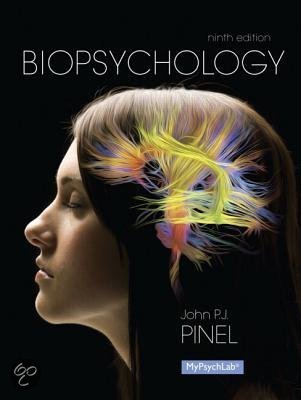
Biopsychology
John P.J. Pinel
9th Edition
,Table of Contents
Chapter 01 Biopsychology As A Neuroscience 1
Chapter 02 Evolution, Genetics, and Experience 22
Chapter 03 Anatomy of the Nervous System 56
Chapter 04 Neural Conduction and Synaptic Transmission 93
Chapter 05 The Research Methods of Biopsychology 130
Chapter 06 The Visual System 168
Chapter 07 Mechanisms of Perception 203
Chapter 08 The Sensorimotor System 238
Chapter 09 Development of the Nervous System 266
Chapter 10 Brain Damage and Neuroplasticity 295
Chapter 11 Learning, Memory, and Amnesia 338
Chapter 12 Hunger, Eating, and Health 373
Chapter 13 Hormones and Sex 407
Chapter 14 Sleep, Dreaming, and Circadian Rhythms 444
Chapter 15 Drug Addiction and the Brain's Reward Circuits 488
Chapter 16 Lateralization, Language, and the Split Brain 524
Chapter 17 Biopsychology of Emotion, Stress, and Health 565
Chapter 18 Biopsychology of Psychiatric Disorders 602
, ______________________________________________________________________________________________
Test Bank - Biopsychology, 9th Edition (Pinel, 2014)
CHAPTER 01
BIOPSYCHOLOGY AS A NEUROSCIENCE: WHAT IS BIOPSYCHOLOGY, ANYWAY?
MULTIPLE CHOICE QUESTIONS
1) The human brain weighs about
A) 0.3 kilograms (0.7 pounds).
B) 0.8 kilograms (1.8 pounds).
C) 1.0 kilograms (2.2 pounds).
D) 1.3 kilograms (2.9 pounds).
E) 2.3 kilograms (5.1 pounds).
Answer: D
Diff: 2 Page Ref: 2
Topic: Chapter 1 Introduction
Type: (Factual)
2) The human brain is composed of various cells, including about 100 billion that are specialized to
W W W . T B S M . W S
receive and transmit electrochemical signals. These specialized cells are called
A) glial cells.
B) axons.
C) neurons.
D) oligodendroglia.
E) sulci.
Answer: C
Diff: 1 Page Ref: 2
Topic: Chapter 1 Introduction
Type: (Factual)
3) The study of the nervous system is called
A) neuroscience.
B) psychology.
C) biopsychology.
D) neurochemistry.
E) neurophysiology.
Answer: A
Diff: 1 Page Ref: 2
Topic: Chapter 1 Introduction
Type: (Factual)
4) Jimmie G., the man frozen in time, had a severe problem with his
A) memory.
B) temperature regulation.
C) IQ.
D) attention.
E) ability to tell time.
Answer: A
Diff: 1 Page Ref: 3
______________________________________________________________________________________________
1|Page
, ______________________________________________________________________________________________
Test Bank - Biopsychology, 9th Edition (Pinel, 2014)
Topic: Chapter 1 Introduction
Type: (Factual)
5) Which of the following is a major theme of your text?
A) thinking creatively about biopsychology
B) clinical implications
C) the evolutionary perspective
D) neuroplasticity
E) all of the above
Answer: E
Diff: 1 Page Ref: 3
Topic: Chapter 1 Introduction
Type: (Factual)
6) Research has now established that the brain is
A) static.
B) immutable.
W W W . T B S M . W S
C) plastic.
D) white.
E) gray.
Answer: C
Diff: 1 Page Ref: 4
Topic: 1.1 What Is Biopsychology?
Type: (Factual)
7) Biopsychology is the scientific study of the
A) biology of behavior.
B) brain.
C) chemistry of the brain.
D) biology of the brain.
E) biology of cognition.
Answer: A
Diff: 1 Page Ref: 4
Topic: 1.1 What Is Biopsychology?
Type: (Factual)
8) Psychobiology, behavioral biology, and behavioral neuroscience are all approximate synonyms for
A) cognitive behavior.
B) behavioral psychology.
C) biopsychology.
D) neurophysiology.
E) neuroscience.
Answer: C
Diff: 2 Page Ref: 4
Topic: 1.1 What Is Biopsychology?
Type: (Factual)
______________________________________________________________________________________________
2|Page
, ______________________________________________________________________________________________
Test Bank - Biopsychology, 9th Edition (Pinel, 2014)
9) Psychology is often defined as the scientific study of
A) psychophysics.
B) behavior.
C) biopsychology.
D) the brain.
E) conditioning.
Answer: B
Diff: 1 Page Ref: 4
Topic: 1.1 What Is Biopsychology?
Type: (Factual)
10) The man who played a key role in the emergence of biopsychology as a discipline by writing “The
Organization of Behavior” is
A) Sperry.
B) Hebb.
C) Lashley.
D) Milner.
W W W . T B S M . W S
E) Pinel.
Answer: B
Diff: 2 Page Ref: 4
Topic: 1.1 What Is Biopsychology?
Type: (Factual)
11) According to the textbook, the science of biopsychology as it is practiced today emerged as a
discipline in about
A) 1549.
B) 1649.
C) 1749.
D) 1849.
E) 1949.
Answer: E
Diff: 2 Page Ref: 4
Topic: 1.1 What Is Biopsychology?
Type: (Conceptual)
Rationale: Although this question appears to be factual, the choices are so diverse that the student only
has to have a general concept of when biopsychology emerged to correctly answer the question.
12) Which of the following is the youngest scientific discipline?
A) physics
B) astrology
C) biology
D) biopsychology
E) chemistry
Answer: D
Diff: 1 Page Ref: 4
Topic: 1.1 What Is Biopsychology?
Type: (Conceptual)
Rationale: To answer this question correctly, the student needs only a general concept of the relative
birth dates of the various disciplines. Astrology, of course, is not a science.
______________________________________________________________________________________________
3|Page
, ______________________________________________________________________________________________
Test Bank - Biopsychology, 9th Edition (Pinel, 2014)
13) Biopsychology is a branch or division of
A) neuropsychology.
B) psychophysiology.
C) neuroscience.
D) all of the above
E) both A and B
Answer: C
Diff: 2 Page Ref: 4
Topic: 1.2 Relation between Biopsychology and Other Disciplines
Type: (Factual)
14) What distinguishes biopsychology from the other subdisciplines of neuroscience?
A) its focus on the study of behavior
B) its focus on animal subjects
C) its focus on psychiatric disorders
D) its focus on psychoactive drugs
W W W . T B S M . W S
E) both C and D
Answer: A
Diff: 2 Page Ref: 4
Topic: 1.2 Relation between Biopsychology and Other Disciplines
Type: (Conceptual)
Rationale: All of the options characterize biopsychology, but only A distinguishes it from the other
subdisciplines of neuroscience.
15) Which subdiscipline of neuroscience focuses on the study of brain disorders?
A) ethoexperimental psychology
B) biopsychology
C) developmental neurobiology
D) neuropathology
E) neuroendocrinology
Answer: D
Diff: 2 Page Ref: 4
Topic: 1.2 Relation between Biopsychology and Other Disciplines
Type: (Factual)
16) Structure of the nervous system is to function of the nervous system as
A) biopsychology is to psychology.
B) neuroanatomy is to neurophysiology.
C) neuropathology is to clinical psychology.
D) neuroscience is to biopsychology.
E) biopsychology is to neuroscience.
Answer: B
Diff: 3 Page Ref: 4
Topic: 1.2 Relation between Biopsychology and Other Disciplines
Type: (Factual)
______________________________________________________________________________________________
4|Page
, ______________________________________________________________________________________________
Test Bank - Biopsychology, 9th Edition (Pinel, 2014)
17) Which of the following animals are currently the most common subjects of biopsychological
research?
A) monkeys
B) chimpanzees
C) dogs
D) rats and mice
E) cats
Answer: D
Diff: 2 Page Ref: 4
Topic: 1.3 Types of Research in the Biopsychological Approach
Type: (Factual)
18) The main difference between human brains and the brains of their mammalian relatives is that human
brains tend to be bigger and
A) whiter.
B) all gray.
C) have more cortex.
W W W . T B S M . W S
D) have two hemispheres.
E) both C and D
Answer: C
Diff: 2 Page Ref: 5
Topic: 1.3 Types of Research in the Biopsychological Approach
Type: (Factual)
19) The comparison of brain-behavior relations in different species is called
A) the comparative approach.
B) ethology.
C) biopsychology.
D) evolutionary biology.
E) none of the above
Answer: A
Diff: 1 Page Ref: 5
Topic: 1.3 Types of Research in the Biopsychological Approach
Type: (Factual)
20) An advantage of biopsychological research on nonhuman animals as opposed to humans is that
A) the brains of nonhumans are simpler.
B) there are fewer ethical constraints in studying nonhumans.
C) research in several species makes it possible to use the comparative approach.
D) all of the above
E) none of the above
Answer: D
Diff: 2 Page Ref: 5
Topic: 1.3 Types of Research in the Biopsychological Approach
Type: (Factual)
______________________________________________________________________________________________
5|Page
, ______________________________________________________________________________________________
Test Bank - Biopsychology, 9th Edition (Pinel, 2014)
21) The advantage of humans over other primates as subjects in biopsychological research is that they
A) are often cheaper.
B) can report their subjective experiences.
C) can follow verbal directions.
D) all of the above
E) none of the above
Answer: D
Diff: 2 Page Ref: 5
Topic: 1.3 Types of Research in the Biopsychological Approach
Type: (Factual)
22) The term "within-subjects design" refers to experiments in which
A) each subject is exposed to each condition of the experiment.
B) a different group of subjects is tested in each condition of the experiment.
C) some groups of subjects receive drug injections.
D) invasive procedures are used, that is, those in which the internal physiology of the subjects is
manipulated.
E) either C or D
W W W . T B S M . W S
Answer: A
Diff: 2 Page Ref: 5
Topic: 1.3 Types of Research in the Biopsychological Approach
Type: (Factual)
23) In a successful experiment, the independent variable affects the
A) confounded variable.
B) dependent variable.
C) correlated variable.
D) all of the above
E) none of the above
Answer: B
Diff: 2 Page Ref: 5
Topic: 1.3 Types of Research in the Biopsychological Approach
Type: (Factual)
24) In a well-designed experiment, there is only one systematic difference between the conditions. This
difference is manipulated by the experimenter and is called the
A) between-subject variable.
B) within-subject variable.
C) dependent variable.
D) independent variable.
E) confounded variable.
Answer: D
Diff: 1 Page Ref: 5
Topic: 1.3 Types of Research in the Biopsychological Approach
Type: (Factual)
______________________________________________________________________________________________
6|Page
Biopsychology
John P.J. Pinel
9th Edition
,Table of Contents
Chapter 01 Biopsychology As A Neuroscience 1
Chapter 02 Evolution, Genetics, and Experience 22
Chapter 03 Anatomy of the Nervous System 56
Chapter 04 Neural Conduction and Synaptic Transmission 93
Chapter 05 The Research Methods of Biopsychology 130
Chapter 06 The Visual System 168
Chapter 07 Mechanisms of Perception 203
Chapter 08 The Sensorimotor System 238
Chapter 09 Development of the Nervous System 266
Chapter 10 Brain Damage and Neuroplasticity 295
Chapter 11 Learning, Memory, and Amnesia 338
Chapter 12 Hunger, Eating, and Health 373
Chapter 13 Hormones and Sex 407
Chapter 14 Sleep, Dreaming, and Circadian Rhythms 444
Chapter 15 Drug Addiction and the Brain's Reward Circuits 488
Chapter 16 Lateralization, Language, and the Split Brain 524
Chapter 17 Biopsychology of Emotion, Stress, and Health 565
Chapter 18 Biopsychology of Psychiatric Disorders 602
, ______________________________________________________________________________________________
Test Bank - Biopsychology, 9th Edition (Pinel, 2014)
CHAPTER 01
BIOPSYCHOLOGY AS A NEUROSCIENCE: WHAT IS BIOPSYCHOLOGY, ANYWAY?
MULTIPLE CHOICE QUESTIONS
1) The human brain weighs about
A) 0.3 kilograms (0.7 pounds).
B) 0.8 kilograms (1.8 pounds).
C) 1.0 kilograms (2.2 pounds).
D) 1.3 kilograms (2.9 pounds).
E) 2.3 kilograms (5.1 pounds).
Answer: D
Diff: 2 Page Ref: 2
Topic: Chapter 1 Introduction
Type: (Factual)
2) The human brain is composed of various cells, including about 100 billion that are specialized to
W W W . T B S M . W S
receive and transmit electrochemical signals. These specialized cells are called
A) glial cells.
B) axons.
C) neurons.
D) oligodendroglia.
E) sulci.
Answer: C
Diff: 1 Page Ref: 2
Topic: Chapter 1 Introduction
Type: (Factual)
3) The study of the nervous system is called
A) neuroscience.
B) psychology.
C) biopsychology.
D) neurochemistry.
E) neurophysiology.
Answer: A
Diff: 1 Page Ref: 2
Topic: Chapter 1 Introduction
Type: (Factual)
4) Jimmie G., the man frozen in time, had a severe problem with his
A) memory.
B) temperature regulation.
C) IQ.
D) attention.
E) ability to tell time.
Answer: A
Diff: 1 Page Ref: 3
______________________________________________________________________________________________
1|Page
, ______________________________________________________________________________________________
Test Bank - Biopsychology, 9th Edition (Pinel, 2014)
Topic: Chapter 1 Introduction
Type: (Factual)
5) Which of the following is a major theme of your text?
A) thinking creatively about biopsychology
B) clinical implications
C) the evolutionary perspective
D) neuroplasticity
E) all of the above
Answer: E
Diff: 1 Page Ref: 3
Topic: Chapter 1 Introduction
Type: (Factual)
6) Research has now established that the brain is
A) static.
B) immutable.
W W W . T B S M . W S
C) plastic.
D) white.
E) gray.
Answer: C
Diff: 1 Page Ref: 4
Topic: 1.1 What Is Biopsychology?
Type: (Factual)
7) Biopsychology is the scientific study of the
A) biology of behavior.
B) brain.
C) chemistry of the brain.
D) biology of the brain.
E) biology of cognition.
Answer: A
Diff: 1 Page Ref: 4
Topic: 1.1 What Is Biopsychology?
Type: (Factual)
8) Psychobiology, behavioral biology, and behavioral neuroscience are all approximate synonyms for
A) cognitive behavior.
B) behavioral psychology.
C) biopsychology.
D) neurophysiology.
E) neuroscience.
Answer: C
Diff: 2 Page Ref: 4
Topic: 1.1 What Is Biopsychology?
Type: (Factual)
______________________________________________________________________________________________
2|Page
, ______________________________________________________________________________________________
Test Bank - Biopsychology, 9th Edition (Pinel, 2014)
9) Psychology is often defined as the scientific study of
A) psychophysics.
B) behavior.
C) biopsychology.
D) the brain.
E) conditioning.
Answer: B
Diff: 1 Page Ref: 4
Topic: 1.1 What Is Biopsychology?
Type: (Factual)
10) The man who played a key role in the emergence of biopsychology as a discipline by writing “The
Organization of Behavior” is
A) Sperry.
B) Hebb.
C) Lashley.
D) Milner.
W W W . T B S M . W S
E) Pinel.
Answer: B
Diff: 2 Page Ref: 4
Topic: 1.1 What Is Biopsychology?
Type: (Factual)
11) According to the textbook, the science of biopsychology as it is practiced today emerged as a
discipline in about
A) 1549.
B) 1649.
C) 1749.
D) 1849.
E) 1949.
Answer: E
Diff: 2 Page Ref: 4
Topic: 1.1 What Is Biopsychology?
Type: (Conceptual)
Rationale: Although this question appears to be factual, the choices are so diverse that the student only
has to have a general concept of when biopsychology emerged to correctly answer the question.
12) Which of the following is the youngest scientific discipline?
A) physics
B) astrology
C) biology
D) biopsychology
E) chemistry
Answer: D
Diff: 1 Page Ref: 4
Topic: 1.1 What Is Biopsychology?
Type: (Conceptual)
Rationale: To answer this question correctly, the student needs only a general concept of the relative
birth dates of the various disciplines. Astrology, of course, is not a science.
______________________________________________________________________________________________
3|Page
, ______________________________________________________________________________________________
Test Bank - Biopsychology, 9th Edition (Pinel, 2014)
13) Biopsychology is a branch or division of
A) neuropsychology.
B) psychophysiology.
C) neuroscience.
D) all of the above
E) both A and B
Answer: C
Diff: 2 Page Ref: 4
Topic: 1.2 Relation between Biopsychology and Other Disciplines
Type: (Factual)
14) What distinguishes biopsychology from the other subdisciplines of neuroscience?
A) its focus on the study of behavior
B) its focus on animal subjects
C) its focus on psychiatric disorders
D) its focus on psychoactive drugs
W W W . T B S M . W S
E) both C and D
Answer: A
Diff: 2 Page Ref: 4
Topic: 1.2 Relation between Biopsychology and Other Disciplines
Type: (Conceptual)
Rationale: All of the options characterize biopsychology, but only A distinguishes it from the other
subdisciplines of neuroscience.
15) Which subdiscipline of neuroscience focuses on the study of brain disorders?
A) ethoexperimental psychology
B) biopsychology
C) developmental neurobiology
D) neuropathology
E) neuroendocrinology
Answer: D
Diff: 2 Page Ref: 4
Topic: 1.2 Relation between Biopsychology and Other Disciplines
Type: (Factual)
16) Structure of the nervous system is to function of the nervous system as
A) biopsychology is to psychology.
B) neuroanatomy is to neurophysiology.
C) neuropathology is to clinical psychology.
D) neuroscience is to biopsychology.
E) biopsychology is to neuroscience.
Answer: B
Diff: 3 Page Ref: 4
Topic: 1.2 Relation between Biopsychology and Other Disciplines
Type: (Factual)
______________________________________________________________________________________________
4|Page
, ______________________________________________________________________________________________
Test Bank - Biopsychology, 9th Edition (Pinel, 2014)
17) Which of the following animals are currently the most common subjects of biopsychological
research?
A) monkeys
B) chimpanzees
C) dogs
D) rats and mice
E) cats
Answer: D
Diff: 2 Page Ref: 4
Topic: 1.3 Types of Research in the Biopsychological Approach
Type: (Factual)
18) The main difference between human brains and the brains of their mammalian relatives is that human
brains tend to be bigger and
A) whiter.
B) all gray.
C) have more cortex.
W W W . T B S M . W S
D) have two hemispheres.
E) both C and D
Answer: C
Diff: 2 Page Ref: 5
Topic: 1.3 Types of Research in the Biopsychological Approach
Type: (Factual)
19) The comparison of brain-behavior relations in different species is called
A) the comparative approach.
B) ethology.
C) biopsychology.
D) evolutionary biology.
E) none of the above
Answer: A
Diff: 1 Page Ref: 5
Topic: 1.3 Types of Research in the Biopsychological Approach
Type: (Factual)
20) An advantage of biopsychological research on nonhuman animals as opposed to humans is that
A) the brains of nonhumans are simpler.
B) there are fewer ethical constraints in studying nonhumans.
C) research in several species makes it possible to use the comparative approach.
D) all of the above
E) none of the above
Answer: D
Diff: 2 Page Ref: 5
Topic: 1.3 Types of Research in the Biopsychological Approach
Type: (Factual)
______________________________________________________________________________________________
5|Page
, ______________________________________________________________________________________________
Test Bank - Biopsychology, 9th Edition (Pinel, 2014)
21) The advantage of humans over other primates as subjects in biopsychological research is that they
A) are often cheaper.
B) can report their subjective experiences.
C) can follow verbal directions.
D) all of the above
E) none of the above
Answer: D
Diff: 2 Page Ref: 5
Topic: 1.3 Types of Research in the Biopsychological Approach
Type: (Factual)
22) The term "within-subjects design" refers to experiments in which
A) each subject is exposed to each condition of the experiment.
B) a different group of subjects is tested in each condition of the experiment.
C) some groups of subjects receive drug injections.
D) invasive procedures are used, that is, those in which the internal physiology of the subjects is
manipulated.
E) either C or D
W W W . T B S M . W S
Answer: A
Diff: 2 Page Ref: 5
Topic: 1.3 Types of Research in the Biopsychological Approach
Type: (Factual)
23) In a successful experiment, the independent variable affects the
A) confounded variable.
B) dependent variable.
C) correlated variable.
D) all of the above
E) none of the above
Answer: B
Diff: 2 Page Ref: 5
Topic: 1.3 Types of Research in the Biopsychological Approach
Type: (Factual)
24) In a well-designed experiment, there is only one systematic difference between the conditions. This
difference is manipulated by the experimenter and is called the
A) between-subject variable.
B) within-subject variable.
C) dependent variable.
D) independent variable.
E) confounded variable.
Answer: D
Diff: 1 Page Ref: 5
Topic: 1.3 Types of Research in the Biopsychological Approach
Type: (Factual)
______________________________________________________________________________________________
6|Page