

Unit 9
Assignment A
Diana Duka
Human Regulation and Reproduction
Understand the interrelationship and nervous control of the
cardiovascular and respiratory systems
Regulation of The Cardiovascular and Respiratory Systems
Aim
The aim of this report is to describe and explain the role of the nervous system in relation to
the circulatory system, the cardiovascular system and the diseases as well as the available
treatments.
Introduction
The nervous system is another vital system that acts as the body’s command centre, that
provides normal day to day functions and processes. It is responsible for digestion,
movements, breathing and thoughts. The Autonomic Nervous System is split into two
divisions - the CNS (central nervous system) and the PNS (peripheral nervous system),
which is subdivided into the somatic and autonomic nervous system. It is also responsible
for sending chemical messages from the brain to other body parts, as well as detecting
stimuli and using reflexes as a response. The nervous system mainly consists of the brain,
spinal cord and numerous networks of neurons.
Structure
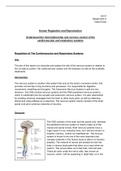
The CNS consists of the brain and the spinal cord, whereas
the peripheral nervous system is mainly made up of the
cranial and spinal nerves. Both nervous systems have a
huge impact on our everyday lives, as it serves humans to
breathe, memory, control our heartbeat etc. The nervous
system is known to be one of the most important and
complex networks in the human body to allow it to function
properly. The network of nerves are present all over the
body in various body parts that allow us to react when we
need to. The nerves allow us to feel heat, cold and pain.
These all come under the nerve cells, also known as
neurons, which I will be explaining in detail later on in the
, report. As mentioned before, the nervous system is complex and one of the most important
parts of it are the nerve cells and the nerve impulses, as they send chemical messages that
are transported around the body. If this communication is lost or is faulty, there can be some
serious impacts on a person's well being and their ability to perform everyday tasks.
(1.)
[flowchart of the nervous system - CNS and PNS]
Assignment A
Diana Duka
Human Regulation and Reproduction
Understand the interrelationship and nervous control of the
cardiovascular and respiratory systems
Regulation of The Cardiovascular and Respiratory Systems
Aim
The aim of this report is to describe and explain the role of the nervous system in relation to
the circulatory system, the cardiovascular system and the diseases as well as the available
treatments.
Introduction
The nervous system is another vital system that acts as the body’s command centre, that
provides normal day to day functions and processes. It is responsible for digestion,
movements, breathing and thoughts. The Autonomic Nervous System is split into two
divisions - the CNS (central nervous system) and the PNS (peripheral nervous system),
which is subdivided into the somatic and autonomic nervous system. It is also responsible
for sending chemical messages from the brain to other body parts, as well as detecting
stimuli and using reflexes as a response. The nervous system mainly consists of the brain,
spinal cord and numerous networks of neurons.
Structure
The CNS consists of the brain and the spinal cord, whereas
the peripheral nervous system is mainly made up of the
cranial and spinal nerves. Both nervous systems have a
huge impact on our everyday lives, as it serves humans to
breathe, memory, control our heartbeat etc. The nervous
system is known to be one of the most important and
complex networks in the human body to allow it to function
properly. The network of nerves are present all over the
body in various body parts that allow us to react when we
need to. The nerves allow us to feel heat, cold and pain.
These all come under the nerve cells, also known as
neurons, which I will be explaining in detail later on in the
, report. As mentioned before, the nervous system is complex and one of the most important
parts of it are the nerve cells and the nerve impulses, as they send chemical messages that
are transported around the body. If this communication is lost or is faulty, there can be some
serious impacts on a person's well being and their ability to perform everyday tasks.
(1.)
[flowchart of the nervous system - CNS and PNS]


