
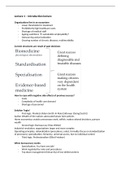
Lecture 1 – Introduction lecture
Organizations live in an ecosystem
- Lower thresholds for treatment
- Prohibitively high healthcare costs
- Shortage of medical staff
- Ageing workforce sustainable employability?
- Outsourcing and privatization
- Growing number of chronic diseases, multimorbidity
Current structures are result of past decisions
How to cope with negative side effects of previous success?
- Costs
- Complexity of health care demand
- Shortage of personnel
Solution ‘logics’
- First logic: Markets (Adam Smith Alain Enthoven (Going Dutch))
Author Wealth of the nations advocated laissez faire policies
Homo economicus avoids unnecessary work, selfish, makes rational decisions, pursues
wealth
- Second logic: Bureaucracy (Max Weber)
Industrial revolution: organizations larger and more complex
Operating principles: rationalization (procedures, rules), formality (focus on standardization
of processes), specialization, hierarchy, universal access, but no individual control
- Third logic: Professionalism (Elliot Freidson)
When bureaucracy works:
- Specialization: You have one job!
- Work regulated by rules and procedures
- Top down management (hierarchy) of low-skilled workers
,Hierarchy: slow, stifles innovation, difficult to provide clear management directives misfit
culture of autonomous professionals
Universal access, but no individual control: Supply driven vs. demand driven health care
Cure
Focus on cure/recovery of the disease
ZVW (zorgverzekeringswet)
- Basic coverage (mandatory insurance)
- Additional care (optional
Care
Long-term care
WMO: Wet maatschappelijke ondersteuning
2015: decentralization of long-term care to municipalities
WLZ: wet langdurige zorg
Regulated market competition since 2006
Linear logic of health care markets
Consumer choice (insurance) competition (between insurance companies to compete for
enrollees) negotiation for good quality at good price (between insurers and health care
providers)
<10% switches insurances, mainly switch for lower premiums
Trends in healthcare provision market
Provider competition? Hospital mergers
,Organisation; people working collectively for a common purpose; an organized group of
people with a particular purpose
Market failure in healthcare
- Healthcare is not a business
- Insufficient competition to offer high quality care at best price
- No direct interaction between supply and demand but mediated by third party
- How to judge quality of care
- Emphasis on costs (low premiums)
- Increased accountability bureaucracy revisited
Donald Light – healthcare professions, markets and countervailing powers
Annemarie Mol – logic of care – health and the problem of patient choice
Can it be organized more efficiently?
Reducing waste (e.g., no lab orders on the day of discharge)
Can the logistics be improved?
Scheduling surgery on the same day of consultation -> reduce follow-ups LEAN training for
medical specialists
Can care be organized closer to home?
Tele-consults (collaboration primary and secondary care) (‘zorgsubstitutie’)
Reducing unnecessary specialized care (‘juiste zorg op de juiste plaats’)
Can care quality be improved?
Measuring outcomes that matter to patients (e.g., quality of life one year after resuscitation)
Doctors as resource stewards?
Fulfilling a role as patient’s advocate
Distributing scarce resources efficiently and fairly across members of the population (and
ensuring access for future generations)
How to reap benefits of different structures (and other upcoming concepts from this course)
without the potential pitfalls?
Organizational structure organizational design choices
, Design – key trade-offs
Differentiation vs integration - how are tasks divided and coordinated
Control vs autonomy – who decides how the work is executed


