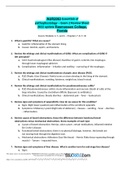
NUR2063 Essentials of pathophysiology
NUR2063 Essentials of pathophysiology – Exam 2 Review Sheet 2022 update Rasmussen College, Florida Covers Modules 4, 5, and 6 – Chapters 7, 8, 9, 10 1. What is gastritis? What are causes? a. Gastritis: Inflammation of the stomach lining. b. Causes: Alcohol, aspirin, and bacteria. 2. Review the etiology and clinical manifestations of GERD. What are complications of GERD if left untreated? a. Gerd (Gastroesophageal reflux disease): Backflow of gastric contents into esophagus through lower esophageal sphincter. b. Complications: Inflammation – irritation and swelling – narrowing of the esophagus 3. Review the etiology and clinical manifestations of peptic ulcer disease (PUD). a. PUD (Peptic Ulcer Disease): Painful sores or ulcers develop in the lining of the stomach. b. Clinical manifestations: vomiting, faintness, weight loss, blood in stool. 4. Review the etiology and clinical manifestations for pseudomembranous colitis? a. PUD (Pseudomembranous colitis): Acute inflammation and necrosis (Death of cells) of the large intestine. Caused by clostridium difficile (Exposure to antibiotics). b. Clinical manifestations: bloody diarrhea – abdominal pain – fever – leukocytosis 5. Review signs and symptoms of appendicitis. How do we assess for this condition? a. Signs: Right lower quadrant pain Inflammation of the vermiform appendix b. Symptoms: McBurney’s point (Right side of abdomen) – Nausea – vomiting – fever – diarrhea – inflammation. 6. Review causes of bowel obstructions. Know the difference between functional bowel obstructions versus mechanical obstructions. Know examples of each type a. Causes of bowel obstruction: Hernias, colon cancer, certain medications, inflamed intestine EX: Crohn’s disease. b. Functional bowel obstructions: there is no physical blockage, however, the bowels are not moving food through the digestive tract c. Mechanical obstructions: Adhesions (Scar like tissue) – Hernia (Fatty tissue squeezing through muscle) – Tumors – impacted feces. 7. Review signs and symptoms of liver disease. What is another term for end-stage liver disease? a. Signs: i. Hepatocellular failure (Decreased clotting factors) ii. Portal hypertension (Increase in pressure within the portal vein EX: GI congestion carries blood from the digestive organs to the liver) iii. Jaundice (yellowing of skin and breakdown of red blood cells) iv. Ascites: Pathologic accumulation of fluid in the peritoneal cavity 1. Diagnosis: Fluid examination from abdominal paracentesis v. Hepatic Encephalopathy: Pathogenesis: Complex neuropsychiatric syndrome from too much ammonia. 1. Symptoms: a. Dementia b. Psychotic symptoms c. Mild confusion vi. Cirrhosis: Irreversible end stage of many different hepatic injuries. 1. EX: Severe acute hepatitis – 9Chronic hepatitis, toxic hepatitis a. Alcoholism 8. Review the etiology and clinical manifestations of gallstones. a. Gallstones: Hardened deposits of digestive fluid. b. Clinical manifestations: Pain in abdomen – Indigestion – nausea – vomiting – cramping 9. Review the etiology and clinical manifestations of pancreatitis. a. Pancreatitis: Inflammation of the pancreas i. Autodigestion of the pancreas from enzyme activation b. Clinical manifestations: pain in epigastrium i. Increases in intensity. ii. Severe palpation iii. Nausea 10. What are the function of the kidneys? How do we assess for renal disorders? a. Function of kidneys: Act as efficient filters to get rid of waste and toxic substances and returning vitamins into the bloodstream. b. Assessment: Urine and blood tests EX: Abnormal urine albumin (Globular protein) levels 11. Review the etiology of polycystic kidney disease. a. Polycystic kidney disease: Clusters of cysts (non-cancerous sacs containing water like fluid) develop in the kidneys. 12. Review the following terms: nephrons, hematuria, proteinuria, nephrolithiasis, pyelonephritis, cystitis a. Nephrons: responsible for filtering specific substances from the blood, b. Hematuria: Blood in the urine c. Proteinuria: Loss of large amounts of protein in the urine. d. Nephrolithiasis: The process of forming a kidney stone in the kidney. e. Pyelonephritis: Urinary tract Infection (UTI) that generally begins in your urethra and travels to one or both of your kidneys. f. Cystitis: Inflammation of the bladder lining. 13. Review the etiology and clinical manifestations of postinfectious acute glomerulonephritis. a. Etiology: Skin and throat infections caused by B hemolytic streptococcus b. Clinical Manifestations: Smoky colored urine, proteinuria, edema, decreased urine output. 14. Review signs and symptoms of acute kidney injury (AKI). Review causes of AKI including prerenal, intrinsic/intrarenal, and postrenal. Know examples of each causes to each type of injury. a. AKI Signs: Disruptions in fluid electrolyte and acid base balances b. AKI Symptoms: Decreased urine output. c. Prerenal: disruption to renal perfusion i. Hypotension, heart failure, fever, drugs. d. Postrenal: Disruption to urine flow distal from the kidney. i. Obstruction within the urinary EX: 1. Stones, tumor or enlarged prostate. e. Intrinsic/Intrarenal: Damage within the kidney blood vessels and tubules. i. Damage to renal tubules resulting in acute tubular necrosis. EX: 1. Renal inflammation, toxic injury, reduced blood supply within the kidneys. 15. Review the stages of AKI presentation. What happens if AKI does not resolve? a. Prodromal phase: Normal or declining urine output b. Oliguric phase: May last up to 8 weeks with usual urine output. 50 to 400 ml/day c. Post oliguric phase: Urine volume increases. Risk for dehydration. d. Does not resolve: Chronic kidney disease 16. Review the causes of chronic kidney disease and the various complications of chronic kidney disease a. Causes: Outcome of progressive loss of functional nephrons within kidney. b. Hypertension and cardiovascular disease: Hypervolemia c. Uremic syndrome: Retention of metabolic wastes, impaired healing. d. Metabolic acidosis: Retention of acidic waste products, hyperkalemia. 17. Review the different types of incontinence including urge, stress, overflow incontinence, and reflex incontinence a. Urge Incontinence: Sudden need to void with an involuntary leakage of urine b. Stress incontinence: Small amounts of urine voided involuntarily. Can occur sneezing, laughing. c. Reflex Incontinence: Disruption of nervous communication. Person will have difficulty starting urination. d. Overflow incontinence: When the bladder becomes full and overflows. Ex: Enlarged prostate. 18. What is cystitis? What is some important patient teaching to prevent cystitis? What can happen if cystitis does not resolve? a. Cystitis: Inflammation of the bladder lining.
Document information
- Uploaded on
- December 11, 2022
- Number of pages
- 8
- Written in
- 2022/2023
- Type
- Exam (elaborations)
- Contains
- Questions & answers