FINA 4358-CHAPTER 1 QUIZ
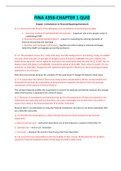
FINA 4358-CHAPTER 1 QUIZ Chapter 1 Introduction to Financial Reporting Homework Q 1-1. Discuss the role of each of the following in the formulation of accounting principles: a. American Institute of Certified Public Accountants – important role in the private sector in establishing GAAP b. Financial Accounting Standards Board – a basis for evaluating the existing standards of financial accounting and reporting c. Securities and Exchange Commission – regulate securities trading in national exchanges, determine GAAP and regulate accounting profession. Q 1-3. The president of your firm, Lesky and Lesky, has little background in accounting. Today, he walked into your office and said, “A year ago we bought a piece of land for $100,000. This year, inflation has driven prices up by 6%, and an appraiser just told us we could easily resell the land for $115,000. Yet our balance sheet still shows it at $100,000. It should be valued at $115,000. That’s what it’s worth. Or, at a minimum, at $106,000.” Respond to this statement with specific reference to the accounting principles applicable in this situation. Historical cost concept because the valuation of the asset doesn’t change the balance sheet value. Q 1-5 A corporation like General Electric has many owners (stockholders). Which concept enables the accountant to account for transactions of General Electric separate and distinct from the personal transactions of the owners of General Electric? The concept separate enables the accountant to account for separate and distinct because this concept states that business is separate from entity of owner. Q 1-7 Because of assumptions and estimates that go into the preparation of financial statements, the statements are inaccurate and are, therefore, not a very meaningful tool to determine the profits or losses of an entity or the financial position of an entity. Comment. Because there’s no alternative to using the financial statements, we have to use those statements that are a little bit inaccurate Q 1-9 Describe the following terms, which indicate the period of time included in the financial statements: a. Natural business year – ends when operations are at low frequency, usually on December 31 b. Calendar year – end on 31st December c. Fiscal year – closing at the end of a month any other than December Q 1-11 Countries have had problems with the stability of their money. Briefly describe the problem caused for financial statements when money does not hold a stable value.When money doesn’t hold a constant value, the financial statements cant be compared because the measure of money isn’t the same. Q 1-13 An arbitrary write-off of inventory can be justified under the conservatism concept. Is this statement true or false? Discuss. I think its false because an arbitrary write off cannot be used when there isn’t a good reasonable excuse. The conservatism concept isn’t enough to justify. Q 1-15 There are other acceptable methods of recognizing revenue when the point of sale is not acceptable. List and discuss the other methods reviewed in this chapter, and indicate when they can be used. Cost recovery – for high speculative transactions and can be used when revenue is considered as a return of investment Receipt of cash – used when collection of cash receipts does not give reasonable estimation at the time of sale End of production and during production – EOP is used when revenue is received when project is completed vs DP is used when revenue is recognized during the project Q 1-17 The consistency concept requires the entity to give the same treatment to comparable transactions from period to period. Under what circumstances can an entity change its accounting methods, provided it makes full disclosure? If there’s a justification to changing its accounting methods, the change can be made even though it is recommended that same accounting principles are followed. Q 1-19 No estimate or subjectivity is allowed in the preparation of financial statements. Discuss. Yes it is true. Preparing financial statements should always be subjective. Q 1-21 The same generally accepted accounting principles apply to all companies. Comment. It applies to most companies, but for some companies that are difficult to measure the cost/revenue because of certain projects, they use other accounting procedures. Q 1-23 Some industry practices lead to accounting reports that do not conform to the general theory that underlies accounting. Comment. Yes some businesses that cannot determine certain aspects of the general theory accounting, they have to use a different accounting principle Q 1-25 Why did the FASB commence the Accounting Standards CodificationTM project? FASB commence the accounting standards codificationTM project to establish the standards of accounting to the public. Q 1-27 At which point is revenue from sales on account (credit sales) commonly recognized? It is recognized at the point of sale.Q 1-29 Dexter Company charges to expense all equipment that costs $25 or less. What concept supports this policy? Materiality concept support this policy Q 1-31 What is the basic problem with the monetary assumption when there has been significant inflation? When there’s a high inflation, the financial statements show a very inaccurate value of money loss so it will be difficult to compare with the other financial statements because money doesn’t have the same value Q 1-33 Briefly explain the term generally accepted accounting principles. It is a set of accounting standards and principles that is used by most companies. When companies are preparing financial statements they use this as a reference Q 1-35 What is the FASB Conceptual Framework for Accounting and Reporting intended to provide? It is intended to provide a set of procedures that would serve as a prescribed standard and facilitate the evaluation of financial accounting Q 1-37 The objectives of general-purpose external financial reporting are primarily to serve the needs of management. Comment. It serve more than the needs of management; it provides accurate information so that financial statements can be compared and provide a comprehendible information for the company Q 1-39 According to SFAC No. 2, relevance and reliability are the two primary qualities that make accounting information useful for decision making. Comment on what is meant by relevance and reliability. Relevant decisions in preparing the financial statements means that the numbers must have a predictive and feedback value in a timely manner while a reliability means the information must be accurate Q 1-41 There are five different measurement attributes currently used in practice. List these measurement attributes. Historical cost Current cost Current market value Net realization value Present values of future cash flows
Document information
- Uploaded on
- December 4, 2022
- Number of pages
- 6
- Written in
- 2022/2023
- Type
- Exam (elaborations)
- Contains
- Questions & answers