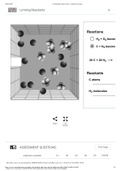
Limiting Reactants Gizmo _ Explore Learning
1. The limiting reactant in a chemical reaction is the reactant that A. is used up at the end of the reaction. B. is left over after the reaction. C. has the largest number of atoms. D. has the fewest number of atoms. Correct Answer: A. is used up at the end of the reaction. Explanation: The limiting reactant will be the reactant that is "fully consumed" upon completion of the reaction. The reactant that has the fewest number of molecules isn't necessarily the limiting reactant. For example, if 2 carbon atoms (2C) are combined with 2 hydrogen molecules (2H ), there are twice as many atoms of hydrogen as carbon, but hydrogen is the limiting reactant, as 8 atoms of hydrogen are needed to form 2 molecules of CH . You answered this question correctly! 2 4 2. How many water molecules (H O) can be produced from 6 molecules of hydrogen gas (white) reacting with 6 molecules of oxygen gas (red)? Which reactant is the limiting reactant? 3. 34 atoms of carbon (C) react with 22 molecules of hydrogen gas (H ). How many molecules of methane (CH ) will be formed, and what will be left over? 4. When aluminum (Al) reacts with chlorine gas (Cl ), aluminum chloride (AlCl ) is produced according to the balanced equation below:
Document information
- Uploaded on
- November 18, 2022
- Number of pages
- 5
- Written in
- 2022/2023
- Type
- Exam (elaborations)
- Contains
- Questions & answers