NSG 125 Practice
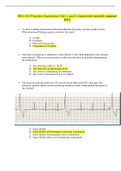
NSG 125 Practice Questions Unit 1 and 2 Answered correctly summer 2022. 1. A client is taking triamterene-hydrochlorothiazide (Dyazide) and furosemide (Lasix). What assessment finding requires action by the nurse? A. Cough B. Headache C. Pulse of 62 beats/min D. Potassium of 2.9 mEq/L 2. The nurse is preparing to administer a beta-blocker to the client diagnosed with coronary artery disease. Which assessment data would cause the nurse to question administering the medication? A. The client has a BP of 110/70. B. The client has an apical pulse of 56. C. The client is complaining of a headache. D. The client’s potassium level is 4.5 mEq/L 3. The nurse is receiving report on a 45 year old client status post MI 2 days ago. The telemetry monitor alarms and the following rhythm is noted. What should document as this rhythm? A. Sinus rhythm B. Sinus rhythm with premature ventricular contractions C. Sinus rhythm with premature atrial contractions D. Sinus rhythm with a run of ventricular tachycardia 4. A client presents to the emergency department with hypoventilation and has a respiratory rate of 10 breaths/minute. The ECG monitor displays tachycardia, with a heart rate of 120 beats/minute. Arterial blood gases are drawn and the nurse reviews the results, expecting to note which finding? A. An increased pH and a decreased CO2 B. A decreased pH and an increased CO2 C. A decreased pH and a decreased HCO3 D. An increased pH with an increased HCO3 5. What is the priority goal for a client admitted with left sided heart failure? a. Client’s lung sounds will be clear, weight will return to baseline, and will be able sleep on one pillow by time of discharge. b. Client’s RR will be 12-20/min, HR between 60-100, SBP 100-140 when walking by time of discharge. c. Client will have no pitting edema, jugular vein distention, or abdominal ascites by time of discharge. d. Client will not have chest pain, ST segment changes, or cold clammy skin during hospitalization. 6. A client is diagnosed with heart failure is prescribed carvedilol (Coreg). The nurse should consult with the health care provider before giving this medication upon finding a history of: A. Asthma. B. Peptic ulcer disease. C. Alcohol dependency. D. Myocardial infarction (MI). 7. A client comes into the ER complaining of chest heaviness, dyspnea, and left arm pain. The patient is triaged at the bedside. He is placed on the bedside monitor. A 12-lead EKG is obtained and an IV has been started. What is your next immediate intervention(s) that you should anticipate? A. Schedule an emergency cardiac catheterization to evaluate coronary artery blockages B. Prepare the client for immediate electroshock therapy. C. Order a stat chest x-ray and start an albuterol neb treatment. D. Apply oxygen and administer SL nitroglycerin, morphine, and an aspirin 8. A client has severe dyspnea. Which of the following assessment findings indicates to the nurse that the respiratory problem is a chronic issue indicative of COPD? A. Wheezing on expiration. B. Productive cough. C. Clubbed fingers. D. Diaphoresis. 9. A 62 year-old client with COPD has been admitted to the medical floor for left lower lobe pneumonia. He is having difficulty clearing secretions from his lungs. What is the best nursing intervention to support this client with clearing secretions? A. Monitor pulse oximetry every 4 hours. B. Encourage increased fluid intake as tolerated. C. Assess level of patient anxiety. D. Give him cough suppressants as ordered by his doctor. 10. The nurse is assessing a client with chronic anemia. Which clinical manifestation does the nurse expect to see in this client? A. Dyspnea with activity B. Hypertension C. Bradycardia D. Warm, flushed skin 11. The nurse reviews the blood gas results of a client with atelectasis. The nurse analyzes the results and determines that the client is experiencing respiratory acidosis. Which results validates the nurse’s findings? A. pH 7.25, PCO2 50 mm Hg B. pH 7.35, PCO2 40 mm Hg C. pH 7.50, PCO2 52 mm Hg D. pH 7.52, PCO2 28 mm Hg . 12. The nurse is planning care for a client who has a platelet count of 30,000/mm3. Which intervention does the nurse include in this client’s plan of care? A. Oxygen by nasal cannula B. Bleeding Precautions C. Isolation Precautions D. Vital signs every 4 hours 13. When providing health teaching for the client with COPD, the nurse educates the client on the side effects that may occur with the use of bronchodilators. What possible clinical manifestations should the client be aware of? (Select all that apply) A. Bradycardia B. Nervousness C. Tremors D. Drowsiness E. Palpitations 14. A client in the ER presents with HR: 127, BP: 197/104, RR: 22, T: 102.0, and SpO2: 86%. Physical assessment shows cough with pink frothy sputum, distended jugular veins, and crackles in all lung fields. The nurse can reasonably expect which pharmacological interventions: A. Metoprolol IV, oxygen, nitroglycerin gtt, furosemide IV B. Oral antibiotics, an IV fluid bolus of normal saline, acetaminophen, albuterol inhaler C. Oxygen, nitroglycerin SL x3, morphine IV, acetaminophen D. Lidocaine IV, acetaminophen, albuterol inhaler, heparin gtt 15. A 67-year-old client with has a history of smoking 1 pack of cigarettes a day for 40 years. He has just returned to the floor follow a partial right lobectomy. In an effort to prevent atelectasis, the nurse should encourage the client to: A. Cough and deep breathe every 2 hours. B. Lie on 2 pillows. C. Splint the incision when coughing. D. Continually remain in a semi-fowler’s position 16. What is the priority problem in the client diagnosed with congestive heart failure? a. Fluid volume overload. b. Decreased cardiac output. c. Activity intolerance d. Knowledge deficit. 17. Which laboratory data confirm the diagnosis of congestive heart failure? a. Chest x-ray (CXR). b. Liver function tests c. Blood urea nitrogen (BUN).
Document information
- Uploaded on
- November 13, 2022
- Number of pages
- 17
- Written in
- 2022/2023
- Type
- Exam (elaborations)
- Contains
- Questions & answers