

ATI Fundamentals Proctored Exam Q & As with Rationales
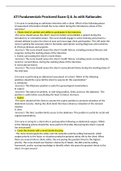
ATI Fundamentals Proctored Exam Q & As with Rationales 1) A nurse is conducting an admission interview with a client. Which of the following pieces of assessment information should the nurse collect during the introductory phase of the interview? A. Clients level of comfort and ability to participate in the interview -The nurse should assess the client’s level of comfort and establish a rapport during the introductory or orientation phase. The nurse should engage in active listening and present a relaxed attitude to place the client at ease and encourage client participation. This will assist the nurse in gaining the necessary data to formulate appropriate nursing diagnoses and outcomes. B. Previous illnesses and surgeries -incorrect: The nurse should assess the client’s health history, including previous illnesses and surgeries, during the working phase of the interview. C. Events surrounding the client’s recent illness -incorrect: The nurse should assess the client’s health history, including events surrounding the recent or current illness, during the working phase of the interview. D. Sociocultural history -incorrect: The nurse should assess the client’s sociocultural history during the working phase of the interview. 2) A nurse is performing an abdominal assessment of a client. Which of the following positions should the nurse tell the client to assume for this examination? A. Lithotomy -incorrect: The lithotomy position is useful for gynecological examinations. B. Lateral -incorrect: The lateral recumbent, or side-lying position, limits access to the abdomen. This position is useful when auscultating the heart to detect murmurs. C. Supine -The nurse should tell the client to assume the supine position to promote relaxation of the abdominal muscles. Having the client bend the knees enhances relaxation of the stomach muscles. D. Sims -incorrect: The Sims’ position limits access to the abdomen. This position is useful for rectal and vaginal examinations. 3) A nurse is caring for a client who is postoperative following an abdominal surgery. Which of the following actions should the nurse perform first after discovering the client’s wound has eviscerated?
Document information
- Uploaded on
- November 12, 2022
- Number of pages
- 152
- Written in
- 2022/2023
- Type
- Exam (elaborations)
- Contains
- Questions & answers


