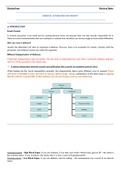
Criminal Law Revision Notes
DEFENCES: AUTOMATISM AND INSANITY
_______________________________________________________________________________________________
a) INTRODUCTION
Social Context
A criminal accusation is not made just for causing physical harm, but because they are also morally responsible for it.
There are moral communications that are underpins a criminal trial, therefore you always ought to have acted differently.
Who can raise a defence?
Usually, the defendant will raise an argument in defence. However, there is an exception for insanity whereby both the
prosecutor and defense counsel can make the argument.
Different Categorisation of Defences
! Note that categorisation does not matter. We just need to understand how and when a particular defence operates
and if it will be successful in the instant case.
→ A classic categoristion between excuses and justification (this is purely an academic point of view).
When looking into the ‘moral responsibility principle’, the categorisation below gives different ways to respond. Those
who have committed a crime, but have an excuse, admit wrong - doing. Justifications on the other hand, is arguing
that the said act is permissible at that instance; you are not trying to excuse your behaviour.
_______________________________________________________________________________________________
Hyperglycaemia - High Blood Sugar; If you are diabetic, if you take your insulin without food, get low BP - the insulin is
the external factor. If you overdose with insulin, then it is also a case of hyperglycaemia.
Hypoglycaemia - Low Blood Sugar; If you are diabetic, and do nothing - the consequences are a result of an internal
factor.
,Criminal Law Revision Notes
_______________________________________________________________________________________________
b) EXAM QUESTION
1. Rav suffers from diabetes. He takes insulin three times per day. On the rare occasion he has not taken it, it has
resulted in hyperglycaemia which has caused him to blackout. One morning he is attacked and robbed in the
street outside his home. So, upset is he that he forgets to take his insulin for a whole day. During the evening,
while driving, he drives through a red traffic light, nearly causing an accident. He is stopped by Amir, a police
officer who requires him to submit to a breathalyser test. Rav, who is not thinking clearly, punches Amir. He gets
back in his car and drives off at speed, not noticing Jimmi, who is crossing the road. Jimmi is killed in the resulting
crash.
→ Is the individual liable for the offence? Yes. He drives through a red - light traffic offence; this is a strict liability
offence hence you do not need to know the actus reus and mens rea. He then punches a police officer, speeds off
and kills a pedestrian.
→ Can the individual rely on a defence?
2. A nurse puts a baby in the fireplace. The baby dies. The nurse is charged with murder, but denies mens rea. Will
the jury convict?
_______________________________________________________________________________________________
Hyperglycaemia - High Blood Sugar; If you are diabetic, if you take your insulin without food, get low BP - the insulin is
the external factor. If you overdose with insulin, then it is also a case of hyperglycaemia.
Hypoglycaemia - Low Blood Sugar; If you are diabetic, and do nothing - the consequences are a result of an internal
factor.
, Criminal Law Revision Notes
______________________________________________________________________________________________
c) AUTOMATISM
→ If this defence is proven successfully, then there is an outright acquittal.
→ D has to invoke this defence and prosecution has the burden of proof.
→ Effect of this defence: negates both mens rea and actus reus.
→ Definition: The following is a quote by Lord Denning in Bratty (1961):
“No act is punishable if it is done involuntarily and an involuntary act in this context—some people prefer to speak of it
as automatism— means an act which is done by the muscles without any control by the mind such as a spasm, a
reflex or a convulsion; or an act done by a person who is not conscious of what he is doing, such as an act done
whilst suffering from a concussion…”
There are two elements/possible versions of automatism in the definition
→ This form of defence can include:
Physical Causes (the way reflexes affect our bodily movement)
Hill v Baxter (1957): The defendant was attacked by swarm of bees in his car. His reaction to the bees (a reflex)
caused the accident.
Mental Causes
Quick and Paddison (1973): In this case, the defendant was a psychiatric nurse working in a mental hospital was a
diabetic. The defendant took insulin without eating, which caused his blood level to drop, becoming hypoglycaemic.
Hypoglycaemia can impair consciousness and lead to aggressive outbursts. The defendant ended up attacking a patient.
He was convicted of assault occasioning actual bodily harm. He relied on automatism for defence. At first instance, the
trial judge ruled that this amounted to a plea of insanity. The defendant, anxious to avoid a special verdict, thereupon
changed his plea to guilty. He then appealed the judge’s ruling. On appeal, the CA quashed the conviction saying that
the defence should be put to the jury.
→ This defence is applicable to offences which require mens rea (i.e. murder) and strict liability offences (i.e. driving
offences).
An example: A sudden defect in the car, say sudden brake failure, can amount to automatism.
Spurge (1961): Per Salmon J, ‘There does not seem to this court to be any real distinction between a man being
suddenly deprived of all control of a motor car by sudden affliction of his person and being so deprived by some defect
which suddenly manifests itself in the motor car. In both cases the motor car is suddenly out of control of its driver through
no fault of his.’
→ Automatism: Requirements
Hyperglycaemia - High Blood Sugar; If you are diabetic, if you take your insulin without food, get low BP - the insulin is
the external factor. If you overdose with insulin, then it is also a case of hyperglycaemia.
Hypoglycaemia - Low Blood Sugar; If you are diabetic, and do nothing - the consequences are a result of an internal
factor.