GED Study Guide SOCIAL STUDIES
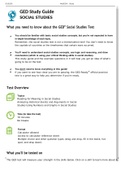
GED Study Guide SOCIAL STUDIES What you need to know about the GED® Social Studies Test You should be familiar with basic social studies concepts, but you're not expected to have in-depth knowledge of each topic. Remember, the social studies test is not a memorization test! You don’t need to know the capitals of countries or the timeframes that certain wars occurred. You’ll need to understand social studies concepts, use logic and reasoning, and draw conclusions (which is using your critical thinking skills in social studies). This study guide and the example questions in it will help you get an idea of what’s going to be on the test. You don’t need to know everything in this guide! If you want to see how close you are to passing, the GED Ready® official practice test is a great way to help you determine if you’re ready. Test Overview Topics Reading for Meaning in Social Studies Analyzing Historical Events and Arguments in Social Studies Using Numbers and Graphs in Social Studies Time (to take the test) 70 minutes No breaks Format Calculator allowed Access to calculator reference sheet Multiple choice and other question types (drag and drop, fill in the blank, hot spot, and drop down) What you'll be tested on h 4 The GED test will measure your strength in the skills below. Click on a skill to learn more about it. h 1 Main ideas and details in social studies readings You'll be presented with social studies passages and be asked to: Determine the main ideas Use details to make inferences or claims Social studies passages often make particular claims about a topic and then provide details that the author uses to support the assertions made. Social studies readings may be from a primary source (created by someone with firsthand knowledge of an event) or a secondary source (created by someone at a later time who did not have firsthand knowledge of the event). Sometimes these documents are complex or written in an "old-fashioned" style, and it takes skill to read and understand what the main point or points of the reading are - which might not be obvious to you on the first read. For example, a reading about American History might argue that the cause of the American Revolution was the unfair taxation of the American colonies. The reading might then provide details or examples of unfair taxation that support the author's position. Or, you might read an excerpt of a letter written by a soldier during the U.S. Civil War. This primary source document explains the perspective of that individual and what he was doing or experiencing at the time. As a reader, your task might be to explain or summarize the main points or theme of what the soldier was trying to communicate. Example Questions Main ideas and details in social studies readings This excerpt is from the "Declaration of Sentiments" presented to the Seneca Falls Convention by Elizabeth Cady Stanton in 1848. h 4 Question: What concept is a main idea of this excerpt? A nationalism B natural rights C imperialism D majority rule h 4 2 Social studies vocabulary You'll be presented with social studies passages which include common social studies terms and phrases. For example, the term "capitalism" describes the main economic system that is in place in the U.S. You may need to be able to understand what that term means in order to distinguish it from other economic systems, such as "socialism" or "communism." Example Questions Social studies vocabulary The chart below describes the four methods used to amend the U.S. Constitution. Four Methods of Amending the U.S. Constitution Step 1 Step 2 1. A two-thirds vote in both houses of the U.S. Congress Ratified by three-fourths of the state legislatures 2. A two-thirds vote in both houses of the U.S. Congress Ratified by ratification conventions in three-fourths of the states 3. A national constitutional convention called by two-thirds of the state legislatures Ratified by three-fourths of the state legislatures 4. A national constitutional convention called by two-thirds of the state legislatures Ratified by ratification conventions in three-fourths of the states The 17th Amendment The 1787, delegates to the Constitutional Convention decided to give state legislatures the power to select U.S. senators. The purpose was to ensure that the interests of the states were represented in that national legislature. However, some argued that the people should directly elect their senators. They thought the interests of the states would be preserved because the people were the source of all government power. h 4 The first of nearly 300 congressional resolutions calling for direct election of senators came in 1826. Over the next 85 years, an amendment to directly elect U.S. senators was debated extensively. Finally, in 1913, the 17th Amendment, which allowed for the direct election of senators, was ratified. Question: What does the word convention mean in both the chart and The 17th Amendment passage? A cultural tradition B formal assembly C agreed-upon contract D preferred writing style h 4 3 How authors use language in social studies You'll be asked to identify how authors use language, (for example, imagery or facts) to establish their points of view or purpose. Social studies authors use language to support their arguments in a variety of different ways. One author might use facts to create an argument, while another might use metaphors to create more of an emotional argument. For example, an author writing about competition in the communications industry might cite facts about company revenues, profits, or market share. Another writer discussing the effects of competition on cell phone prices might provide examples of how consumers felt about their treatment by cell phone service providers. These authors have different purposes and use different kinds of language to support their purposes. As a reader, it is important to be able to identify the different characteristics of writing in order to be able to understand and evaluate the meaning of the passage. Example Questions How authors use language in social studies This excerpt is from President Barack Obama's 2017 farewell address. h Question: 4 Based on the excerpt, which phrase identifies an unstated purpose of President Obama's speech? A to encourage support for the incoming administration B to gain support for the newly elected members of Congress C to convince his audience to actively participate in government D to convince his audience to be honest when dealing with the government h 4 4 Fact versus opinion You'll be asked to determine when an author is using factual statements or inferences, as opposed to opinions. For example, an author might begin with the opinion that the 1960s were one of the most difficult and divided times in American history. They may go on to cite evidence or facts that describe the Vietnam War, civil rights protests, and the Cuban Missile Crisis. Example Questions h 4 5 Claims and evidence in social studies You'll be presented with social studies passages and be asked to: Determine whether a claim is or is not supported by evidence Compare information that differs between sources For example, you might be provided with a passage that discusses the historical expansion westward of the United States in the 19th century and that argues that the expansion was beneficial to the Native American people who had occupied the land previously. The reading might provide evidence to support that claim and your task could be to evaluate whether it does. You might also be asked to read information from different sources and analyze whether the differing versions are credible in supporting the claims that are made. Example Questions Claims and evidence in social studies This paragraph is paraphrased from Federalist No. 84, an essay by Alexander Hamilton, published in 1788. Hamilton's Essay This paragraph is paraphrased from a letter written by James Madison to Thomas Jefferson in 1788. Madison's Letter I have always favored a bill of rights, so long as it does not imply that the government has powers it is not meant to have. At the same time, I do not think the absence of a bill of rights is a major defect. The real threat to individual rights is not the government, but a strong-willed majority of the people. Nevertheless, the threat may occasionally come from the government, in which case a bill of rights will be essential. It is a sad truth that freedom is endangered h whether the government has too much or too little power, and finding the thin 4 line between the extremes is not easy. Question: How does Hamilton's essay differ from Madison's letter? A Only Hamilton suggests that governments might abuse power. B Only Hamilton argues that no other constitution contains guarantees of individual liberty. C Only Hamilton says that a bill of rights is acceptable as long as it does not give unintended power to the government. D Only Hamilton says that a bill of rights would damage the safeguards of liberty the proposed constitution h 4 Analyzing Historical Events and Arguments in Social Studies 1 Making inferences Social studies authors often use evidence to guide the reader to draw conclusions. You'll be asked to make inferences or draw conclusions by applying your logic and reasoning skills to the evidence presented in social studies readings. For example, you may be provided with several pieces of evidence about a particular historical event and then infer what the most likely outcome might be in the future. Example Questions Making inferences A recent magazine article examined government in the United States during the first decades after independence from Britain. Question: Which quotation from the article allows a reader to infer that the power of the U.S. government is limited? A "A fear of tyranny led to the creation of a national government under the Articles of Confederation, which lasted less than a decade." B "As a result, the founders drafted the U.S. Constitution, which addressed weaknesses of the Articles of Confederation." C "The U.S. Constitution, ratified over two hundred years ago, greatly changed the relationship between the national and state governments." D "The U.S. Constitution included safeguards to protect individual rights against abuse by the government." h 4 2 Connections between different social studies elements (people, events, places, processes) You'll be asked to: Analyze cause-and-effect relationships Describe the connections between people, places, environments, processes, and events Put events in order and understand the steps in a process (for example, how a bill becomes a law) Analyze the relationship of events, processes, and/or ideas. For example, you might analyze whether earlier events actually caused later ones or simply occurred before them. Taking another example, an author writing about WWI might cite events leading up to the war, including political and social events. In the years prior to WWI, social unrest, fueled by food shortages, led to riots. Deposed Russian leadership left a dangerous power vacuum. At the same time, increasingly aggressive clashes arose between world empires. In these passages, you will be provided with the historical facts. You will be asked to determine the connections between them. Example Questions Connections between different social studies elements (people, events, places, processes) Reconstruction Policies Question: h Which event in the passage happened second? 4 A Civil and political rights were granted to African American men. B Radical Republicans in Congress took control of Reconstruction. C President Lincoln proposed mild conditions for states to rejoin the Union. D Radical Republicans and President Johnson disagreed over Reconstruction policies. h 4 3 The effect of different social studies concepts on an argument or point-of-view All social studies authors have a point of view and purpose for what they write. You'll be asked to: Analyze how events and situations shape the author's point of view Evaluate whether the author's evidence is factual, relevant, and sufficient Make judgments about how different ideas impact the author's argument For example, an author might present their point of view that non-violent approaches are the most effective way to impact government policy. They could present evidence from the movement to resist British rule in India, led by Mohandas Gandhi, alongside evidence from the American civil rights movement in the United States, led by Martin Luther King, Jr. Example Questions h 4 4 Identifying bias and propaganda in social studies readings You'll be asked to identify when a social studies reading uses bias or propaganda. Sometimes authors promote their point of view by appealing to a reader's emotions. They can use loaded language (words that trigger emotions) to lead the reader to the author's point of view. For example, during the Cold War, as tensions rose between the U.S. and the Soviet Union, many Americans worried that communism could destroy American society. This worry was fueled by writings describing communism as an "iceberg that could sink America" or as "purgatory under Communism." Example Questions h 4 1 Using data presented in visual form, including maps, charts, graphs, and tables Data can be represented in many different visual forms, including charts, tables, graphs, maps, photographs, and cartoons. You'll be presented with data in visual form and will be asked to: Make sense of information that is presented in different ways Analyze information from maps, tables, charts, photographs, and political cartoons Represent textual data into visual form (charts, graphs, and tables) Interpret, use, and create graphs with appropriate labeling, and use the data to predict trends For example, a line graph can show the population growth of a city before and through the Industrial Revolution. You may be asked to predict future growth for the city. Example Questions Using data presented in visual form, including maps, charts, graphs, and tables The information in the graph is from the U.S. Senate website. h Question: 4 Which session of Congress had twice as many women representatives as the 101st session? A 104th B 106th C 108th D 110th h 4 2 Dependent and independent variables A variable is simply a person, place, or thing you are trying to measure. Some variables impact other variables. You'll be presented with a graph showing independent and dependent variables, and will be asked to analyze and show how they are related to each other. For example, a graph can show the number of people and the food consumption in a town. The number of people is the independent variable. The number of people that will impact the food consumption is the dependent variable. More people will result in more food consumption. Example Questions Dependent and independent variables This excerpt is from an article published by the U.S. Environmental Protection Agency (EPA). Question: Which graph represents the relationship discussed in the excerpt? A B C D h 4 h 3 Correlation versus causation You'll be asked to recognize the difference between correlation and causation between events. For example, you may be presented with a passage describing the significant growth of a city. The passage could include facts about industrial innovations, including the assembly line and factories. You may also be presented with information about medical advancements. You'll use the data provided to determine the direct relationship (causation) between the industrial innovations and urban population growth. However, there may not be evidence of a direct relationship between the medical advancements and urban population growth (a correlation). Example Questions Correlation versus causation Rebellion in the Thirteen Colonies Question: Which statement represents a cause-and-effect relationship? A Because the colonists refused to pay the new taxes, they prepared for war. h 4 B Because Britain had accumulated war debts, it imposed new taxes on the colonists. C Because they had fought in the French and Indian War, colonists refused to pay taxes. D Because colonists protested taxes, British soldiers fired on them at Lexington and Concord. h 4 4 Using statistics in social studies You'll be asked to find the mean, median, mode, and range of a data set. For example, you may be presented with the population of all of the counties in a state. You may be asked to calculate the mean, median, mode, and range of the poplations of the state's counties. Example Questions Using statistics in social studies The information in the table is from the United Nations. Largest Urban Areas By Population, 2007 Urban Area Estimated Population (millions) 1. Tokyo, Japan 35.6 2. Mexico City, Mexico 19.0 3. New York, United States 19.0 4. Mumbai, India 18.9 5. São Paolo, Brazil 18.8 Question: What is the range in the population of the five urban areas in the table? You may use the calculator. A 9.5 million B 16.8 million C 19.0 million D 22.26 million h 4
Written for
- Institution
- GED - General Educational Development
- Course
- GED - General Educational Development
Document information
- Uploaded on
- November 7, 2022
- Number of pages
- 30
- Written in
- 2022/2023
- Type
- Exam (elaborations)
- Contains
- Questions & answers
Subjects
-
ged study guide social studies
-
ged study guide social studies what you need to know about the ged® social studies test you should be familiar with basic social studies concepts
-
but youre not e

Also available in package deal