
hw3_answer keys_edit_210513 ECE 4360
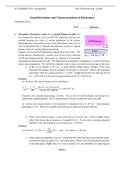
ECE 4360/MSE 5410 – Spring 2020 Prof. Grace Huili Xing - Cornell HW#3-1 NanoFabrication and Characterization of Electronics Homework set #3 Name: _________Solutions____ 1. (20 points) (Parameter values in a Typical Plasma System) We have learned the plasma system in PECVD, sputtering and dry etch without knowing the values of various parameters in the system. Plasma physics is beyond the scope of this fabrication course, but we will use this homework to illustrate the parameter values in a typical plasma system for semiconductor processing. Suppose you have an ICP high-density plasma above the wafer. The plasma process chamber has a circular cross section with a diameter of 300 mm diameter and the “dark space” or “sheath” is 10 mm thick separating the plasma and the wafer. The plasma process chamber is maintained at a constant pressure and at room temperature. We will fill the chamber with Ar only to avoid the chemical part of the etch. a. If the Ar ion density is 1012 cm-3 (a good plasma charge density already), what is the ionization percentage when the chamber Ar pressure is 50 mTorr? What is the ionization percentage when the Argon pressure is 1 mTorr ? (5 pts) Recall that the ideal gas law of pV = nRT, with R as the universal gas constant at 62.36 L×Torr/K×mol. Solution: At 50 mTorr, the volume density of Ar molecules is: . Therefore, the ionization percentage is 0.06%. This is low for an ICP plasma, but typical for a capacitively coupled plasma. The Ar total pressure is used to control the mean free path. At 1 mTorr, the volume density of Ar molecules is calculated to be 3.3´1013cm-3 . The ionization percentage is: 3%. This is an excellent value and can be achieved in an ICP plasma. b. What is the mean free path l of gas molecules at 50 mTorr and 1 mTorr? (5 pts) (Hint: refer to the kinetic theory of gases in Campbell Ch.10. If you want to calculate using the diameter of the gas molecule, you can assume do = 0.4 nm.) Solution: At 50 mTorr = 6.7 Pa, = 1 mm. At 1 mTorr, l = 50 mm. c. If the scattering probability of an Ar+ is less than 0.05 when traveling across the dark space, estimate the mean fre
Document information
- Uploaded on
- October 30, 2022
- Number of pages
- 7
- Written in
- 2022/2023
- Type
- Exam (elaborations)
- Contains
- Questions & answers


