Localisation of function in the brain
The theory that different areas of the brain are responsible for specific behaviours and
processes. Before Broca's and Wernicke's research, scientist took a more holistic view that
all parts of the brain were responsible for the processing of thoughts and actions.
Therefore, if a certain area gets damaged, the function it is responsible for will also be
Affected.
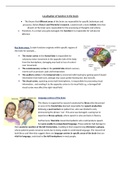
Key brain areas: Certain functions originate within specific regions of
the brain for example....
The motor cortex in the frontal lobe is responsible for
voluntary motor movement in the opposite side of the body
from the hemisphere, damaging may lead to loss of control
over movement.
The somatosensory cortex in the parietal lobe detects sensory
events such as pressure, pain and temperature.
The auditory cortex in the temporal lobe is concerned with hearing by gaining speech based
information from both ears, damage may cause partial hearing loss (but not full).
The visual cortex, spanning across both hemispheres, is responsible for processing visual
information, and sending it to the opposite cortex to its visual field e.g. a damaged left
visual cortex may affect the right visual field.
Language centres of the brain
This theory is supported by research conducted by Broca who discovered
an area in the frontal lobe deemed responsible for speech production
following a post mortem on patient tan, who was limited to only
pronouncing the phrase ' tan'. This area was damaged, causing tan to
experience Brocas aphasia, where speech is slow and lacks in fluency.
Furthermore, Wernicke researched patients who could produce speech
but were unable to comprehend language. These patients had damage to
their posterior position of the left frontal lobe, resulting in them experiencing Wernicke's aphasia,
where patients speak nonsense words due to being unable to understand language. The research of
both Broca and Wernicke suggest there are language centres in specific areas of the brain that are
vital for language, restricted to the left hemisphere in most people.
The theory that different areas of the brain are responsible for specific behaviours and
processes. Before Broca's and Wernicke's research, scientist took a more holistic view that
all parts of the brain were responsible for the processing of thoughts and actions.
Therefore, if a certain area gets damaged, the function it is responsible for will also be
Affected.
Key brain areas: Certain functions originate within specific regions of
the brain for example....
The motor cortex in the frontal lobe is responsible for
voluntary motor movement in the opposite side of the body
from the hemisphere, damaging may lead to loss of control
over movement.
The somatosensory cortex in the parietal lobe detects sensory
events such as pressure, pain and temperature.
The auditory cortex in the temporal lobe is concerned with hearing by gaining speech based
information from both ears, damage may cause partial hearing loss (but not full).
The visual cortex, spanning across both hemispheres, is responsible for processing visual
information, and sending it to the opposite cortex to its visual field e.g. a damaged left
visual cortex may affect the right visual field.
Language centres of the brain
This theory is supported by research conducted by Broca who discovered
an area in the frontal lobe deemed responsible for speech production
following a post mortem on patient tan, who was limited to only
pronouncing the phrase ' tan'. This area was damaged, causing tan to
experience Brocas aphasia, where speech is slow and lacks in fluency.
Furthermore, Wernicke researched patients who could produce speech
but were unable to comprehend language. These patients had damage to
their posterior position of the left frontal lobe, resulting in them experiencing Wernicke's aphasia,
where patients speak nonsense words due to being unable to understand language. The research of
both Broca and Wernicke suggest there are language centres in specific areas of the brain that are
vital for language, restricted to the left hemisphere in most people.