
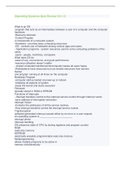
Operating Systems Quiz Review Ch.1-3 questions with complete solutions
What is an OS -program that acts as an intermediary between a user of a computer and the computer hardware -Resource Allocator -Control Program 4 components of a computer system -Hardware - provides basic computing resources -OS - controls use of hardware among various apps and users - Application programs - system resources used to solve computing problems of the users -users - people, machines, computers What does OS do -ease of use, convenience, and good performance -resource utilization doesnt matter - shared computer(mainframe/minicomputer) keeps all users happy -Workstations have resources but use shared resources from servers Kernel one program running at all times on the computer Bootstrap Program -computer startup loaded at power-up or rebook -initializes all aspects of system -loads OS kernel and starts execution Firmware typically stored in ROM or EPROM Functions of Interrupts - Interrupt transfers control to the interrupt service routine through interrupt vector -save address of interrupted instruction Interrupt Vector -Contains the addresses of all the service routines -How interrupt transfers control the interrupt service routine Trap/Exception software-generated interrupt caused either by an error or a user request An operating system is ________________________ interrupt driven Interrupt handling OS preserves state of CPU by storing registers and program counter ROM read-only memory EEPROM electrically erasable programmable read-only memory Multiprogramming allows multiple programs to be active in memory simultaneously Main object of Multiprogramming is ____________ increase CPU and Device utilization Time Sharing each computation gets a turn at the CPU in a timely manner, not only when other computations block Storage Hierarchy -Speed -Cost -Volatility Caching copying information into faster storage system What can be viewed as a Cache for Secondary memory? Main Memory Device Driver device controller to manage I/O Main Memory only large storage media that the CPU can access directly -Random access -Typically volatile Secondary storage extension of main memory that provides large nonvolatile storage capacity Hard Disks -rigid metal or glass platters covered with magnetic recording material Disk Controller determines the logical interaction between the device and the computer Disk surface logically divided into tracks, which are subdivided into sectors Solid-State Disks - faster than hard disks, nonvolatile -becoming more popular Direct Memory Access Structure -Used for high-speed I/O devices able to transmit information at close to memory speeds -Only one interrupt is generated per block, rather than the one interrupt per byte Device Controller transfers blocks of data from buffer storage directly to main memory without CPU intervention Most Systems use a ___________________ processor single general-purpose Advantages of Multiprocesser 1. Increased throughout 2. Economy of Scale 3. Increased reliability 2 types of Multiprocessers 1. Asymmetric Multiprocessing 2. Symmetric Multiprocessing Asymmetric Multiprocessing each processor is assigned a specific task Symmetric Multiprocessing each processor performs all tasks Clustered System -Like multiprocessor systems, but multiple systems working together -Sharing Storage thru Storage-Area Network (SAN) Asymmetric clustering one machine is in hot-standby mode
Document information
- Uploaded on
- October 22, 2022
- Number of pages
- 4
- Written in
- 2022/2023
- Type
- Exam (elaborations)
- Contains
- Questions & answers


