

Part 1: Introduction
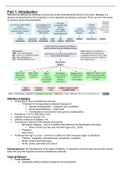
Seizures are defined as individual occurrences of abnormal electrical activity in the brain. Epilepsy is a
disease characterized by the propensity to have repeated spontaneous seizures. There are two main types
of seizures, focal and generalized.
Definition of Epilepsy
Propensity to have spontaneous seizures
o Threshold for having seizures reduced because of
Genetic predisposition – polygenic and mendelian
Environmental factors – brain insult
Combination of environment and genetic predisposition
Prevalence: 0.5-1% (600,000 in UK)
Lifetime chance of seizure: 5%
Lifetime incidence of epilepsy: 3%
Considered a spectrum from genetic to acquired
o Monogenic epilepsy – due to mutations that influence the thresholds of the brain
Many of them but they are rare (McTague et al., 2016)
o Polygenic
o Brain insult
Incidence with age: a curve – common in childhood, then increases again in adulthood
o Children: congenital, developmental, and genetic conditions
o 20-50: alcohol and head injury
o 40-60: stroke, dementia and tumour
Epileptogenesis: the development of the state of epilepsy sequence of events that converts the normal
brain into one that supports recurrent spontaneous seizures
Types of Seizures
1. Focal seizures
a. Originating withing networks limited to one hemisphere
, b. May be discretely localised or more widely distributed
2. Generalised seizures
a. Originating at some point within, and rapidly engaging, bilaterally distributed networks
b. Can include cortical and subcortical structures – not necessarily include the entire cortex
Basis of argument Epilepsy and seizures are not one and the same. While seizures are just
characterised by hyperexcitability of neurons, epilepsy is a chronic disorder characterised by recurring
spontaneous seizures. Therefore, an individual can experience a single seizure while not being diagnosed
with epilepsy. Due to this, there is particular interest in understanding what facilitates the transition from
seizures to epilepsy. In order to understand this, we first need to establish the neurobiological basis of
seizures, why they occur, and how they clinically manifest. From this, we can begin to expand on the effect
of chronic, recurring seizures on the brain and what facilitates the transition from normal brain functioning to
one that supports repeated seizures.
Part 2: Neurobiology of Seizures
Scharfman, 2007
While seizures can be caused by a variety of factors and mechanisms (environmental or genetic), they all
arise via a disruption of mechanisms that maintain a balance of excitation and inhibition of neurons.
Neurons have mechanisms by which they control or facilitate their action potential discharge – an
imbalance of this, whether it be facilitatory or inhibitory, will lead to excess excitation that leads to
seizures
As such, disruption of mechanisms that bring neurons close to firing thresholds or inhibition of
neurons is thought to prevent seizure activity
Electrical basis of nerve cell function
https://www.ncbi.nlm.nih.gov/books/NBK2510/#!po=18.8889
Basic mechanism of neuronal excitability is the action potential caused by membrane depolarization
through shifts in membrane potential
This hyperexcitable state can result from increased neurotransmission, changes in voltage-gated
channels, inhibitory transmission, or a change in the intracellular and extracellular concentrations
Resting membrane potential ensures neurons are not constantly firing but close to threshold so
that they can discharge
o High conc of intracellular K+ and extracellular NA+ -60mV resting potential
When this balance of ions is disrupted, it can lead to depolarization leading to aberrant excitation
and activation of neurons
o Terminals depolarize transmitter release neurons depolarize AP discharge
Seizures can lead to changes in transmembrane gradients elevation in extracellular K+ that will
further depolarize neurons
Argument: Seizures are caused by a synchronization of neurons
Excessive discharge alone does not directly cause a seizure. A seizure is caused by
synchronization of a network of neurons
There are many ways that neurons can synchronize
Circuitry Associated with Spike-Wave Discharge
o EEG manifestations of epilepsy due to highly synchronised firing between cortical and
thalamic neurons rhythmic periods of rapid increased activity and quiescence on EEG
o Connectivity of thalamocortical networks explains alternating activity
o Thalamic neurons normally act as a conduit for information propagation into the cortex
Excitatory projections relay sensory and other subcortical signals through the
thalamus to pyramidal neurons in multiple cortical layers for processing
These projections are also sent to thalamic reticular nucleus (layer of GABAergic
cells in lateral thalamus)
The thalamic reticular nucleus projects to all thalamic nuclei also receives cortical
input
Participates in thalamo-thalamic and cortico-thalamic negative feedback
o This negative feedback circuitry of the thalamic reticular nucleus produces the rhythmic
spike-wave discharge
Increased firing in cortex causes increased activity via afferents into the nRT
Results in inhibitory GABAergic firing onto other thalamic nuclei
Seizures are defined as individual occurrences of abnormal electrical activity in the brain. Epilepsy is a
disease characterized by the propensity to have repeated spontaneous seizures. There are two main types
of seizures, focal and generalized.
Definition of Epilepsy
Propensity to have spontaneous seizures
o Threshold for having seizures reduced because of
Genetic predisposition – polygenic and mendelian
Environmental factors – brain insult
Combination of environment and genetic predisposition
Prevalence: 0.5-1% (600,000 in UK)
Lifetime chance of seizure: 5%
Lifetime incidence of epilepsy: 3%
Considered a spectrum from genetic to acquired
o Monogenic epilepsy – due to mutations that influence the thresholds of the brain
Many of them but they are rare (McTague et al., 2016)
o Polygenic
o Brain insult
Incidence with age: a curve – common in childhood, then increases again in adulthood
o Children: congenital, developmental, and genetic conditions
o 20-50: alcohol and head injury
o 40-60: stroke, dementia and tumour
Epileptogenesis: the development of the state of epilepsy sequence of events that converts the normal
brain into one that supports recurrent spontaneous seizures
Types of Seizures
1. Focal seizures
a. Originating withing networks limited to one hemisphere
, b. May be discretely localised or more widely distributed
2. Generalised seizures
a. Originating at some point within, and rapidly engaging, bilaterally distributed networks
b. Can include cortical and subcortical structures – not necessarily include the entire cortex
Basis of argument Epilepsy and seizures are not one and the same. While seizures are just
characterised by hyperexcitability of neurons, epilepsy is a chronic disorder characterised by recurring
spontaneous seizures. Therefore, an individual can experience a single seizure while not being diagnosed
with epilepsy. Due to this, there is particular interest in understanding what facilitates the transition from
seizures to epilepsy. In order to understand this, we first need to establish the neurobiological basis of
seizures, why they occur, and how they clinically manifest. From this, we can begin to expand on the effect
of chronic, recurring seizures on the brain and what facilitates the transition from normal brain functioning to
one that supports repeated seizures.
Part 2: Neurobiology of Seizures
Scharfman, 2007
While seizures can be caused by a variety of factors and mechanisms (environmental or genetic), they all
arise via a disruption of mechanisms that maintain a balance of excitation and inhibition of neurons.
Neurons have mechanisms by which they control or facilitate their action potential discharge – an
imbalance of this, whether it be facilitatory or inhibitory, will lead to excess excitation that leads to
seizures
As such, disruption of mechanisms that bring neurons close to firing thresholds or inhibition of
neurons is thought to prevent seizure activity
Electrical basis of nerve cell function
https://www.ncbi.nlm.nih.gov/books/NBK2510/#!po=18.8889
Basic mechanism of neuronal excitability is the action potential caused by membrane depolarization
through shifts in membrane potential
This hyperexcitable state can result from increased neurotransmission, changes in voltage-gated
channels, inhibitory transmission, or a change in the intracellular and extracellular concentrations
Resting membrane potential ensures neurons are not constantly firing but close to threshold so
that they can discharge
o High conc of intracellular K+ and extracellular NA+ -60mV resting potential
When this balance of ions is disrupted, it can lead to depolarization leading to aberrant excitation
and activation of neurons
o Terminals depolarize transmitter release neurons depolarize AP discharge
Seizures can lead to changes in transmembrane gradients elevation in extracellular K+ that will
further depolarize neurons
Argument: Seizures are caused by a synchronization of neurons
Excessive discharge alone does not directly cause a seizure. A seizure is caused by
synchronization of a network of neurons
There are many ways that neurons can synchronize
Circuitry Associated with Spike-Wave Discharge
o EEG manifestations of epilepsy due to highly synchronised firing between cortical and
thalamic neurons rhythmic periods of rapid increased activity and quiescence on EEG
o Connectivity of thalamocortical networks explains alternating activity
o Thalamic neurons normally act as a conduit for information propagation into the cortex
Excitatory projections relay sensory and other subcortical signals through the
thalamus to pyramidal neurons in multiple cortical layers for processing
These projections are also sent to thalamic reticular nucleus (layer of GABAergic
cells in lateral thalamus)
The thalamic reticular nucleus projects to all thalamic nuclei also receives cortical
input
Participates in thalamo-thalamic and cortico-thalamic negative feedback
o This negative feedback circuitry of the thalamic reticular nucleus produces the rhythmic
spike-wave discharge
Increased firing in cortex causes increased activity via afferents into the nRT
Results in inhibitory GABAergic firing onto other thalamic nuclei


