
ATI study guide answer key
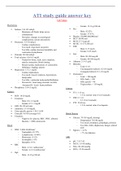
ATI study guide answer key Lab Values Electrolytes Sodium: 136-145 mEq/L Maintains cell fluids; helps nerves communicate Hct Female: 12-16 g/100 mL Male: 42-52% Female: 37-47% Deviation: changes in neurological complications; seizure precautions Potassium: 3.5-5.0 mEq/L Cardiac complications Too much: stops heart (asystole) Too little: cardiac electrical instability and ventricular dysrhythmias Chloride: 98-106 mEq/L Total calcium: 9.0-10.5 mg/dL Needed for bones, teeth, nerve impulses, muscle contraction, blood clotting Muscle/cardiac implications r/t contractility Imbalance: tingling, spasms Magnesium: 1.3-2.1 mg/dL Cardiac implications Too much: muscle weakness, hypotension, bradycardia Too little: ventricular tachycardia/fibrillation Prevents K+ from being excreted: too little decreased K+ levels heart problems Phosphorus: 3.0-4.5 mg/dL Kidneys BUN: 10-20 mg/dL Creatinine Male: 0.6-1.2 mg/dL Female: 0.5-1.1 mg/dL GFR: 90-120 mL/min Ammonia: 15-110 mg/dL Urine specific gravity: 1.015-1.030 Urine pH: 4.6-8.0 (average 6.0) Urinalysis Negative for: glucose, RBC, WBC, albumin Bacteria 1000 colonies/mL Blood WBC: 5,000-10,000/mm3 Neutrophils: 45-75% Lymphocytes: 16-46% Monocytes: 4-11% Eosinophils: 1-8% Basophils: 0-3% RBC Male: 4.7-6.1 million/mm3 Female: 4.2-5.4 million/mm3 Platelet: 150,000-400,000/mm3 MCV: 80-90 mm3 MCH: 27-31 pg/cell MCHC: 31-37% Hb/cell ESR Male: 0-17 mm/h Female: 0-25 mm/h Iron Male: 80-180 mcg/dL Female: 60-160 mcg/dL Albumin: 3.1-4.3 g/dL Bilirubin Total: 0-1.0 Unconjugated (indirect): 0.2-0.8 mg/dL Conjugated (direct): 0.1-1.0 mg/dL Cholesterol Total: 200 mg/dL LDL (bad): 100 HDL (good): 40 Triglycerides: 150 mg/dL Clotting PT: 11-13 sec 1.5-2x normal value if on Coumadin INR: 0.7-1.8 2-3 if on Coumadin PTT: 25-40 sec 1.5-2x normal value if on heparin Blood Glucose Glucose: 70-105 mg/dL (fasting) Postprandial: 70-140 mg/dL Too much: polydipsia, polyphagia, polyuria Too little: chills, diaphoresis, hunger, altered LOC HgbA1c: 6.5% 7% for diabetics ABG pH: 7.35-7.45 PaCO2: 35-45 mmHg PaO2: 80-100 mmHg HCO3: 22-26 mmol/L Hgb Male: 14-18 g/100 mL Cardiac Creatinine phosphokinase MB (CK-MB): 30-170 units/L Increases 4-6 hours after MI and remains elevated for 24-72 hours Troponin: 0.2 ng/dL Gold standard for determining if there was an MI GI/Endocrine Stomach pH: 1.5-2.5 Liver enzymes ALT/SGPT: 8-20 units/L AST/SGOT: 5-40 units/L (Kaplan says 8-20 units/L) ALP: 42-128 units/L Total protein: 6-8 gm/dL Pancreatic enzymes Amylase: 56-90 IU/L Lipase: 0-110 units/L Prothrombin time: 0.8-1.2 TSH: 0.5-5.0 mcU/mL Med Levels Digoxin: 0.5-2.0 ng/mL Lithium: 0.8-1.4 mEq/L Dilantin: 10-20 mcg/mL Theophylline: 10-20 mcg/mL Metabolic Panel (BMP or CMP): test can be basic or comprehensive; assesses fluid/electro status, glucose, renal and liver function Complete blood count (CBC): assesses amount of cells in blood – platelets, WBC, RBC, Hgb, Hct Arterial Blood Gases (ABGs): assesses for acid-base imbalances in body – test important for respiratory or metabolic conditions Coagulation Levels: assesses clotting times (PT/INR or aPTT) – test important for many blood disorders and for pts on anticoagulants Lipid Panel (Lipid Profile): assesses for risk of cardiovascular disease by measuring lipoproteins, triglycerides, cholesterol Hemoglobin A1C: assesses average blood glucose level during past 3 months – great test to check glucose management in DM pts Drug Levels: assesses amount of drug present in system – many pts are on drugs with very narrow therapeutic drug range; this test helps determine if drug is sub-therapeutic or toxic in pts system Metabolic Panel • Glucose: 70–100 mg/dL • Calcium: 8.5–10.5 mg/L • Chloride: 95–105 mEq/L • Magnesium: 1.5–2.5 mg/dL • Phosphorus:2.5–4.5 mg/dL • Potassium: 3.5–5 mEq/L • Sodium: 135–145 mEq/L • BUN: 5–20 • Serum creatinine: 0.6–1.2 mg/dL • Total Protein: 6.2–8.2 g/dL • Albumin: 3.4–5.4 g/dL • Bilirubin: 0.1–1 mg/dL (1) (formed w/ breakdown of RBC – high levels in pts w/ jaundice) These 3 enzymes found in liver – if elevated, can indicate liver problems and other diseases: • ALP (alkaline phosphatase): 40–120 U/L (international units per liter) • ALT (alanine transaminase): 7–56 U/L • AST (aspartate transaminase) 10–40 U/L *this blood test can be ordered as BMP (basic metabolic panel) or CMP (comprehensive metabolic panel). CMP includes liver function Complete Blood Count • RBC: 4.5–5.5 million • WBC: 5,000–10,000 • Platelets: 150,000–400,000 • Hemoglobin: o 12–16 g/dL (women)
Document information
- Uploaded on
- October 6, 2022
- Number of pages
- 152
- Written in
- 2022/2023
- Type
- Exam (elaborations)
- Contains
- Questions & answers


