
3.5.1 Photosynthesis
13 March 2022 12:25
The light-dependent reaction in such detail as to show that:
• chlorophyll absorbs light, leading to photoionisation of chlorophyll
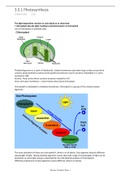
Lots of chloroplast in palisade layer.
Thylakoid (granum is a stack of thylakoids) - folded membranes (provides large surface area) which
contains photosynthetic proteins (chlorophyll) and electron carrier proteins embedded in it, both
involved in LDR
Stroma - fluid centre which contains enzymes needed for LIR
Inner and outer membrane - control what enters/exits chloroplast
Chlorophyll is embedded in thylakoid membrane. Chlorophyll is a group of five closely related
pigments.
The most abundant of these are chlorophyll A, which is in all plants. Each pigment absorbs different
wavelength of light. Having multiple pigments means that wide range of wavelengths of light can be
absorbed, so more light energy is absorbed for the LDR (photoionisation of chlorophyll).
Different proportions of each pigments causes different colours on leaves.
Energy Transfers Page 1
, • some of the energy from electrons released during photoionisation is conserved in the
production of ATP and
reduced NADP
• the production of ATP involves electron transfer associated with the transfer of electrons down
the electron transfer chain and passage of protons across chloroplast membranes and is catalysed
by ATP synthase embedded in these membranes (chemiosomotic theory)
• photolysis of water produces protons, electrons and oxygen.
LDR occurs in the thylakoid membranes.
Light energy and Water are needed to create reduced NADP and ATP.
1. Photolysis of water
Light energy absorbed by the chlorophyll splits water into proton, electrons and oxygen.
Protons form reduced NADP, needed in LIR
Electrons passed along electron carrier chain
Oxygen used in respiration/diffuse out of leaf through stomata
2. Photoionisation of chlorophyll
Light energy is absorbed by chlorophyll, so electrons become excited and raise up an energy
level to leave the chlorophyll (ionising the chlorophyll)
Some of the energy from the released electrons is used to make ATP and NADPH in
chemiosmosis.
3. Chemiosmosis
The electrons that became excited in photoionisation move along a series of proteins
embedded in the membrane of chloroplast. It passes along the electron transfer chain,
releasing energy. This energy is used to actively transport protons from stroma into the
thylakoid lumen across the membrane. This creates an electrochemical gradient (higher
concentration of protons in the thylakoid lumen). This allows protons to pass through ATP
synthase via facilitated diffusion, resulting in the production of ATP.
Energy Transfers Page 2
13 March 2022 12:25
The light-dependent reaction in such detail as to show that:
• chlorophyll absorbs light, leading to photoionisation of chlorophyll
Lots of chloroplast in palisade layer.
Thylakoid (granum is a stack of thylakoids) - folded membranes (provides large surface area) which
contains photosynthetic proteins (chlorophyll) and electron carrier proteins embedded in it, both
involved in LDR
Stroma - fluid centre which contains enzymes needed for LIR
Inner and outer membrane - control what enters/exits chloroplast
Chlorophyll is embedded in thylakoid membrane. Chlorophyll is a group of five closely related
pigments.
The most abundant of these are chlorophyll A, which is in all plants. Each pigment absorbs different
wavelength of light. Having multiple pigments means that wide range of wavelengths of light can be
absorbed, so more light energy is absorbed for the LDR (photoionisation of chlorophyll).
Different proportions of each pigments causes different colours on leaves.
Energy Transfers Page 1
, • some of the energy from electrons released during photoionisation is conserved in the
production of ATP and
reduced NADP
• the production of ATP involves electron transfer associated with the transfer of electrons down
the electron transfer chain and passage of protons across chloroplast membranes and is catalysed
by ATP synthase embedded in these membranes (chemiosomotic theory)
• photolysis of water produces protons, electrons and oxygen.
LDR occurs in the thylakoid membranes.
Light energy and Water are needed to create reduced NADP and ATP.
1. Photolysis of water
Light energy absorbed by the chlorophyll splits water into proton, electrons and oxygen.
Protons form reduced NADP, needed in LIR
Electrons passed along electron carrier chain
Oxygen used in respiration/diffuse out of leaf through stomata
2. Photoionisation of chlorophyll
Light energy is absorbed by chlorophyll, so electrons become excited and raise up an energy
level to leave the chlorophyll (ionising the chlorophyll)
Some of the energy from the released electrons is used to make ATP and NADPH in
chemiosmosis.
3. Chemiosmosis
The electrons that became excited in photoionisation move along a series of proteins
embedded in the membrane of chloroplast. It passes along the electron transfer chain,
releasing energy. This energy is used to actively transport protons from stroma into the
thylakoid lumen across the membrane. This creates an electrochemical gradient (higher
concentration of protons in the thylakoid lumen). This allows protons to pass through ATP
synthase via facilitated diffusion, resulting in the production of ATP.
Energy Transfers Page 2


