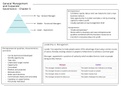
General Management
and Corporate
Governance – Chapter 5
Entrepreneur:
- Combines capital, labour and raw material to start a new
Top – General Manager business venture
- Sees opportunity in market and takes a risk by investing
capital to make a profit
Middle – Functional Managers - Usually operates at top management level
Intrapreneur:
Lower – Supervisors - “Inside entrepreneur”
- Works within a business and uses entrepreneurial
qualities combined with the business’ resources to
transform innovative ideas into profit
Leadership vs. Management:
Entrepreneurial qualities, characteristics, Leader: has expertise to make people aware of the advantage of pursuing a certain course
and skills: of action, thereby creating a desire in people to follow them to achieve a common goal.
- Can be learned and developed Manager: appointed in a position of authority which enables them to insist on people
- Identify opportunity doing as they instruct.
- Take risks
- Understand target market
- Opportunist
- Committed
- Realistic and proactive
- Motivate others
- Make quick decisions
- Communicate clearly and accurately
- Capitalise on opportunities
- Personally motivated
, Management Styles: Advantages and disadvantages:
Democratic: Allows subordinates to provide input + participate in A: Ensure buy-in + commitment from subordinates
decision making D: Slower decision making
Autocratic: Seldom allows input from subordinates + makes decisions A: Best approach when fast + decisive action is needed
D: Employees have low morale + feel undervalued
Laissez-faire: Believes that he should not interfere in process of A: Good results if workforce is highly skilled + motivated
carrying out a task
Transactional: Approach of ‘give and take’, motivating employees to D: If reward is deemed as insufficient, employees become
complete tasks in return for possible rewards demotivated = labour unrest
Transformational: Charismatic, motivates employees by helping them A: Group performance improves (creativity, productivity). Builds
understand the meaning of their work. trust and teamwork
Situational: Combination of all of the above Adapt style to whatever is required in a specific situation
Disciplinary action = autocratic etc
Motivational Factors: Monetary Factors: Non-monetary Factors:
Advantages of motivated workforce: - Salary increase = temporary - Job enlargement: more tasks added
- Good customer service = customers return raise in motivation - Job enrichment: more responsibility +
- More productive - Performance bonus, payment authority
- Less absenteeism / staff turnover through commission - Flexible hours
- Spread positive info about business - Empowerment + advancement: learn new
= improves business image skills
- Recognition: feel appreciated