
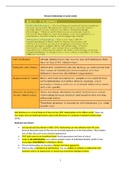
Virtual relationships in social media
Self-disclosure is a crucial feature of face-to-Face (FtF) relationships in the offline world. There are
two major and contradicting theories about self-disclosure in Computer-mediated-relationships
(CMC).
Reduced cues theory
Lee Sproull and Sara Kiesler (1986)- CMC relationships are less effective than FtF ones
because they lack many of the cues we normally depend on in FtF interactions. This includes
non-verbal cues such as our physical appearance.
CMC lacks cues to our emotional state (facial expressions and tone of voice).
Leads to de-individuation as it reduces people’s sense of individual identity, which in turn
encourages disinhibition in relating to others.
Virtual relationships are therefore blunter and more aggressive.
There is also a reluctance to self-disclose. You are unlikely to initiate a relationship with
someone who is so impersonal, or reveal your innermost feelings to them.
1


