CVRN Practice Questions and Answers 2022
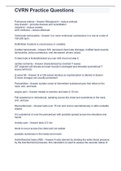
Pulmonary edema Nitroglycerin - reduce preload loop diuretic - promote diuresis and venodilation morphine - reduce anxiety ACE inhibitors - reduce afterload Ventricular tachycardia 3 or more ventricular contractions in a row at a rate of 100-200 bpm. Defibrillate if patient is unconscious or unstable 00:05 01:01 Cardiac tamponade S/S: decresed chest tube drainage, muffled heart sounds, tachycardia, pulsus paradoxus, and decreased urinary output. if chest tube is kinked/blocked you can milk it but not strip it. cardiac ischemia characterized by inverted T waves (ST segment will elevate as heart muscle is damaged and elevated symmetrical T waves will form) Q wave MI Q or QS waves develop as repolarization is altered or absent Q wave changes are usually permanent Pericardities sudden onset of intermittent substernal pain that refers to the neck, arm, and back angina pain related to exertion and lasts 5-15 min. Felt substernal or retrosternal, radiating across the chest and sometimes in the neck, arm, and jaw. Myocardial pain lasts over 15 min and occurs spontaineously or after unstable angina It is substernal or over the pericardium with possible spread across the shoulders and hands Anxiety pain lasts 2-3 min tends to occur across the chest and not radiate possible numbness in the hands and mouth Ankle-Brachial Index (ABI) A ratio derived by dividing the ankle blood pressure by the brachial blood pressure; this calculation is used to assess the vascular status of the lower extremities. To obtain the ABI, a blood pressure cuff is applied to the lower extremities just above the malleoli. The systolic pressure is measured by Doppler ultrasound at both the dorsalis pedis and posterior tibial pulses. The higher of these two pressures is then divided by the higher of the two brachial pulses. 1.2 - possible calcification in vessel walls 1-1.2 - Normal .9-.99 - acceptable .8-.89 - some arterial disease 0.5-0.79 - moderate arterial disease (intermittent claudication) 0.5 - severe disease, ischemia S4 sounds Atrial Gallop - Extra beat occurring just before s1 associated with: - Left ventricular hypertrophy - hypertension - aortic stenosis S3 extra beat heard after S2 associated with: - decreased ventricular compliance - left ventricular failure - mitral regurgitation
Document information
- Uploaded on
- August 29, 2022
- Number of pages
- 9
- Written in
- 2022/2023
- Type
- Exam (elaborations)
- Contains
- Questions & answers