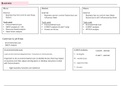
Business
Environments:
Micro: Market: Macro:
Internal External External
- Business has full control over these - Business cannot control factors but can - Business has no control over these
factors infl uence them factors but is still infl uenced by them
Tools used: Tools used: Tools used:
Environmental scan Environmental scan Environmental scan
SWOT-analysis (S + W) A SWOT-analysis (O and T only) A SWOT-analysis
Resource-based analysis Porters six forces PE2STLE analysis
Value-chain analysis
Common to all three
environments:
- Environmental scan
- SWOT analysis
An environmental scan: A SWOT-analysis:
S and W – internal
Look at the internal departments / functions in the business. S – strengths
O and T – external
Important to do an environmental scan to identify factors that may impact W – weaknesses
on business and then adjust existing plans or develop new plans to deal
with factors/events O – opportunities
- Eight business functions are looked at T – threats
, Micro Environment:
Brief look at it: Eight business functions:
An environmental scan: look at the internal departments / functions in the 1. Purchasing function
business. (eight business functions) 2. Production function
A SWOT-analysis (S and W only): review the internal departments / functions 3. Financial function
in the business.
4. Human resources function
A resource-based analysis: consider both tangible and intangible resources
5. Marketing function
and how these are utilised in the organisation.
A value-chain analysis: examine the value created (or not) in a chain of 6. Public relations function
activities performed within the business. 7. Administrative function
8. General management function
1. Purchasing function 2. Production function
Buys goods and services needed by all departments at the Combination of the 4 factors of production in order to provide
lowest price possible right product at right time and place in the right quantity at
- Own use right price.
- Resell
- Processing Transform raw materials into a product that satisfies needs of
Most suitable supplier chosen consumer
Ensure ROI (profitability) - Keep manufacturing costs as low as possible (retain
Develop a system to control inventory (trading stock) to quality)
maintain optimum stock levels - Continues product design
- Automation = activities now performed by machines
Low labour costs, faster, accurate
High capital investment, job losses, maintenance