Physics Test Revision - Chapter 6
Naming forms of energy:
- moving objects have kinetic energy.
- lifting an object above ground causes it to have gravitational potential energy.
- Fuels such as coal or petrol is chemical energy. It can be found in many things like muscles or batteries.
- An electric current carries electrical energy.
- A close relation of chemical energy is nuclear energy. Uranium is example of nuclear fuel. all radioactive
materials are stores of nuclear energy; the energy is stored in the nucleus of atoms.
- The energy stored by an object that has been stretched or squashed in an elastic way is strain energy. This
could also be called elastic energy.
- The energy stored in hot objects is called internal energy.
- Energy that is going from hotter objects to colder objects is called thermal energy.
- Light radiating from an object is light energy.
- An object giving off sound is sound energy.
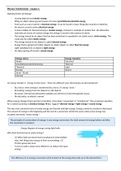
Energy stores Energy transfers
Kinetic Electrical
Gravitational potential energy Thermal
Chemical Light
Nuclear Sound
Strain / Elastic
Internal
An energy transfer is “energy on the move.” There are different ways that energy can be transferred:
- By a force: when energy is transferred by a force, it’s doing “work.”
- By heating: energy from hot objects to cold objects.
- By waves: infrared and ultraviolet radiation are all forms of electromagnetic waves.
- By electricity: an electric current
When energy changes from one form of another, it has been “converted” or “transferred.” The conversion equation
for a rocket launching is chemical energy k.e. + g.p.e + thermal energy + light energy + sound energy.
The two most common forms of waste energy are thermal and light energy. Energy cannot be created or destroyed.
The amount of energy in the beginning and the end of a conversion will be the same unless some energy has
escaped, becoming “waste energy.”
The principle of conversation of energy: In any energy conversion, the total amount of energy before and after
the conversion is constant.
- Energy diagram of energy saving light bulb:
Why does heat end up as waste energy?
- (1) When fuels are burst heat is produced as intermediate
step. Hot things lose energy to their surroundings. (2)
Friction generates heat.
- A way to make a lamp more efficient is to reduce the input
energy.
The efficiency of an energy conversion is the fraction of the energy that ends up in the desired form.
Naming forms of energy:
- moving objects have kinetic energy.
- lifting an object above ground causes it to have gravitational potential energy.
- Fuels such as coal or petrol is chemical energy. It can be found in many things like muscles or batteries.
- An electric current carries electrical energy.
- A close relation of chemical energy is nuclear energy. Uranium is example of nuclear fuel. all radioactive
materials are stores of nuclear energy; the energy is stored in the nucleus of atoms.
- The energy stored by an object that has been stretched or squashed in an elastic way is strain energy. This
could also be called elastic energy.
- The energy stored in hot objects is called internal energy.
- Energy that is going from hotter objects to colder objects is called thermal energy.
- Light radiating from an object is light energy.
- An object giving off sound is sound energy.
Energy stores Energy transfers
Kinetic Electrical
Gravitational potential energy Thermal
Chemical Light
Nuclear Sound
Strain / Elastic
Internal
An energy transfer is “energy on the move.” There are different ways that energy can be transferred:
- By a force: when energy is transferred by a force, it’s doing “work.”
- By heating: energy from hot objects to cold objects.
- By waves: infrared and ultraviolet radiation are all forms of electromagnetic waves.
- By electricity: an electric current
When energy changes from one form of another, it has been “converted” or “transferred.” The conversion equation
for a rocket launching is chemical energy k.e. + g.p.e + thermal energy + light energy + sound energy.
The two most common forms of waste energy are thermal and light energy. Energy cannot be created or destroyed.
The amount of energy in the beginning and the end of a conversion will be the same unless some energy has
escaped, becoming “waste energy.”
The principle of conversation of energy: In any energy conversion, the total amount of energy before and after
the conversion is constant.
- Energy diagram of energy saving light bulb:
Why does heat end up as waste energy?
- (1) When fuels are burst heat is produced as intermediate
step. Hot things lose energy to their surroundings. (2)
Friction generates heat.
- A way to make a lamp more efficient is to reduce the input
energy.
The efficiency of an energy conversion is the fraction of the energy that ends up in the desired form.