
Module 4
Analyzing and Interpreting Financial
Statements
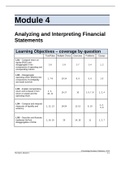
Learning Objectives – coverage by question
True/False Multiple Choice Exercises Problems Essays
LO1 – Compute return on
equity (ROE) and
disaggregate it into 1-6 1-9 1-7 1-4 1, 2
components of operating and
nonoperating returns.
LO2 – Disaggregate
operating return (RNOA) into
1, 7-9 10-14 8, 9 5, 6 1-3
components of profitability
and asset turnover.
LO3 – Explain nonoperating
return and compute it from 1, 2,
15-17 10 1-3, 7, 8 1, 2, 4
return on equity and the 10, 11
operating return.
LO4 – Compute and interpret
1, 2,
measures of liquidity and 1, 12, 13 18-24 11-13 9, 10
5, 6
solvency.
LO5 – Describe and illustrate
traditional DuPont 1, 14, 15 25 14, 15 11 1, 2, 7
disaggregation of ROE.
©Cambridge Business Publishers, 2015
Test Bank, Module 4 4-1
,Module 4: Analyzing and Interpreting Financial Statements
True/False
Topic: Use of Ratios
LO: 1-5
1. Ratios provide one way to compare companies in the same industry regardless of their size.
Answer: True
Rationale: Ratios mitigate problems arising from different sizes of companies.
Topic: Financial Leverage and RNOA
LO: 1, 3
2. Highly leveraged firms have higher RNOA than firms with lower leverage.
Answer: False
Rationale: Financial leverage does not affect the RNOA computation because it is based on operating
profit. Financial leverage will increase ROE, however.
Topic: Return on Equity and Treasury Stock
LO: 1
3. Repurchasing shares near year-end will increase a firm’s return on equity (ROE).
Answer: True
Rationale: Repurchasing shares will decrease equity because treasury stock is a contra-account (it
reduces total equity). If the repurchases happen at year-end, there are likely no significant profit
impacts and thus, the numerator in the ROE ratio will be unaffected. Thus, the ratio will increase.
Topic: Nonoperating Return
LO: 1
4. All else equal, when investors consider a firm’s return on equity (ROE) they consider less risky a firm
that earns proportionately more of that return from operating activities as opposed to nonoperating
activities.
Answer: True
Rationale: Financial leverage will increase nonoperating return and ROE; however this adds risk to
the investment. For equal returns, investors typically prefer less risk.
Topic: Tax on Operating Profit
LO: 1
5. To determine tax on net operating profit, we begin with total tax expense and deduct taxes related to
net nonoperating expenses.
Answer: False
Rationale: We begin with total tax expense and add back any taxes related to net nonoperating
expenses (NNE).
©Cambridge Business Publishers, 2015
4-2 Financial & Managerial Accounting for MBAs, 4th Edition
,Topic: NOPAT
LO: 1
6. NOPAT is equivalent to income from operating activities.
Answer: False
Rationale: NOPAT is income from operating activities after tax which excludes nonoperating
expenses such as interest expense. Income from operating activities often includes interest expense
and is before tax.
Topic: Asset Turnover Effect on RNOA/ROE
LO: 2
7. Increasing a company’s net operating asset turnover (NOAT) increases both RNOA and ROE.
Answer: True.
Rationale: ROE = RNOA + FLEV × Spread. RNOA is further disaggregated into profit margin × asset
turnover. Therefore an increase in asset turnover will yield an increase in RNOA, which will result in
an increase in ROE if all other variables remain constant.
Topic: Profitability and RNOA
LO: 2
8. If Company A has a higher net operating profit margin (NOPM) than Company B, then Company A’s
RNOA will be higher.
Answer: False
Rationale: RNOA depends on NOPM but also depends on operating asset productivity (NOAT). If
Company B had a much higher operating asset productivity, its RNOA could be higher despite the
lower profitability.
Topic: Net Operating Asset Turnover
LO: 2
9. Net operating asset turnover (NOAT) measures a company’s profitability.
Answer: False
Rationale Net operating asset turnover is a productivity or efficiency concept.
Topic: Financial Leverage and Debt Ratings
LO: 3
10. All else being equal, higher financial leverage will decrease a company’s debt rating and increase the
interest rate it must pay.
Answer: True
Rationale: Higher levels of financial leverage increase the probability of default and of bankruptcy.
This reduces credit ratings and increases costs for borrowed funds.
Topic: Return on Equity (ROE)
LO: 3
11. ROE can be disaggregated into operating and nonoperating returns. Nonoperating return will be
positive as long as Spread is positive.
Answer: False
Rationale: The nonoperating return can be negative (which reduces ROE) if spread is positive and
financial leverage (FLEV) is negative.
©Cambridge Business Publishers, 2015
Test Bank, Module 4 4-3
, Topic: Current Ratio
LO: 4
12. A current ratio greater than 1.0 is generally desirable for a company.
Answer: True
Rationale: A company with a current ratio greater than 1.0 indicates positive working capital. In
general, companies prefer greater levels of current assets than current liabilities.
Topic: Solvency
LO: 4
13. Solvency ratios measure a company’s ability to meet its debt obligations.
Answer: True
Rationale: A solvent company is one that can meet its debt obligations including principal and interest
payments as they come due.
Topic: ROA versus RNOA
LO: 5
14. The only difference between adjusted return on assets (ROA) and return on net operating assets
(RNOA) is that the denominator in RNOA is typically smaller than the denominator in ROA because
the former is net of operating liabilities.
Answer: False
Rationale: It is true that the denominator in RNOA is typically smaller but the other difference between
the ratios is that the numerators are different. ROA includes all net income whereas RNOA includes
only net profits from operating activities.
Topic: Basic DuPont Analysis
LO: 5
15. The DuPont analysis disaggregates return on equity into profitability, efficiency and leverage
components.
Answer: True
Rationale: The DuPont disaggregation of return on equity is: ROE = Profit margin (PM) × Asset
turnover (AT) × Financial leverage (FL). These three terms measure profitability, efficiency and
leverage respectively.
©Cambridge Business Publishers, 2015
4-4 Financial & Managerial Accounting for MBAs, 4th Edition
Analyzing and Interpreting Financial
Statements
Learning Objectives – coverage by question
True/False Multiple Choice Exercises Problems Essays
LO1 – Compute return on
equity (ROE) and
disaggregate it into 1-6 1-9 1-7 1-4 1, 2
components of operating and
nonoperating returns.
LO2 – Disaggregate
operating return (RNOA) into
1, 7-9 10-14 8, 9 5, 6 1-3
components of profitability
and asset turnover.
LO3 – Explain nonoperating
return and compute it from 1, 2,
15-17 10 1-3, 7, 8 1, 2, 4
return on equity and the 10, 11
operating return.
LO4 – Compute and interpret
1, 2,
measures of liquidity and 1, 12, 13 18-24 11-13 9, 10
5, 6
solvency.
LO5 – Describe and illustrate
traditional DuPont 1, 14, 15 25 14, 15 11 1, 2, 7
disaggregation of ROE.
©Cambridge Business Publishers, 2015
Test Bank, Module 4 4-1
,Module 4: Analyzing and Interpreting Financial Statements
True/False
Topic: Use of Ratios
LO: 1-5
1. Ratios provide one way to compare companies in the same industry regardless of their size.
Answer: True
Rationale: Ratios mitigate problems arising from different sizes of companies.
Topic: Financial Leverage and RNOA
LO: 1, 3
2. Highly leveraged firms have higher RNOA than firms with lower leverage.
Answer: False
Rationale: Financial leverage does not affect the RNOA computation because it is based on operating
profit. Financial leverage will increase ROE, however.
Topic: Return on Equity and Treasury Stock
LO: 1
3. Repurchasing shares near year-end will increase a firm’s return on equity (ROE).
Answer: True
Rationale: Repurchasing shares will decrease equity because treasury stock is a contra-account (it
reduces total equity). If the repurchases happen at year-end, there are likely no significant profit
impacts and thus, the numerator in the ROE ratio will be unaffected. Thus, the ratio will increase.
Topic: Nonoperating Return
LO: 1
4. All else equal, when investors consider a firm’s return on equity (ROE) they consider less risky a firm
that earns proportionately more of that return from operating activities as opposed to nonoperating
activities.
Answer: True
Rationale: Financial leverage will increase nonoperating return and ROE; however this adds risk to
the investment. For equal returns, investors typically prefer less risk.
Topic: Tax on Operating Profit
LO: 1
5. To determine tax on net operating profit, we begin with total tax expense and deduct taxes related to
net nonoperating expenses.
Answer: False
Rationale: We begin with total tax expense and add back any taxes related to net nonoperating
expenses (NNE).
©Cambridge Business Publishers, 2015
4-2 Financial & Managerial Accounting for MBAs, 4th Edition
,Topic: NOPAT
LO: 1
6. NOPAT is equivalent to income from operating activities.
Answer: False
Rationale: NOPAT is income from operating activities after tax which excludes nonoperating
expenses such as interest expense. Income from operating activities often includes interest expense
and is before tax.
Topic: Asset Turnover Effect on RNOA/ROE
LO: 2
7. Increasing a company’s net operating asset turnover (NOAT) increases both RNOA and ROE.
Answer: True.
Rationale: ROE = RNOA + FLEV × Spread. RNOA is further disaggregated into profit margin × asset
turnover. Therefore an increase in asset turnover will yield an increase in RNOA, which will result in
an increase in ROE if all other variables remain constant.
Topic: Profitability and RNOA
LO: 2
8. If Company A has a higher net operating profit margin (NOPM) than Company B, then Company A’s
RNOA will be higher.
Answer: False
Rationale: RNOA depends on NOPM but also depends on operating asset productivity (NOAT). If
Company B had a much higher operating asset productivity, its RNOA could be higher despite the
lower profitability.
Topic: Net Operating Asset Turnover
LO: 2
9. Net operating asset turnover (NOAT) measures a company’s profitability.
Answer: False
Rationale Net operating asset turnover is a productivity or efficiency concept.
Topic: Financial Leverage and Debt Ratings
LO: 3
10. All else being equal, higher financial leverage will decrease a company’s debt rating and increase the
interest rate it must pay.
Answer: True
Rationale: Higher levels of financial leverage increase the probability of default and of bankruptcy.
This reduces credit ratings and increases costs for borrowed funds.
Topic: Return on Equity (ROE)
LO: 3
11. ROE can be disaggregated into operating and nonoperating returns. Nonoperating return will be
positive as long as Spread is positive.
Answer: False
Rationale: The nonoperating return can be negative (which reduces ROE) if spread is positive and
financial leverage (FLEV) is negative.
©Cambridge Business Publishers, 2015
Test Bank, Module 4 4-3
, Topic: Current Ratio
LO: 4
12. A current ratio greater than 1.0 is generally desirable for a company.
Answer: True
Rationale: A company with a current ratio greater than 1.0 indicates positive working capital. In
general, companies prefer greater levels of current assets than current liabilities.
Topic: Solvency
LO: 4
13. Solvency ratios measure a company’s ability to meet its debt obligations.
Answer: True
Rationale: A solvent company is one that can meet its debt obligations including principal and interest
payments as they come due.
Topic: ROA versus RNOA
LO: 5
14. The only difference between adjusted return on assets (ROA) and return on net operating assets
(RNOA) is that the denominator in RNOA is typically smaller than the denominator in ROA because
the former is net of operating liabilities.
Answer: False
Rationale: It is true that the denominator in RNOA is typically smaller but the other difference between
the ratios is that the numerators are different. ROA includes all net income whereas RNOA includes
only net profits from operating activities.
Topic: Basic DuPont Analysis
LO: 5
15. The DuPont analysis disaggregates return on equity into profitability, efficiency and leverage
components.
Answer: True
Rationale: The DuPont disaggregation of return on equity is: ROE = Profit margin (PM) × Asset
turnover (AT) × Financial leverage (FL). These three terms measure profitability, efficiency and
leverage respectively.
©Cambridge Business Publishers, 2015
4-4 Financial & Managerial Accounting for MBAs, 4th Edition


