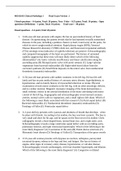
MD3110E Clinical Pathology I Final Exam Version 2 Complete with Multiple Choice Latest 2022
1. A 60-year-old man presents with angina. He has no past medical history of heart disease. On questioning, the patient reveals that he had repeated sexually transmitted diseases in the past, including a painless chancre (a hard, round sore) on his penis, for which he never sought medical attention. Rapid plasma reagin (RPR), Venereal Disease Research Laboratory (VDRL) slide test, and fluorescent treponemal antibody (FTA) serologic tests (indicative of syphilis infection) are positive. Echocardiography and computed tomography of the heart are performed. The history of untreated syphilis suggests that these tests will most likely detect which of the following abnormalities? (A) Aortic valvular insufficiency and linear calcification along the ascending aorta (B) Bicuspid aortic valve with aortic stenosis (C) Large valvular vegetations from bacterial endocarditis (D) Right-sided heart failure from the carcinoid syndrome (E) Small fibrin deposits on the mitral valve from nonbacterial thrombotic (marantic) endocarditis 2. A 50-year-old man presents with sudden weakness in his left leg. He has felt well lately and has no past medical history of coronary artery disease, hyperlipidemia, or hypertension, and no family history of myocardial infarction or stroke. Physical examination reveals motor weakness in the left leg, with no other neurologic deficits, and no cardiac murmur. Magnetic resonance imaging of the brain demonstrates a small ischemic infarct in the arterial distribution of the brain correlating with motor control of the left leg. Angiography and echocardiography reveal normal coronary arteries, normal valves with no vegetations, and a small right-to-left shunt. Which of the following is most likely associated with this scenario? (A) Atrial septal defect (B) Bacterial endocarditis (C) Nonbacterial thrombotic (marantic) endocarditis (D) Tetralogy of Fallot (E) Ventricular septal defect 3. A 3-year-old boy presents with cyanosis and shortness of breath that develops when he plays with friends. According to his mother, the boy was born cyanotic. The boy is very small and short for his age, and he squats on the floor next to his mother. Chest radiography reveals a boot-shaped heart, normal heart size, and a right aortic arch. Echocardiography reveals a large ventricular septal defect with an overriding aorta, pulmonary stenosis, and right ventricular hypertrophy. Which of the following is the most likely diagnosis? (A) Coarctation of the aorta (B) Patent ductus arteriosus (C) Rheumatic heart disease (D) Tetralogy of Fallot (E) Transposition of the great vessels 4. A 53-year-old woman presents with dyspnea on exertion, orthopnea, paroxysmal nocturnal dyspnea, edema in the legs and feet, and fatigue. She has no history of angina, other signs of coronary artery disease, hypertension, or valvular disease. Echocardiography reveals cardiomegaly, with four-chamber hypertrophy and dilation. Which of the following is the most likely diagnosis? (A) Congestive or dilated
Document information
- Uploaded on
- July 26, 2022
- Number of pages
- 14
- Written in
- 2021/2022
- Type
- Exam (elaborations)
- Contains
- Questions & answers