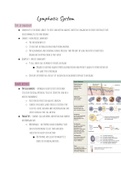
Lymphatic System
Types of immunity
● Immunity is the bodies ability to resist and defend against infectious organisms or other substances that
could damage tissues and organs
● Innate / nonspecific immunity
○ You are born with it
○ It does not distinguish one threat from another
○ Physical barriers and internal defence processes that prevent or slow the entry of infectious
organisms or attack them if they enter
● Adaptive / specific immunity
○ T cells and b cells respond to specific antigens
■ Organise a defence against particular bacterium and protects against further attacks by
the same type of pathogen
○ Develops after birth as a result of accidental or deliberate exposure to antigens
Innate defences
● Physical barriers - pathogens need to first enter body
tissues by crossing epithelial tissue at either the skin or a
mucous membrane
○ Hairs provide protection against abrasion
○ Sebaceous and sweat glands produce secretions that
flush the surface and wash away microorganisms and
secrete chemicals that kill bacteria
● Phagocytes - remove cellular debris and attack and remove
microorganisms
○ Microphages - neutrophils and eosinophils that
can enter peripheral tissues that have been
subjected to injury or infection
■ Neutrophils are quick to phagocytize
debris or invading bacteria
, ■ Eosinophils target foreign substances that are coated with antibodies
○ Macrophages - divided from monocytes
■ Engulf pathogens and destroy it with lysosomal enzymes
■ Bind to or remove pathogen from interstitial fluid but require assistance to destroy
■ Release chemicals into interstitial fluid to destroy target (nitric oxide or hydrogen
peroxide)
● Immune surveillance - natural killer cells police peripheral tissues and recognise and destroy abnormal
cells by detecting antigens
1. Recognition and adhesion - recognises abnormal components on cells membrane and adheres to the cell
2. Realignment of golgi apparatus - golgi apparatus moves around nucleus until it points toward the
abnormal cell
3. Secretion of perforin - golgi apparatus releases a flood of secretory vesicles that contain perforins from
the membrane through exocytosis that diffuse to target plasma membrane
4. Lysis of abnormal cells - perforins interact with targets plasma membrane and creates pores in membrane
and target cell can no longer maintain its internal environment so it disintegrates
● Interferons - small proteins released by lymphocytes and macrophages that binds to surface receptors on
membrane of normal cell and triggers the production of antiviral proteins in cytoplasm that interferes
with viral replication inside cell
● Complement system - complement proteins that enhance the action of antibodies and phagocytes
○ Classical pathway, lectin pathway, alternative pathway
● Inflammation - localised tissue response to injury
○ Produces local redness, swelling, heat and pain that in some way kills cells, damages connective
tissue fibres or injures the tissue
○ Mast cells release histamine and heparin and prostaglandins into the interstitial fluid
■ Histamine makes capillaries more permeable = speeds up blood flow to area
■ Stimulates local sensory neurons to produce pain - person limits damage (cleans
infected wound, removes splinter)
■ Increased blood flow will increase local temperature that increases rate of enzymatic
reactions and accelerates phagocyte activity
■ Vessel permeability is increased so clotting factors and complement proteins can leave
bloodstream and enter injured area
Types of immunity
● Immunity is the bodies ability to resist and defend against infectious organisms or other substances that
could damage tissues and organs
● Innate / nonspecific immunity
○ You are born with it
○ It does not distinguish one threat from another
○ Physical barriers and internal defence processes that prevent or slow the entry of infectious
organisms or attack them if they enter
● Adaptive / specific immunity
○ T cells and b cells respond to specific antigens
■ Organise a defence against particular bacterium and protects against further attacks by
the same type of pathogen
○ Develops after birth as a result of accidental or deliberate exposure to antigens
Innate defences
● Physical barriers - pathogens need to first enter body
tissues by crossing epithelial tissue at either the skin or a
mucous membrane
○ Hairs provide protection against abrasion
○ Sebaceous and sweat glands produce secretions that
flush the surface and wash away microorganisms and
secrete chemicals that kill bacteria
● Phagocytes - remove cellular debris and attack and remove
microorganisms
○ Microphages - neutrophils and eosinophils that
can enter peripheral tissues that have been
subjected to injury or infection
■ Neutrophils are quick to phagocytize
debris or invading bacteria
, ■ Eosinophils target foreign substances that are coated with antibodies
○ Macrophages - divided from monocytes
■ Engulf pathogens and destroy it with lysosomal enzymes
■ Bind to or remove pathogen from interstitial fluid but require assistance to destroy
■ Release chemicals into interstitial fluid to destroy target (nitric oxide or hydrogen
peroxide)
● Immune surveillance - natural killer cells police peripheral tissues and recognise and destroy abnormal
cells by detecting antigens
1. Recognition and adhesion - recognises abnormal components on cells membrane and adheres to the cell
2. Realignment of golgi apparatus - golgi apparatus moves around nucleus until it points toward the
abnormal cell
3. Secretion of perforin - golgi apparatus releases a flood of secretory vesicles that contain perforins from
the membrane through exocytosis that diffuse to target plasma membrane
4. Lysis of abnormal cells - perforins interact with targets plasma membrane and creates pores in membrane
and target cell can no longer maintain its internal environment so it disintegrates
● Interferons - small proteins released by lymphocytes and macrophages that binds to surface receptors on
membrane of normal cell and triggers the production of antiviral proteins in cytoplasm that interferes
with viral replication inside cell
● Complement system - complement proteins that enhance the action of antibodies and phagocytes
○ Classical pathway, lectin pathway, alternative pathway
● Inflammation - localised tissue response to injury
○ Produces local redness, swelling, heat and pain that in some way kills cells, damages connective
tissue fibres or injures the tissue
○ Mast cells release histamine and heparin and prostaglandins into the interstitial fluid
■ Histamine makes capillaries more permeable = speeds up blood flow to area
■ Stimulates local sensory neurons to produce pain - person limits damage (cleans
infected wound, removes splinter)
■ Increased blood flow will increase local temperature that increases rate of enzymatic
reactions and accelerates phagocyte activity
■ Vessel permeability is increased so clotting factors and complement proteins can leave
bloodstream and enter injured area