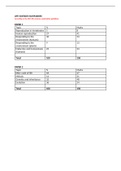
LIFE SCIENCES SUMMARIES
According to the 2021 life sciences examination guidelines
PAPER 1
Topic % Marks
Reproduction in Vertebrates 5 8
Human reproduction 27 41
Responding to the 36 54
environment (humans)
Responding to the 9 13
environment (plants)
Endocrine and homeostasis 23 34
(humans)
Total 100 150
PAPER 2
Topic % Marks
DNA: code of life 18 27
Meiosis 14 21
Genetics and inheritance 32 48
Evolution 36 54
Total 100 150
,PAPER 1
REPRODUCTION IN VERTEBRATES
TYPES OF FERTILIZATION
External Internal
Occurs outside of the female’s body, in the Occurs inside the female’s body
water
TYPE OF REPRODUCTIVE STRATEGY
1 Ovipary
- Eggs are laid and hatch aftertime
- A shell protects the embryo
- Yolk nourishes the embryo
2 Ovovivipary
- An embryo develops inside an egg
- The egg develops inside the body
- The young hatch inside the mother’s body
- The young are born alive
3 Vivipary
- Egg is fertilized internally.
- An embryo develops inside an egg
- Young are born alive
PARENTAL CARE
- Prenatal energy (before birth) or postnatal energy (after birth) that is supplied by the
parents to ensure survival of the offspring
1 None
- Many eggs are laid
- Prenatal energy is given before birth
- Low survival rate
2 Lots
- Few eggs are laid
- Postnatal energy is given after birth
- High survival rate
,TYPES OF DEVELOPMENT
- The strategy that allows embryos and offspring young to be nourished and protected
by predators
-
1 Altricial
- Not fully developed at birth
- Naked
- Eyes closed
- Can’t move well after birth
- Brain is small compared to the body
- Can’t feed or protect themselves
- Lots of parental care
2 Precocial
- Born fully developed
- Eyes open
- Can move well after birth as legs and feet are well developed
- Brain is large compared to the body
- No parental care
AMNIOTIC EGG
- A major evolutionary step enabling animals to move onto land
- It always has an amnion
- Animals with this type of egg are called amniotes
- A hard shell may be around the egg
- OR a uterus in placental mammals is around it
- Extra embryonic membranes develop after fertilization and are found around the
embryo
- Amnion for protection (prevent dehydration and is a shock absorber)
- Allantois for excretion of nitrogenous waste
- Chorion for exchange of gases (birds and reptiles)
OR it forms the placenta (mammals)
- Yolk sac for food for the embryo
, HUMAN REPRODUCTION
MALE REPRODUCTION ORGAN: PENIS
Prostate gland
Seminal vesicle Sperm duct
Penis
Cowper’s gland Urethra
Epididymis
Scrotum
Testes
Seminal vesicle
- Secretes a nutrient-rich fluid that provides energy for the sperm cells
Cowper’s gland
- Produces mucus that helps with the movement of sperm
Scrotum
- Protects the testes
- To keep the testes at a temperature that is lower than body temperature/optimum
temperature for sperm production which is necessary to produce healthy sperm
Testes
- Produces sperm by the process of spermatogenesis and testosterone (male
hormone)
Prostate gland
- Produces an alkaline fluid that neutralizes the acid vaginal fluid
Sperm duct
- Transports sperm from the epididymis to the urethra
- When cut = vasectomy
No sperm in the semen
Urethra
- Transports semen and urine out of the body Penis
Epididymis - Copulation
- Sperm cells mature here - Deposits semen in the vagina
- Sperm cells are stored here temporarily
What are the consequences for reproduction if the testes are found inside the body?
- Body temperature of 37 degrees Celsius is too high for optimal sperm production
- High temperature will lead to the formation of abnormal sperms
- Reducing the chance of reproduction
STRUCTURE OF THE SPERM CELL
NB Examiner might give a scenario
- Eg) man wearing tight underwear/pants
- Man is sitting on a couch for a long-time watching TV
(In both scenarios, the testes are pulled against the body increasing the temperature )
According to the 2021 life sciences examination guidelines
PAPER 1
Topic % Marks
Reproduction in Vertebrates 5 8
Human reproduction 27 41
Responding to the 36 54
environment (humans)
Responding to the 9 13
environment (plants)
Endocrine and homeostasis 23 34
(humans)
Total 100 150
PAPER 2
Topic % Marks
DNA: code of life 18 27
Meiosis 14 21
Genetics and inheritance 32 48
Evolution 36 54
Total 100 150
,PAPER 1
REPRODUCTION IN VERTEBRATES
TYPES OF FERTILIZATION
External Internal
Occurs outside of the female’s body, in the Occurs inside the female’s body
water
TYPE OF REPRODUCTIVE STRATEGY
1 Ovipary
- Eggs are laid and hatch aftertime
- A shell protects the embryo
- Yolk nourishes the embryo
2 Ovovivipary
- An embryo develops inside an egg
- The egg develops inside the body
- The young hatch inside the mother’s body
- The young are born alive
3 Vivipary
- Egg is fertilized internally.
- An embryo develops inside an egg
- Young are born alive
PARENTAL CARE
- Prenatal energy (before birth) or postnatal energy (after birth) that is supplied by the
parents to ensure survival of the offspring
1 None
- Many eggs are laid
- Prenatal energy is given before birth
- Low survival rate
2 Lots
- Few eggs are laid
- Postnatal energy is given after birth
- High survival rate
,TYPES OF DEVELOPMENT
- The strategy that allows embryos and offspring young to be nourished and protected
by predators
-
1 Altricial
- Not fully developed at birth
- Naked
- Eyes closed
- Can’t move well after birth
- Brain is small compared to the body
- Can’t feed or protect themselves
- Lots of parental care
2 Precocial
- Born fully developed
- Eyes open
- Can move well after birth as legs and feet are well developed
- Brain is large compared to the body
- No parental care
AMNIOTIC EGG
- A major evolutionary step enabling animals to move onto land
- It always has an amnion
- Animals with this type of egg are called amniotes
- A hard shell may be around the egg
- OR a uterus in placental mammals is around it
- Extra embryonic membranes develop after fertilization and are found around the
embryo
- Amnion for protection (prevent dehydration and is a shock absorber)
- Allantois for excretion of nitrogenous waste
- Chorion for exchange of gases (birds and reptiles)
OR it forms the placenta (mammals)
- Yolk sac for food for the embryo
, HUMAN REPRODUCTION
MALE REPRODUCTION ORGAN: PENIS
Prostate gland
Seminal vesicle Sperm duct
Penis
Cowper’s gland Urethra
Epididymis
Scrotum
Testes
Seminal vesicle
- Secretes a nutrient-rich fluid that provides energy for the sperm cells
Cowper’s gland
- Produces mucus that helps with the movement of sperm
Scrotum
- Protects the testes
- To keep the testes at a temperature that is lower than body temperature/optimum
temperature for sperm production which is necessary to produce healthy sperm
Testes
- Produces sperm by the process of spermatogenesis and testosterone (male
hormone)
Prostate gland
- Produces an alkaline fluid that neutralizes the acid vaginal fluid
Sperm duct
- Transports sperm from the epididymis to the urethra
- When cut = vasectomy
No sperm in the semen
Urethra
- Transports semen and urine out of the body Penis
Epididymis - Copulation
- Sperm cells mature here - Deposits semen in the vagina
- Sperm cells are stored here temporarily
What are the consequences for reproduction if the testes are found inside the body?
- Body temperature of 37 degrees Celsius is too high for optimal sperm production
- High temperature will lead to the formation of abnormal sperms
- Reducing the chance of reproduction
STRUCTURE OF THE SPERM CELL
NB Examiner might give a scenario
- Eg) man wearing tight underwear/pants
- Man is sitting on a couch for a long-time watching TV
(In both scenarios, the testes are pulled against the body increasing the temperature )