

3.2.4
Immune System
Antigens
• protein/glycoprotein recognised by body as ‘foreign’ - stimulates immune response
• speci c molecules on cell surface
• foreign antigens:
- pathogens (e.g. bacteria, viruses, fungi)
- non-‘self’ material (e.g. transfused blood/ transplanted organs)
- toxins (chemicals)
- abnormal body cells (e.g. cancer)
Antigenic Variation
• antigen changes due to mutation in pathogen
• second infection, memory cells x recognise strains w. dif antigens (immunologically distinct)
• primary response carried out against new antigens
• di cult develop vaccine e.g. in uenza - vaccine chosen yearly - most suitable for currently
circulating strain
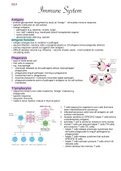
Phagocytes
• type of white blood cell
• rst cells to respond
• e.g. macrophage
1. chemicals released by the pathogens attract macrophages/
phagocytes.
2. phagocytes engulf pathogen, forming a phagosome.
3. lysosomes fuse w. phagosome.
4. enzymes (lysozyme + hydrolytic enzymes) digest pathogen.
5. phagocyte presents some of pathogen’s antigens on its cell-surface
membrane.
T lymphocytes
• respond to body’s own cells invaded by ‘foreign’ material e.g.
phagocytes
• speci c response
• long term immunity
• made in bone marrow, mature in thymus gland
1. T cells respond to organism’s own cells that have
been infected/become cancerous.
2. infected/cancerous cells have dif antigens on cell-
surface membranes.
3. receptor proteins on SPECIFIC helper T cells bind to
complementary antigens.
4. activates T cell to divide by mitosis to form clones.
5. cloned T cells can become helper T cells (TH cells)
and cytotoxic T cells (TC cells):
- helper T cells release chemicals (cytokines) that
stimulate phagocytes to engulf pathogens by
phagocytosis
- helper T cells release cytokines that activate
SPECIFIC B cells
- helper T cells activate cytotoxic T cells which kill
infected cells
- others develop into memory T cells
fi ffi fi fl
, 3.2.4
B lymphocytes
• made + mature in bone marrow
• carry single antibody speci c for particular antigen (monoclonal)
1. SPECIFIC B cells take up antigens from pathogen.
2. B cells present antigens on cell-surface membranes.
3. SPECIFIC helper T cells bind to antigens + activate SPECIFIC B cell making it competent =
clonal selection.
4. competent B cells divide by mitosis to form clones = plasma cells.
5. Plasma cells SECRETE antibodies = complementary to antigens on surface of pathogen.
6. Antibodies attach to the antigens on the pathogens and form an antigen-antibody complex to:
- destroy pathogens
- mark pathogens out for phagocytes
- clump pathogens together (agglutination) to prevent them spreading :. phagocytes engulf
more easily
7. Some B cells develop into MEMORY B cells.
cellular response (cell mediated) = T-cells + immune sys cells they interact w. e.g. phagocytes
humoral response = B-cells, clonal selection + production of monoclonal antibodies
*both needed to remove pathogen from body. interact
Primary + Secondary Response
• Primary
- pathogen enters body 1st time
- slow as ↓ B-cells can make antibody needed
- eventually enough produced but meanwhile person
shows symptoms
- memory cells produced :. immune
• Secondary
- if person comes into contact w. same antigen again,
SPECIFIC memory B + T cells become activated +
RAPIDLY divide by mitosis = ↑ conc of T cells + plasma
cells. plasma cells secrete correct antibody + destroy
pathogens bef damage cells + cause disease.
fi
Immune System
Antigens
• protein/glycoprotein recognised by body as ‘foreign’ - stimulates immune response
• speci c molecules on cell surface
• foreign antigens:
- pathogens (e.g. bacteria, viruses, fungi)
- non-‘self’ material (e.g. transfused blood/ transplanted organs)
- toxins (chemicals)
- abnormal body cells (e.g. cancer)
Antigenic Variation
• antigen changes due to mutation in pathogen
• second infection, memory cells x recognise strains w. dif antigens (immunologically distinct)
• primary response carried out against new antigens
• di cult develop vaccine e.g. in uenza - vaccine chosen yearly - most suitable for currently
circulating strain
Phagocytes
• type of white blood cell
• rst cells to respond
• e.g. macrophage
1. chemicals released by the pathogens attract macrophages/
phagocytes.
2. phagocytes engulf pathogen, forming a phagosome.
3. lysosomes fuse w. phagosome.
4. enzymes (lysozyme + hydrolytic enzymes) digest pathogen.
5. phagocyte presents some of pathogen’s antigens on its cell-surface
membrane.
T lymphocytes
• respond to body’s own cells invaded by ‘foreign’ material e.g.
phagocytes
• speci c response
• long term immunity
• made in bone marrow, mature in thymus gland
1. T cells respond to organism’s own cells that have
been infected/become cancerous.
2. infected/cancerous cells have dif antigens on cell-
surface membranes.
3. receptor proteins on SPECIFIC helper T cells bind to
complementary antigens.
4. activates T cell to divide by mitosis to form clones.
5. cloned T cells can become helper T cells (TH cells)
and cytotoxic T cells (TC cells):
- helper T cells release chemicals (cytokines) that
stimulate phagocytes to engulf pathogens by
phagocytosis
- helper T cells release cytokines that activate
SPECIFIC B cells
- helper T cells activate cytotoxic T cells which kill
infected cells
- others develop into memory T cells
fi ffi fi fl
, 3.2.4
B lymphocytes
• made + mature in bone marrow
• carry single antibody speci c for particular antigen (monoclonal)
1. SPECIFIC B cells take up antigens from pathogen.
2. B cells present antigens on cell-surface membranes.
3. SPECIFIC helper T cells bind to antigens + activate SPECIFIC B cell making it competent =
clonal selection.
4. competent B cells divide by mitosis to form clones = plasma cells.
5. Plasma cells SECRETE antibodies = complementary to antigens on surface of pathogen.
6. Antibodies attach to the antigens on the pathogens and form an antigen-antibody complex to:
- destroy pathogens
- mark pathogens out for phagocytes
- clump pathogens together (agglutination) to prevent them spreading :. phagocytes engulf
more easily
7. Some B cells develop into MEMORY B cells.
cellular response (cell mediated) = T-cells + immune sys cells they interact w. e.g. phagocytes
humoral response = B-cells, clonal selection + production of monoclonal antibodies
*both needed to remove pathogen from body. interact
Primary + Secondary Response
• Primary
- pathogen enters body 1st time
- slow as ↓ B-cells can make antibody needed
- eventually enough produced but meanwhile person
shows symptoms
- memory cells produced :. immune
• Secondary
- if person comes into contact w. same antigen again,
SPECIFIC memory B + T cells become activated +
RAPIDLY divide by mitosis = ↑ conc of T cells + plasma
cells. plasma cells secrete correct antibody + destroy
pathogens bef damage cells + cause disease.
fi


