

3.1.4
Proteins
Biuret Test
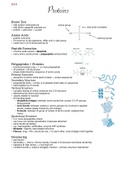
• add sodium hydroxide sol amine group
• add dilute copper(II) sulphate sol side chain (variable)
• protein = pale blue -> purple
Amino Acids
• protein monomer carboxyl group
• 20 common to all organisms, di er only in side group
• made from C,H,O,N (sometimes S)
Peptide Formation
• 2 amino acids joined = dipeptide
• many amino acids joined = polypeptide (unbranched)
Polypeptides + Proteins
• functional protein may = 1 or more polypeptide
• dif proteins = dif structures
• shape determined by sequence of amino acids
Primary Structure
• sequence of amino acids (each protein = unique sequence)
Secondary Structure
• polypeptide folds = α-helix or β-pleated sheet (dep on sequence)
• held together by H-bonds
Tertiary Structure
• complex folding of whole molecule into 3-D structure
• determined by amino acid sequence
• closely related to function
• dif bonding types
• disulphide bridges: between amino acids that contain S in R-groups.
strong bonds
• ionic bonds: between carboxyl +amino groups not involved in peptide
bonds. weaker (easily broken by pH change)
• H-bonds: between R-group of variety of amino acids. weakest (but
many)
Quaternary Structure
• 2 or more polypeptide chains
• can have non-protein (prosthetic) molecules attached
• same bonds as tertiary
• e.g. haemoglobin, antibodies, enzyme ATP synthase
• Globular: majority, ball-shaped structure
• Fibrous: long + thin, structural role. // to each other, cross bridges hold together
Denaturing
• permanent
• secondary +, held w. H/ionic bonds, if break 3-D structure lost (folds randomly)
• happens at high temps + v low/high pH
• covalent bonds (+ sulphur bridges) x broken :. primary structure maintained
ff
Proteins
Biuret Test
• add sodium hydroxide sol amine group
• add dilute copper(II) sulphate sol side chain (variable)
• protein = pale blue -> purple
Amino Acids
• protein monomer carboxyl group
• 20 common to all organisms, di er only in side group
• made from C,H,O,N (sometimes S)
Peptide Formation
• 2 amino acids joined = dipeptide
• many amino acids joined = polypeptide (unbranched)
Polypeptides + Proteins
• functional protein may = 1 or more polypeptide
• dif proteins = dif structures
• shape determined by sequence of amino acids
Primary Structure
• sequence of amino acids (each protein = unique sequence)
Secondary Structure
• polypeptide folds = α-helix or β-pleated sheet (dep on sequence)
• held together by H-bonds
Tertiary Structure
• complex folding of whole molecule into 3-D structure
• determined by amino acid sequence
• closely related to function
• dif bonding types
• disulphide bridges: between amino acids that contain S in R-groups.
strong bonds
• ionic bonds: between carboxyl +amino groups not involved in peptide
bonds. weaker (easily broken by pH change)
• H-bonds: between R-group of variety of amino acids. weakest (but
many)
Quaternary Structure
• 2 or more polypeptide chains
• can have non-protein (prosthetic) molecules attached
• same bonds as tertiary
• e.g. haemoglobin, antibodies, enzyme ATP synthase
• Globular: majority, ball-shaped structure
• Fibrous: long + thin, structural role. // to each other, cross bridges hold together
Denaturing
• permanent
• secondary +, held w. H/ionic bonds, if break 3-D structure lost (folds randomly)
• happens at high temps + v low/high pH
• covalent bonds (+ sulphur bridges) x broken :. primary structure maintained
ff


