CHAPTER 1: INTRODUCTION AND INTERPRETATION
[NB!! When answering questions in 3rd year, always state at the beginning of the answer
which person is being dealt with (natural person or other person). Also always indicate the
dates in the year of assessment being dealt with]
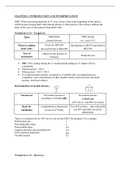
Normal tax (s 5) – Taxpayers:
Types Individuals Other person
(natural person) (co., trust, CC)
When is syllabus Focus for BEL298 Introduction in FR278 and detail in
dealt with? Revised briefly in BEL399 BEL399
Year of 1 March to the last day of
Financial year
assessment February
NB!! YOA ending during the 12 month period ending on 31 March 2014 is
examinable.
Natural person = 2014
Other person =
It is imposed upon persons, irrespective of whether they are natural persons,
companies, close corporations or other taxable entities (such as trusts, deceased
persons, insolvent estates).
Determination of taxable income…
Normal tax On taxable income in On taxable income
accordance with tax table at fixed rate
(28% for co. and 40% for trusts)
Basis for Comprehensive framework Use AFS as basis – start with profit
calculation (revise in 4th Term) per SCI and make necessary
adjustments
There is no framework for 399, but we can use the SOCI for guidance. For example:
Profit before tax x
Non-deductible items x
Non-taxable items (x)
Capital reduction/ special deductions (x)
S18A donation deduction (x)
Taxable income xx
Normal tax (s 5) – Recovery:
, During year of assessment
Employees’ tax
Provisional tax and Employees’ tax are not additional taxes
The collection of tax is facilitated through a system of employees’ tax and provisional
tax payments (certain people have to register depending on what income they earn).
Employees’ tax is deducted by employers from the remuneration payable to
employees.
Normal tax (s 5) – Process:
At the end of year of assessment
3
Objection & Appeal
CHAPTER 2 & 3: GROSS INCOME
Gross income- definition in s1:
Resident (worldwide) or non-resident (source in RSA)
total amount, in cash or otherwise
received by or accrued to or in favour of such TP
during such year or period of assessment
excluding receipts or accruals of a capital nature (Chap. 4)
Gross income – case law:
AMOUNT?
COURT CASE PRINCIPLE
Lategan v CIR Not only cash, but also value of other property earned by
TP, whether corporeal or incorporeal, which has monetary
value.
CIR v Butcher Bros (Pty) Amount should have ascertainable monetary value
Ltd (onus on the Commissioner to prove amount).
,CSARS v Brummeria Interest free loan is a benefit with interest savings and has
ascertainable monetary value and should therefore be
included in gross income.
RECEIVED BY?
COURT CASE PRINCIPLE
Geldenhuys v CIR 'Received by' = 'on behalf of one-self' and 'for own benefit'.
Pyott Ltd v CIR Deposit received by TP which can be applied for own benefit
should be included in gross income.
MP Finance Group CC v Amount 'received' if TP intended to use for own benefit
CSARS (even if from illegal sources).
ACCRUED TO?
COURT CASE PRINCIPLE
CIR v People’s Stores ‘Accrued to’ = ‘entitled to’ irrespective of when the cash
(Walvis Bay) Pty Ltd flows occur.
CIR v Witwatersrand The subsequent loss of income after it has accrued does not
Association of Racing change the fact that the income was ‘accrued to’ the taxpayer
Clubs and therefore does not affect gross income.
Mooi v SIR Accrual should be unconditional. Receipts are not subject to
conditions.
How do courts determine whether a particular receipt is of a capital nature or not?
Firstly, S82- the onus rests on the taxpayer to prove that an amount is capital
o The onus rests on the Commissioner to determine the amount (Butcher Bros
case)
Secondly, Taxpayer’s intention (golden rule):
o The intention of the taxpayer, at the time of acquiring the asset, during the
whole period over which he held the asset (may be a change in intention), and
at the time of its sale, is of great, and sometimes decisive importance
o The form of realisation:
o The taxpayer’s actual activities with regard to the asset
o The taxpayer’s other business activities
o If a taxpayer is a company, the objectives as set out in statutory documents
(memorandum of association)
Thirdly, objective factors:
o Taxpayer’s conduct in relation to the transaction
o Nature of taxpayer’s business/ occupation
o Frequency of similar transactions (NNB!!)
o Continuity of activities
o Period the asset was held
, o In the case of the company, objectives of directors (minutes, statutory
documents)
o Activities of owner in relation to asset up to date of sale
o Documentary evidence
o History of the taxpayer’s holding the asset, e.g. how many times did he refuse
an offer for the asset
o Circumstances of the realisation
o Accounting treatment of the proceeds
o Financial resources and the taxpayer’s ability to accommodate his professed
intention
o Involvement in a scheme of making profit-making
Fourthly, change of intention:
NOT OF A CAPITAL NATURE? NB! INTENTION = GOLDEN RULE
COURT CASE PRINCIPLE
CIR v Richmond Estates TP’s intention may change, e.g. Property acquired to
(Pty) Ltd speculate (income) could later be held as investment (capital
[Apply when directors asset).
decisions are made]
NB!! Will be tested Original/primary intention = capital in nature (then not
CIR v Nussbaum taxed, because of CGT). Secondary intention = revenue in
nature (profit making scheme). If both are pursued
simultaneously, then the secondary intention could taint the
primary intention.
[If profit making scheme, then will get taxed on profit and
the capital asset shall be regarded as income in nature.]
CIR v Stott TP entitled to realise asset for greatest possible benefit, not
necessarily change in intention.
CIR v Nel Sale due to abnormal / special circumstances = no change in
[Apply when there is a intention
forced case]
Natal Estates Ltd v SIR Change of intention implies more than a mere decision to
[Apply when there are sell a capital asset (‘Rubicon should be crossed').
activities of sale]
CIR v Visser The ‘fruit’ and ‘tree’ principle. Income (‘fruit’) is produced
by the capital (‘tree’).
NB!! NEW The accounting treatment of the proceeds is merely a factor
Stellenbosch Farmers to consider (NOT CONCLUSIVE).
Winery Ltd vs. C: SARS [Must look at the intention of the taxpayer]
CIR v George Forest The sale of fixed capital assets is of a capital nature.
Timber
[NB!! When answering questions in 3rd year, always state at the beginning of the answer
which person is being dealt with (natural person or other person). Also always indicate the
dates in the year of assessment being dealt with]
Normal tax (s 5) – Taxpayers:
Types Individuals Other person
(natural person) (co., trust, CC)
When is syllabus Focus for BEL298 Introduction in FR278 and detail in
dealt with? Revised briefly in BEL399 BEL399
Year of 1 March to the last day of
Financial year
assessment February
NB!! YOA ending during the 12 month period ending on 31 March 2014 is
examinable.
Natural person = 2014
Other person =
It is imposed upon persons, irrespective of whether they are natural persons,
companies, close corporations or other taxable entities (such as trusts, deceased
persons, insolvent estates).
Determination of taxable income…
Normal tax On taxable income in On taxable income
accordance with tax table at fixed rate
(28% for co. and 40% for trusts)
Basis for Comprehensive framework Use AFS as basis – start with profit
calculation (revise in 4th Term) per SCI and make necessary
adjustments
There is no framework for 399, but we can use the SOCI for guidance. For example:
Profit before tax x
Non-deductible items x
Non-taxable items (x)
Capital reduction/ special deductions (x)
S18A donation deduction (x)
Taxable income xx
Normal tax (s 5) – Recovery:
, During year of assessment
Employees’ tax
Provisional tax and Employees’ tax are not additional taxes
The collection of tax is facilitated through a system of employees’ tax and provisional
tax payments (certain people have to register depending on what income they earn).
Employees’ tax is deducted by employers from the remuneration payable to
employees.
Normal tax (s 5) – Process:
At the end of year of assessment
3
Objection & Appeal
CHAPTER 2 & 3: GROSS INCOME
Gross income- definition in s1:
Resident (worldwide) or non-resident (source in RSA)
total amount, in cash or otherwise
received by or accrued to or in favour of such TP
during such year or period of assessment
excluding receipts or accruals of a capital nature (Chap. 4)
Gross income – case law:
AMOUNT?
COURT CASE PRINCIPLE
Lategan v CIR Not only cash, but also value of other property earned by
TP, whether corporeal or incorporeal, which has monetary
value.
CIR v Butcher Bros (Pty) Amount should have ascertainable monetary value
Ltd (onus on the Commissioner to prove amount).
,CSARS v Brummeria Interest free loan is a benefit with interest savings and has
ascertainable monetary value and should therefore be
included in gross income.
RECEIVED BY?
COURT CASE PRINCIPLE
Geldenhuys v CIR 'Received by' = 'on behalf of one-self' and 'for own benefit'.
Pyott Ltd v CIR Deposit received by TP which can be applied for own benefit
should be included in gross income.
MP Finance Group CC v Amount 'received' if TP intended to use for own benefit
CSARS (even if from illegal sources).
ACCRUED TO?
COURT CASE PRINCIPLE
CIR v People’s Stores ‘Accrued to’ = ‘entitled to’ irrespective of when the cash
(Walvis Bay) Pty Ltd flows occur.
CIR v Witwatersrand The subsequent loss of income after it has accrued does not
Association of Racing change the fact that the income was ‘accrued to’ the taxpayer
Clubs and therefore does not affect gross income.
Mooi v SIR Accrual should be unconditional. Receipts are not subject to
conditions.
How do courts determine whether a particular receipt is of a capital nature or not?
Firstly, S82- the onus rests on the taxpayer to prove that an amount is capital
o The onus rests on the Commissioner to determine the amount (Butcher Bros
case)
Secondly, Taxpayer’s intention (golden rule):
o The intention of the taxpayer, at the time of acquiring the asset, during the
whole period over which he held the asset (may be a change in intention), and
at the time of its sale, is of great, and sometimes decisive importance
o The form of realisation:
o The taxpayer’s actual activities with regard to the asset
o The taxpayer’s other business activities
o If a taxpayer is a company, the objectives as set out in statutory documents
(memorandum of association)
Thirdly, objective factors:
o Taxpayer’s conduct in relation to the transaction
o Nature of taxpayer’s business/ occupation
o Frequency of similar transactions (NNB!!)
o Continuity of activities
o Period the asset was held
, o In the case of the company, objectives of directors (minutes, statutory
documents)
o Activities of owner in relation to asset up to date of sale
o Documentary evidence
o History of the taxpayer’s holding the asset, e.g. how many times did he refuse
an offer for the asset
o Circumstances of the realisation
o Accounting treatment of the proceeds
o Financial resources and the taxpayer’s ability to accommodate his professed
intention
o Involvement in a scheme of making profit-making
Fourthly, change of intention:
NOT OF A CAPITAL NATURE? NB! INTENTION = GOLDEN RULE
COURT CASE PRINCIPLE
CIR v Richmond Estates TP’s intention may change, e.g. Property acquired to
(Pty) Ltd speculate (income) could later be held as investment (capital
[Apply when directors asset).
decisions are made]
NB!! Will be tested Original/primary intention = capital in nature (then not
CIR v Nussbaum taxed, because of CGT). Secondary intention = revenue in
nature (profit making scheme). If both are pursued
simultaneously, then the secondary intention could taint the
primary intention.
[If profit making scheme, then will get taxed on profit and
the capital asset shall be regarded as income in nature.]
CIR v Stott TP entitled to realise asset for greatest possible benefit, not
necessarily change in intention.
CIR v Nel Sale due to abnormal / special circumstances = no change in
[Apply when there is a intention
forced case]
Natal Estates Ltd v SIR Change of intention implies more than a mere decision to
[Apply when there are sell a capital asset (‘Rubicon should be crossed').
activities of sale]
CIR v Visser The ‘fruit’ and ‘tree’ principle. Income (‘fruit’) is produced
by the capital (‘tree’).
NB!! NEW The accounting treatment of the proceeds is merely a factor
Stellenbosch Farmers to consider (NOT CONCLUSIVE).
Winery Ltd vs. C: SARS [Must look at the intention of the taxpayer]
CIR v George Forest The sale of fixed capital assets is of a capital nature.
Timber