

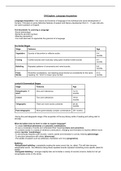
CN English: Language Acquisition
Language Acquisition = the nature and functions of language in the individual and social development of
humans. It focuses on some distinctive features of speech and literacy development from 0 - 11 year olds who
are native speakers of English.
The Essentials To Learning a Language
-Sound (phonology)
-Sentence structure (syntax)
-Meaning (semantics)
-You must also learn to appreciate the grammar of a language
Pre-Verbal Stages
Stage Features Age
Vegetative Sounds of discomfort or reflexive action. 0-4
months
Cooing Comfort sounds and vocal play using open mouthed vowel sounds. 4-7
months
Babbling Repeated patterns of consonants and vowel sounds. 6-9
months
Proto Word-like vocalisations, not matching actual words but consistently for the same 9-12
Words meaning. Ex. ‘mmm’ to mean ‘give me that’. months
Lexical & Grammatical Stages
Stage Features Age
Holophrastic / 1 One word utterances 12-18
word months
2 word Two word utterances 18-24
months
Telegraphic There are more words combined 24-36
months
Post-telegraphic More grammatically complex combinations 36+ months
-During the post-telegraphic stage of the acquisition of the key literacy skills of reading and writing start to
develop.
What do babies have to learn in order to acquire language?
-To create individual phonemes and phonetic combinations.
-To use a vocabulary of words and understand their meanings (lexis and semantics).
-To combine words in a variety of sentence constructions, changing word formation to express different word
classes (syntax / morphology).
-To see prosodic features such as pitch, volume, speed and intonation to convey meaning (phonology).
-To structure interactions with others (discourse).
-The sublets of speech such as politeness, implication and irony (pragmatics).
Babbling
-Reduplicated babbling = repeatedly creating the same sound (da, ba, daba). This will later become
reduplicated words - the difference being these repeated sounds represent something more specific (dada for
daddy).
-Variegated babbling = emerges slightly later and includes a variety of sounds (mooma, bada) but not yet
recognisable words on the whole.
, -Examples of sounds: plosives, fricatives, affricatives, approximates, nasals, laterals.
Making Noises - Learning in 8’s
-Early 8 = m, b, y,, n, w, d, p, h (age 3)
-Middle 8 = e, ng, k, g, f, v, th, j (age 4-5)
-Last 8 = sh, th, o, s, z, l, r, zh (age 6)
Phonological Errors
-Deletion = omitting the final consonant in words
Book = Boo, Dish = Dis
-Substitution = substituting one sound for another, especially the ‘harder’ sounds that develop later.
This = Dis, Lorry = Borry, Think = Fink
-Addition = adding an extra vowel sound to the end of words, creating a CVCV pattern.
Doll = Dolly, Horse = Horesy, Dog = Doggie
-Assimilation = changing one consonant or vowel for another but the chosen sound is closer to those already in
the word
Ship = Pip, Dog = Gog, Grandad = Gangag
-Reduplication = repeating a whole syllable
Mum = Mama, Dad = Dada
-Consonant cluster reductions = consonant clusters can be difficult to articulate, so children reduce them to
smaller units.
Telephone = Tephone, Spider = Pider, Grandad = Gandad
-Deletion of unstressed syllables = omitting the opening syllable in polysyllabic words
Shoes = Oos, Banana = Nana
Two Word - Early demonstrations to grammar
-Occurs at approximately 18-24 months.
-They realise that all things have a name (naming insight) which means rapid acquisition.
-2 or 3 new words are learnt each day by age 2 a child will have approximately 300 words in their vocabulary.
-At 18 months children start to move from holophrastic phrases to utterances with more meaning.
-A child begins to understand grammar and the relationship between words.
-Has a vocabulary spurt or naming explosion.
-Gain naming insight and enter into rapid acquisition.
Telegraphic Stage
-Child moves towards more complete utterances.
-Utterances mostly contain content words and leave out the grammatical words. Ex. ‘Me go park’ instead of
‘I want to go to the park’.
Key Terms
-Content words = words vital for meaning.
-Grammatical words = words for structural accuracy, but not necessarily meaning.
-Overextension = applying a label to more than it should. Ex. using ‘apple’ for any round fruit.
-Underextension = applying a label to fewer references than it should. Ex. ‘Milk’ for when it is in a cup but not
applying the same word for milk in a bottle / glass in a book.
Post-Telegraphic
-Around age 3 a child will produce speech resembling that of an adult.
-Using grammatical words that were previously omitted.
-Use contractions, pronouns and prepositions correctly.
-Use different tenses and tense agreements.
-Use connectives and connect ideas to produce more ‘sentence-like’ speech.
-By 4, speech will largely be accurate and sentences complete.
Language Acquisition = the nature and functions of language in the individual and social development of
humans. It focuses on some distinctive features of speech and literacy development from 0 - 11 year olds who
are native speakers of English.
The Essentials To Learning a Language
-Sound (phonology)
-Sentence structure (syntax)
-Meaning (semantics)
-You must also learn to appreciate the grammar of a language
Pre-Verbal Stages
Stage Features Age
Vegetative Sounds of discomfort or reflexive action. 0-4
months
Cooing Comfort sounds and vocal play using open mouthed vowel sounds. 4-7
months
Babbling Repeated patterns of consonants and vowel sounds. 6-9
months
Proto Word-like vocalisations, not matching actual words but consistently for the same 9-12
Words meaning. Ex. ‘mmm’ to mean ‘give me that’. months
Lexical & Grammatical Stages
Stage Features Age
Holophrastic / 1 One word utterances 12-18
word months
2 word Two word utterances 18-24
months
Telegraphic There are more words combined 24-36
months
Post-telegraphic More grammatically complex combinations 36+ months
-During the post-telegraphic stage of the acquisition of the key literacy skills of reading and writing start to
develop.
What do babies have to learn in order to acquire language?
-To create individual phonemes and phonetic combinations.
-To use a vocabulary of words and understand their meanings (lexis and semantics).
-To combine words in a variety of sentence constructions, changing word formation to express different word
classes (syntax / morphology).
-To see prosodic features such as pitch, volume, speed and intonation to convey meaning (phonology).
-To structure interactions with others (discourse).
-The sublets of speech such as politeness, implication and irony (pragmatics).
Babbling
-Reduplicated babbling = repeatedly creating the same sound (da, ba, daba). This will later become
reduplicated words - the difference being these repeated sounds represent something more specific (dada for
daddy).
-Variegated babbling = emerges slightly later and includes a variety of sounds (mooma, bada) but not yet
recognisable words on the whole.
, -Examples of sounds: plosives, fricatives, affricatives, approximates, nasals, laterals.
Making Noises - Learning in 8’s
-Early 8 = m, b, y,, n, w, d, p, h (age 3)
-Middle 8 = e, ng, k, g, f, v, th, j (age 4-5)
-Last 8 = sh, th, o, s, z, l, r, zh (age 6)
Phonological Errors
-Deletion = omitting the final consonant in words
Book = Boo, Dish = Dis
-Substitution = substituting one sound for another, especially the ‘harder’ sounds that develop later.
This = Dis, Lorry = Borry, Think = Fink
-Addition = adding an extra vowel sound to the end of words, creating a CVCV pattern.
Doll = Dolly, Horse = Horesy, Dog = Doggie
-Assimilation = changing one consonant or vowel for another but the chosen sound is closer to those already in
the word
Ship = Pip, Dog = Gog, Grandad = Gangag
-Reduplication = repeating a whole syllable
Mum = Mama, Dad = Dada
-Consonant cluster reductions = consonant clusters can be difficult to articulate, so children reduce them to
smaller units.
Telephone = Tephone, Spider = Pider, Grandad = Gandad
-Deletion of unstressed syllables = omitting the opening syllable in polysyllabic words
Shoes = Oos, Banana = Nana
Two Word - Early demonstrations to grammar
-Occurs at approximately 18-24 months.
-They realise that all things have a name (naming insight) which means rapid acquisition.
-2 or 3 new words are learnt each day by age 2 a child will have approximately 300 words in their vocabulary.
-At 18 months children start to move from holophrastic phrases to utterances with more meaning.
-A child begins to understand grammar and the relationship between words.
-Has a vocabulary spurt or naming explosion.
-Gain naming insight and enter into rapid acquisition.
Telegraphic Stage
-Child moves towards more complete utterances.
-Utterances mostly contain content words and leave out the grammatical words. Ex. ‘Me go park’ instead of
‘I want to go to the park’.
Key Terms
-Content words = words vital for meaning.
-Grammatical words = words for structural accuracy, but not necessarily meaning.
-Overextension = applying a label to more than it should. Ex. using ‘apple’ for any round fruit.
-Underextension = applying a label to fewer references than it should. Ex. ‘Milk’ for when it is in a cup but not
applying the same word for milk in a bottle / glass in a book.
Post-Telegraphic
-Around age 3 a child will produce speech resembling that of an adult.
-Using grammatical words that were previously omitted.
-Use contractions, pronouns and prepositions correctly.
-Use different tenses and tense agreements.
-Use connectives and connect ideas to produce more ‘sentence-like’ speech.
-By 4, speech will largely be accurate and sentences complete.


