
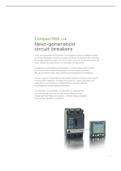
Compact NSX
Next-generation
circuit breakers
Today, next-generation Compact NSX circuit breakers provide an intelligent outlook
and set the standards of tomorrow. A power monitoring unit enhances their invariably
impeccable protective functions. For the first time, users can monitor both energy and
power, offering new performance in a remarkably compact device.
Compactness, discrimination and modularity – all of the features which defined
the success of the Compact NS generation of circuit breakers combined
with new functions for safe, easy monitoring and management of installations.
The new range of Compact NSX circuit breakers stands out from the crowd, thanks
to its electronic intelligence. Through direct access to in-depth information, and
networking via open protocols, Compact NSX lets operators optimise
the management of their electrical installations.
Far more than a circuit breaker, Compact NSX is a measurement
and communication tool ready to meet energy-efficiency needs
through optimised energy consumption, increased energy availability,
and improved installation management.
1
, Functions Introduction
and characteristics General characteristics of the
Compact NSX range
Compliance with standards
DB112018
Compact NSX circuit breakers and auxiliaries comply with the following:
1 b international recommendations:
2 v IEC 60947-1: general rules
v IEC 60947-2: circuit breakers
NSX250 H 3 v IEC 60947-3: switch-disconnectors
v IEC 60947-4: contactors and motor starters
4 v IEC 60947-5.1 and following: control circuit devices and switching elements;
100 100
70 70 automatic control components
5
65 65 b European (EN 60947-1 and EN 60947-2) and corresponding national standards:
50 50 6 v France NF
35 35
10 10 v Germany VDE
v United Kingdom BS
v Australia AS
7 v Italy CEI
b the specifications of the marine classification companies (Veritas, Lloyd's Register
8 of Shipping, Det Norske Veritas, etc.), standard NF C 79-130 and recommendations
9 issued by the CNOMO organisation for the protection of machine tools.
100
65 10 For U.S. UL, Canadian CSA, Mexican NOM and Japanese JIS standards, please
35
consult us.
Standardised characteristics indicated on the rating plate: Pollution degree
1 Type of device: frame size and breaking capacity class Compact NSX circuit breakers are certified for operation in pollution-degree III
2 Ui: rated insulation voltage. environments as defined by IEC standards 60947-1 and 60664-1 (industrial
3 Uimp: rated impulse withstand voltage. environments).
4 Ics: service breaking capacity.
5 Icu: ultimate breaking capacity for various values of the
rated operational voltage Ue Climatic withstand
6 Ue: operational voltage. Compact NSX circuit breakers have successfully passed the tests defined by the
7 Colour label indicating the breaking capacity class.
following standards for extreme atmospheric conditions:
8 Circuit breaker-disconnector symbol.
9 Reference standard. b IEC 60068-2-1: dry cold (-55 °C)
10 Main standards with which the device complies. b IEC 60068-2-2: dry heat (+85 °C)
Note: when the circuit breaker is equipped with an extended b IEC 60068-2-30: damp heat (95 % relative humidity at 55 °C)
rotary handle, the door must be opened to access the rating b IEC 60068-2-52 severity level 2: salt mist.
plate.
Environment
Compact NSX respects the European environment directive EC/2002/95 concerning
the restriction of hazardous substances (RoHS).
Product environment profiles (PEP) have been prepared, describing the
environmental impact of every product throughout its life cycle, from production to
the end of its service life.
All Compact NSX production sites have set up an environmental management
system certified ISO 14001.
Each factory monitors the impact of its production processes. Every effort is made to
prevent pollution and to reduce consumption of natural resources.
Ambient temperature
b Compact NSX circuit breakers may be used between -25 °C and +70 °C. For
temperatures higher than 40°C (65°C for circuit breakers used to protect motor
feeders), devices must be derated (pages B-8 and B-9).
b Circuit breakers should be put into service under normal ambient, operating-
temperature conditions. Exceptionally, the circuit breaker may be put into service
when the ambient temperature is between -35 °C and -25 °C.
b The permissible storage-temperature range for Compact NSX circuit breakers in
the original packing is -50 °C (1) and +85 °C.
(1) -40 °C for Micrologic control units with an LCD screen.
A-4
, Electromagnetic compatibility
Compact NSX devices are protected against:
b overvoltages caused by circuit switching (e.g. lighting circuits)
b overvoltages caused by atmospheric disturbances
b devices emitting radio waves such as mobile telephones, radios, walkie-talkies,
radar, etc.
b electrostatic discharges produced by users.
Immunity levels for Compact NSX comply with the standards below.
b IEC/EN 60947-2: Low-voltage switchgear and controlgear, part 2: Circuit
breakers:
v Annex F: Immunity tests for circuit breakers with electronic protection
v Annex B: Immunity tests for residual current protection
b IEC/EN 61000-4-2: Electrostatic-discharge immunity tests
b IEC/EN 61000-4-3: Radiated, radio-frequency, electromagnetic-field immunity
tests
b IEC/EN 61000-4-4: Electrical fast transient/burst immunity tests
b IEC/EN 61000-4-5: Surge immunity tests
b IEC/EN 61000-4-6: Immunity tests for conducted disturbances induced by radio-
frequency fields
b CISPR 11: Limits and methods of measurement of electromagnetic disturbance
characteristics of industrial, scientific and medical (ISM) radio-frequency equipment.
Discrimination
Compact NSX reinforces the discrimination capabilities of the Compact NS range by
applying the rapid calculation capacity of the Micrologic trip units.
Total discrimination is now possible between NSX100 and modular Multi 9 circuit
breakers rated y 63 A (see page A-8).
Suitable for isolation with positive contact
PB103578-53
indication
All Compact NSX circuit breakers are suitable for isolation as defined in IEC
standard 60947-2:
b The isolation position corresponds to the O (OFF) position.
b The operating handle cannot indicate the OFF position unless the contacts are
effectively open.
b Padlocks may not be installed unless the contacts are open.
Installation of a rotary handle or a motor mechanism does not alter the reliability of
the position-indication system.
The isolation function is certified by tests guaranteeing:
b the mechanical reliability of the position-indication system
b the absence of leakage currents
b overvoltage withstand capacity between upstream and downstream connections.
The tripped position does not insure isolation with positive contact indication.
Only the OFF position guarantees isolation.
DB112093
Installation in class II switchboards
All Compact NSX circuit breakers are class II front face devices. They may be
installed through the door of class II switchboards (as per IEC standards 61140 and
60664-1) without downgrading switchboard insulation. Installation requires no
special operations, even when the circuit breaker is equipped with a rotary handle or
a motor mechanism.
Degree of protection
The following indications are in accordance with standards IEC 60529 (IP degree of
protection) and IEC 62262 (IK protection against external mechanical impacts).
Bare circuit breaker with terminal shields
b With toggle: IP40, IK07.
b With standard direct rotary handle / VDE: IP40 IK07
Circuit breaker installed in a switchboard
b With toggle: IP40, IK07.
b With direct rotary handle:
v standard / VDE: IP40, IK07
v MCC: IP43 IK07
v CNOMO: IP54 IK08
b With extended rotary handle: IP56 IK08
b With motor mechanism: IP40 IK07.
A-5


